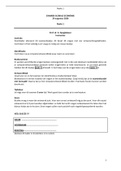
Practice exam
Psychological and Neurobiological Consequences of Child Abuse
Week 1
1.Which brain areas are involved in the hypervigilance of threat in children who suffered
maltreatment?
A) Temporoparietal and prefrontal circuit lobe
B) Limbic and prefrontal cortical circuitry
C) The hippocampus, cerebellum and amygdala
D) The somatosensory cortex and medulla
2. Why would children who suffered maltreatment have deficits in emotion recognition in
others?
A) Because their parents often have less prototypal facial expressions
B) Because their visual cues are overly sensitive to anticipated reward
C) Because their gaze is more drawn to other body parts such as arms and hands
D) Because they often lacked social interaction in their upbringing to recognize facial
expressions
3. Which is false about Early Life Stress (ELS)?
A) The two pathway model of the consequences of ELS is due to the interaction of the
glucocorticoid and oxytocin system
B) The risk of medical problems after having experienced ELS is directly proportional to the
number and magnitude of ELS
C) ELS in rats have shown to cause a decrease in basal and stress-induced ACTH, but an
increase in cortisol reactivity
D) A certain short allele of a serotonin transporter is linked to higher rates of depression
compared to long alleles in those who have experienced ELS
4. When relying on self-measures of reported abuse, we find …
A) That physical abuse becomes more frequent than sexual abuse
B) A higher comorbidity between emotional and sexual abuse
C) A higher prevalence of abuse in general
D) All of the above
, Week 2
5. Which is not true when looking at the relationship between childhood maltreatment,
psychopathology, and adult relationships?
A) Depression is often linked to avoidant or anxious attachment
B) The strongest pathway between childhood maltreatment and the quality of future
relationship is through depression severity and anxious attachment
C) Anxiety and alcohol dependence do not significantly mediate the relationship between
childhood maltreatment and quality of relationships
D) Depression severity only predicts avoidant attachment when there is alcohol dependence
present
6. In D’Arcy and Meng’s study, interaction between adults who have experienced
maltreatment and their children was studied whilst measuring their nervous system
reactivity. What did they find?
A) Experiences of childhood neglect was uniquely associated with autonomic
hyper-reactivity
B) Experiences of childhood abuse was uniquely associated with autonomic hypo-reactivity
C) Neglected parents are more likely to abuse their children, but abused parents are not more
likely to neglect their children
D) Neither of the above
7. What was the main interpretation of the results of Alves’ et al., study on rats?
A) A depression background does not play a role in the drug abuse vulnerability when one
has experienced ELS
B) The extent to which one is withdrawn or extravert mediates the relationship between ELS
and depression
C) ELS causes significantly more drug abuse vulnerability in withdrawn rats rather than
agitated rats
D) Only when depression and an agitated/impulsive personality type are present does ELS
predict drug abuse vulnerability
8. Which statement is false about parents who maltreat their children?
A) Parents are often honest about their behavior toward children when asked to report this
Psychological and Neurobiological Consequences of Child Abuse
Week 1
1.Which brain areas are involved in the hypervigilance of threat in children who suffered
maltreatment?
A) Temporoparietal and prefrontal circuit lobe
B) Limbic and prefrontal cortical circuitry
C) The hippocampus, cerebellum and amygdala
D) The somatosensory cortex and medulla
2. Why would children who suffered maltreatment have deficits in emotion recognition in
others?
A) Because their parents often have less prototypal facial expressions
B) Because their visual cues are overly sensitive to anticipated reward
C) Because their gaze is more drawn to other body parts such as arms and hands
D) Because they often lacked social interaction in their upbringing to recognize facial
expressions
3. Which is false about Early Life Stress (ELS)?
A) The two pathway model of the consequences of ELS is due to the interaction of the
glucocorticoid and oxytocin system
B) The risk of medical problems after having experienced ELS is directly proportional to the
number and magnitude of ELS
C) ELS in rats have shown to cause a decrease in basal and stress-induced ACTH, but an
increase in cortisol reactivity
D) A certain short allele of a serotonin transporter is linked to higher rates of depression
compared to long alleles in those who have experienced ELS
4. When relying on self-measures of reported abuse, we find …
A) That physical abuse becomes more frequent than sexual abuse
B) A higher comorbidity between emotional and sexual abuse
C) A higher prevalence of abuse in general
D) All of the above
, Week 2
5. Which is not true when looking at the relationship between childhood maltreatment,
psychopathology, and adult relationships?
A) Depression is often linked to avoidant or anxious attachment
B) The strongest pathway between childhood maltreatment and the quality of future
relationship is through depression severity and anxious attachment
C) Anxiety and alcohol dependence do not significantly mediate the relationship between
childhood maltreatment and quality of relationships
D) Depression severity only predicts avoidant attachment when there is alcohol dependence
present
6. In D’Arcy and Meng’s study, interaction between adults who have experienced
maltreatment and their children was studied whilst measuring their nervous system
reactivity. What did they find?
A) Experiences of childhood neglect was uniquely associated with autonomic
hyper-reactivity
B) Experiences of childhood abuse was uniquely associated with autonomic hypo-reactivity
C) Neglected parents are more likely to abuse their children, but abused parents are not more
likely to neglect their children
D) Neither of the above
7. What was the main interpretation of the results of Alves’ et al., study on rats?
A) A depression background does not play a role in the drug abuse vulnerability when one
has experienced ELS
B) The extent to which one is withdrawn or extravert mediates the relationship between ELS
and depression
C) ELS causes significantly more drug abuse vulnerability in withdrawn rats rather than
agitated rats
D) Only when depression and an agitated/impulsive personality type are present does ELS
predict drug abuse vulnerability
8. Which statement is false about parents who maltreat their children?
A) Parents are often honest about their behavior toward children when asked to report this