
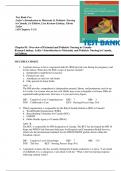
Chapter 01: Overview of Perinatal and Pediatric Nursing in Canada Keenan -Lindsay: Leifer’s Introduction to Maternity and Pediatric Nursing in Canada, 1st Edition MULTIPLE CHOICE 1. A patient chooses to have a registered midwife (RM) provide care during her pregnancy and for her labour. What does the RM’s scope of practice include? a. Independent comprehensive practice b. Prenatal care only c. Attendance at only low -risk births d. Only present for home births ANS: A The RM provides comprehens ive independent prenatal, labour, and postpartum care for up to 6 weeks, for women who are low risk. Births may occur in hospital or at home. RMs are regulated health professions who have a 4-year university degree. DIF: Cognitive Level: Comprehension REF: 7 OBJ: 3 TOP: Collaborative Care KEY: Nursing Process Step: N/A 2. Which organization is responsible for the Baby Friendly Initiative (BFI) in Canada? a. World Health Organization (WHO) b. Breastfeeding Committee for Canada (BCC) c. UNICEF d. Public Health Agency of C anada (PHAC) ANS: B The BCC is responsible for BFI designation in Canada. The BCC has developed the BFI 10 Steps and WHO Code Outcome Indicators for Hospitals and Community Health Services, which sets the international standards for the WHO/UNICEF global c riteria within the Canadian context. DIF: Cognitive Level: Knowledge REF: 7 OBJ: 3 | 9 TOP: The Past KEY: Nursing Process Step: N/A 3. A pregnant woman who has recently immigrated Canada comments to a nurse, “I am afraid of childbirth. It is so dangerous. I am afraid I will die.” What is the best nursing response reflecting cultural safety? TEST BANK Test Bank For: Leifer's Introduction to Maternity & Pediatric Nursing in Canada, 1 st Edition, Lisa Keenan -Lindsay, Gloria Leifer (All Chapters 1 -33) a. “Maternal mortality in Canada is extremely low.” b. “Anesthesia is available to relieve pain during labour and childbirth.” c. “Tell me why you are afraid of childbirth.” d. “Your condition will be monitored during labour and birth.” ANS: C Asking the patient about her concerns helps promote understanding and individualizes patient care. DIF: Cognitive Level: Application REF: 11 OBJ: 7 TOP: Culturally Safe Care KEY: Nursing Proce ss Step: Implementation 4. An urban area has been reported to have a high perinatal mortality rate. What information does this provide? a. Maternal and infant deaths per 100,000 live births per year b. Deaths of fetuses weighing more than 500 g per 10,000 births p er year c. Deaths of infants up to 1 year of age per 1000 live births per year d. Fetal and neonatal deaths per 1000 live births per year ANS: D The perinatal mortality rate includes fetal and neonatal deaths per 1000 live births per year. DIF: Cognitive Level: Comprehension REF: 8 OBJ: 10 TOP: Statistics KEY: Nursing Process Step: Assessment 5. What is the focus of current perinatal care? a. Hospital births for the majority of women b. The traditional family unit c. Care in a labour room and then a birthing room d. A high-quality family experience for each patient ANS: D Current maternity practice focuses on a high-quality family experience for all families. DIF: Cognitive Level: Comprehension REF: 7 | 8 OBJ: 2 | 8 TOP: Perinatal Care KEY: Nursing Process Step: N/A 6. Which organization offers certification for nurses in specialty areas ? a. CNA b. CAPWHN c. CANN d. CAPN ANS: A The Canadian Nurses Association offers certification exams for registered nurses in specialty areas including perinatal, community, neonatal, and pediatric intensive care. CAPWHN, CANN, and CAPN are specialty organizations for nursing groups in Canada. DIF: Cognitive Level: Knowledge REF: 10 OBJ: 2 | 3 TOP: Nursing Certification KEY: Nursing Process Step: N/A 7. Which of the following requires self-reflection and discovery in order to provide care that is culturally appropriate? a. Cultural safety b. Cultural awareness c. Cultural humility d. Cultural competence ANS: C Cultural humility is the precursor to providing culturally appropriate care. It is a process of self-reflection and disc overy to understand one’s own assumptions, biases, and values and how one’s background and social environment have shaped one’s experience DIF: Cognitive Level: Knowledge REF: 4 OBJ: 1 | 7 TOP: Cultural Humility KEY: Nursing Process Step: Evaluatio n 8. In 2015, the WHO developed the Sustainable Development Goals (SDGs). What issues do the new SDG’s include that the Millennium Development Goals (MDGs) did not include? a. Climate change and environmental protection b. Combating HIV and malaria c. Eradicating poverty and hunger d. Achieving universal primary education ANS: A Climate change and environmental protection are new goals of the SDGs. All other options are part of the MDGs DIF: Cognitive Level: Knowledge REF: 13 OBJ: 16 TOP: Sustainable Development Goals KEY: Nursing Process Step: N/A 9. What guidelines define multidisciplinary patient care in terms of expected outcome and timeframe from different areas of care provision? a. Clinical pathways b. Nursing outcome criteria c. Standards of care d. Nursing care plan ANS: A Clinical pathways, also known as critical pathways or care maps, are collaborative guidelines that define patient care across disciplines. Expected progress within a specified timeline is identified. DIF: Cognitive Level: Knowledge REF: 12 OBJ: 13 TOP: Health Care Delivery Systems KEY: Nursing Process Step: N/A 10. A nursing student has reviewed a hospitalized pediatric patient chart, interviewed her mother, and collected admission data. What is the next step the student will take to develop a nursing care plan for this child? a. Identify measurable outcomes with a timeline. b. Choose specific nursing interventions for the child. c. Determine appropriate nursing diagnoses. d. State nursing actions related to the child’s medical diagnosis. ANS: C The nurse uses assessment data to develop appropriate nursing diagnoses. Outcomes and interventions are then developed to address the relevant nursing diagnoses. DIF: Cognitive Level: Application REF: 11 OBJ: 10 TOP: Nursing Process KEY: Nursing Process Step: Nursi ng Diagnosis 11. A nursing student on a maternal –newborn rotation questions the floor nurse about the definition of the practical nurse scope of practice. What resource can the nurse suggest to the student? a. Canadian Nurses Association b. Provincial regulatory board c. Federal government d. Canadian Association of Perinatal & Women’s Health Nursing ANS: B The scope of practice of the practical nurse is determined by the provincial board of nursing. DIF: Cognitive Level: Comprehension REF: 3 OBJ: 2 TOP: Standards of Practice KEY: Nursing Process Step: Implementation 12. Which social determinant of health (SDOH) is specifically related to Indigenous people’s health? a. Colonization b. Education c. Social support networks d. Employment and working conditions ANS: A All of the SDOH are important but the impact of colonization is related specifically to Indigenous people’s health. DIF: Cognitive Level: Knowledge REF: 3 OBJ: 6 TOP: Social Determinants of Health KEY: Nursing Process Step: N/A 13. How does the clinical pathway or critical pathway improve quality of care? a. Lists diagnosis -specific implementations b. Outlines expected progress with stated timelines c. Prioritizes effective nursing diagnoses d. Describes common complications ANS: B Critical pathways outline expected progress with stated timelines. Any deviation from those timelines is called a variance. DIF: Cognitive Level: Comprehension REF: 12 OBJ: 13 TOP: Critical Pathway KEY: Nursing Process Step: Implementation 14. How does electronic charting ensure comprehensive charting more effectively than handwritten charting? a. Provides a uniform style of chart b. Requires certain responses before allowing the user to progress c. All documentation is reflective of the nursing care plan d. Requires a daily audit by the charge nurse ANS: B
Vista previa 4 fuera de 322 páginas
Examen
Test Bank For: Leifer's Introduction to Maternity & Pediatric Nursing in Canada, 1st Edition, Lisa Keenan-Lindsay, Gloria Leifer (All Chapters 1-33,)
Vista previa 4 fuera de 322 páginas
Test Bank For: Leifer's Introduction to Maternity & Pediatric Nursing in Canada, 1st Edition, Lisa Keenan-Lindsay, Gloria Leifer (All Chapters 1-33,) Contents: Chapter 1. Overview of Perinatal and Pediatric Nursing in Canada Chapter 2. The Nurse’s Role in Women’s Health Care Chapter 3. Fetal Development Chapter 4. Prenatal Care and Adaptations to Pregnancy Chapter 5. Nursing Care of Women with Complications During Pregnancy Chapter 6. Nursing Care of the Mother and Infant During Labour and Birth Chapter 7. Pain Management During Labour and Birth Chapter 8. Nursing Care of Women with Complications During Labour and Birth Chapter 9. Nursing Care of The Woman and Family After Birth Chapter 10. Nursing Care of Women with Complications After Birth Chapter 11. The Term Newborn Chapter 12. High-Risk Newborns Chapter 13. An Overview of Growth, Development, and Nutrition Chapter 14. The Infant Chapter 15. The Toddler Chapter 16. The Preschool Child Chapter 17. The School-Age Child Chapter 18. The Adolescent Chapter 19. The Child’s Experience of Hospitalization Chapter 20. Health Care Adaptations for the Child and Family Chapter 21. Complementary and Alternative Health Modalities in Pediatric Nursing Chapter 22. Chronic Conditions and Palliative Care: Caring for the Child and Family Chapter 23. The Child with an Eye, Ear, or Neurological Condition Chapter 24. The Child with a Musculoskeletal Condition Chapter 25. The Child with a Respiratory Condition Chapter 26. The Child with a Cardiovascular Condition Chapter 27. The Child with a Condition of the Blood, Blood-Forming Organs or Lymphatic System Chapter 28. The Child with a Gastrointestinal Condition Chapter 29. The Child with a Genitourinary Condition Chapter 30. The Child with a Skin Condition Chapter 31. The Child with a Metabolic Condition Chapter 32. Childhood Communicable Diseases Chapter 33. The Child with an Emotional or Behavioural Condition
Vista previa del contenido
Libro relacionado

Información del documento
- Subido en
- 16 de enero de 2024
- Número de páginas
- 322
- Escrito en
- 2023/2024
- Tipo
- Examen
- Contiene
- Preguntas y respuestas
$43.49
¿Documento equivocado? Cámbialo gratis
Dentro de los 14 días posteriores a la compra y antes de descargarlo, puedes elegir otro documento. Puedes gastar el importe de nuevo.
Escrito por estudiantes que aprobaron
Inmediatamente disponible después del pago
Leer en línea o como PDF

Los indicadores de reputación están sujetos a la cantidad de artículos vendidos por una tarifa y las reseñas que ha recibido por esos documentos. Hay tres niveles: Bronce, Plata y Oro. Cuanto mayor reputación, más podrás confiar en la calidad del trabajo del vendedor.

