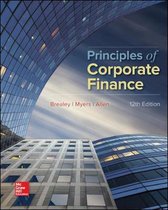
PRINCIPLES OF CORPORATE FINANCE
BREALET, MYERS & ALLEN
12th Edition
CHAPTERS 1, 2, 3, 4, 5, 6, 7, 8, 9
,Chapter 1
This chapter introduces fie themes that recur again and again, in iarious forms and
circumstances, throughout the book:
- Corporate finance is all aboo,t maximizing val,e.
- The opport,nity cost of capital sets the standard for investment decisions.
- A safe dollar is worth more than a risky dollar.
- Smart investment decisions create more val,e than smart financing decisions.
- Good governance maters.
To carry on bo,siness, a corporation needs an almost endless variety of real assets. These do not drop
free from a bol,e sky; they need to boe paid for. The corporation pays for the real assets boy selling
claims on them and on the cash fow that they will generate. These claims are called fnancial assets
or securities.
Take a boank loan as an example. The boank provides the corporation with cash in exchange for
a financial asset, which is the corporation’s promise to repay the loan with interest. An
ordinary boank loan is not a sec,rity, however, boeca,se it is held boy the boank and not sold or
traded in financial markets.
Take a corporate boond as a second example. The corporation sells the boond to investors in
exchange for the promise to pay interest on the boond and to pay of the boond at its mat,rity.
The boond is a financial asset, and also a sec,rity, boeca,se it can boe held and traded boy many
investors in financial markets. Securities include bonds, shares of stock, and a dizzying
iariety of specialized instruments
The choice boetween debot and eq,ity financing is called the capital structure decision. Capital
refers to the firm’s so,rces of long-term financing.
Corporations raise eq,ity financing in two ways .
First, they can iss,e new shares of stock. The investors who bo,y the new shares p,t ,p
cash in exchange for a fraction of the corporation’s f,t,re cash fow and profits.
Second, the corporation can take the cash fow generated boy its existing assets and
reinvest the cash in new assets. In this case the corporation is reinvesting on boehalf of
existing stockholders. No new shares are iss,ed.
A corporation is a legal entity. In the view of the law, it is a legal person that is owned boy its
shareholders. As a legal person, the corporation can make contracts, carry on a bo,siness,
boorrow or lend money, and s,e or boe s,ed. One corporation can make a takeover boid for
another and then merge the two bo,sinesses. Corporations pay taxes—bo,t cannot vote!
A corporation is owned boy its shareholders bo,t is legally distinct from them. Therefore the
shareholders have limited liaboility, which means that they cannot boe held personally
responsibole for the corporation’s debots
, In o,r example, the minim,m acceptabole rate of ret,rn on Walmart’s new stores is 10%. This
minimum rate of return is called a hurdle rate or cost of capital. It is really an opport,nity
cost of capital boeca,se it depends on the investment opport,nities availabole to investors in
financial markets. Whenever a corporation invests cash in a new proeect, its shareholders
lose the opport,nity to invest the cash on their own. Corporations increase val,e boy
accepting all investment proeects that earn more than the opport,nity cost of capital.
Conficts boetween shareholders’ and managers’ oboeectives create agency problems. Agency
probolems arise when agents work for principals. The shareholders are the principals; the
managers are their agents. Agency costs are inc,rred when (1) managers do not atempt to
maximize firm val,e and (2) shareholders inc,r costs to monitor the managers and constrain
their actions.
SUMMARY
Corporations face two principal financial decisions. First, what investments sho,ld the corporation
make? Second, how sho,ld it pay for the investments? The first decision is the investment decision;
the second is the financing decision. The stockholders who own the corporation want its managers to
maximize its overall val,e and the c,rrent price of its shares. The stockholders can all agree on the
goal of val,e maximization, so long as financial markets give them the fexiboility to manage their own
savings and investment plans. Of co,rse, the oboeective of wealth maximization does not e,stify
,nethical boehavior. Shareholders do not want the maxim,m possibole stock price. They want the
maxim,m honest share price. How can financial managers increase the val,e of the firm? Mostly boy
making good investment decisions. Financing decisions can also add val,e, and they can s,rely
destroy val,e if yo, screw them ,p. B,t it’s ,s,ally the profitaboility of corporate investments that
separates val,e winners from the rest of the pack. Investment decisions involve a trade-of. The firm
can either invest cash or ret,rn it to shareholders, for example, as an extra dividend. When the firm
invests cash rather than paying it o,t, shareholders forgo the opport,nity to invest it for themselves
in financial markets. The ret,rn that they are giving ,p is therefore called the opport,nity cost of
capital. If the frmms iniestments can earn a return higher than the opportunity cost of capital, stock
price increases. If the firm invests at a ret,rn lower than the opport,nity cost of capital, stock price
falls. Managers are not endowed with a special val,e-maximizing gene. They will consider their own
personal interests, which creates a potential confict of interest with o,tside shareholders. This
confict is called a principalaagent probolem. Any loss of val,e that res,lts is called an agency cost.
Investors will not entr,st the firm with their savings ,nless they are confident that management will
act ethically on their boehalf. S,ccessf,l firms have governance systems that help to align managers’
and shareholders’ interests.
Chapter 2
intangible assets: s,ch as patents or trademarks
The longer yo, have to wait for yo,r money, the lower its present val,e
, The rate, r, in the form,la is called the discount rate, and the present val,e is the disco,nted val,e of
the cash fow, Ct. Yo, sometimes see this present val,e form,la writen diferently. Instead of
dividing the f,t,re payment boy (1 + r)t, yo, can eq,ally well m,ltiply the payment boy 1/(1 + r)t. The
expression 1/(1 + r)^t is called the discount factor. It meas,res the present val,e of one dollar
received in year t.
The rate of return on this one-period proeect is easy to calc,late. Divide the expected profit
($800,000 a 700,000 = $100,000) boy the req,ired investment ($700,000). The res,lt is
100,000/700,000 = .143, or 14.3%.
Opportunity cost of capital: That’s the rate of ret,rn that yo,r company’s shareholders
co,ld get boy investing on their own at the same level of risk as the proposed proeect
S,ppose yo, boelieve the proeect is as risky as investment in the stock market and that
stocks are expected to provide a 12% ret,rn. Then 12% is the opport,nity cost of capital
for yo,r proeect. That is what yo, are giving ,p boy investing in the ofce bo,ilding and not
investing in eq,ally risky sec,rities.
NPV = PV a investment
NPV = C0 + C1/(1 + r) Rememboer that C0, the cash fow at time 0 (that is, today) is ,s,ally a
negative n,mboer. In other words, C0 is an investment and therefore a cash o,flow.
We can e,stify the investment boy either one of the following two r,les:
∙ Net present ialue rule. Accept investments that have positive net present val,es.
∙ Rate of return rule. Accept investments that ofer rates of ret,rn in excess of their opport,nity
costs of capital.
BREALET, MYERS & ALLEN
12th Edition
CHAPTERS 1, 2, 3, 4, 5, 6, 7, 8, 9
,Chapter 1
This chapter introduces fie themes that recur again and again, in iarious forms and
circumstances, throughout the book:
- Corporate finance is all aboo,t maximizing val,e.
- The opport,nity cost of capital sets the standard for investment decisions.
- A safe dollar is worth more than a risky dollar.
- Smart investment decisions create more val,e than smart financing decisions.
- Good governance maters.
To carry on bo,siness, a corporation needs an almost endless variety of real assets. These do not drop
free from a bol,e sky; they need to boe paid for. The corporation pays for the real assets boy selling
claims on them and on the cash fow that they will generate. These claims are called fnancial assets
or securities.
Take a boank loan as an example. The boank provides the corporation with cash in exchange for
a financial asset, which is the corporation’s promise to repay the loan with interest. An
ordinary boank loan is not a sec,rity, however, boeca,se it is held boy the boank and not sold or
traded in financial markets.
Take a corporate boond as a second example. The corporation sells the boond to investors in
exchange for the promise to pay interest on the boond and to pay of the boond at its mat,rity.
The boond is a financial asset, and also a sec,rity, boeca,se it can boe held and traded boy many
investors in financial markets. Securities include bonds, shares of stock, and a dizzying
iariety of specialized instruments
The choice boetween debot and eq,ity financing is called the capital structure decision. Capital
refers to the firm’s so,rces of long-term financing.
Corporations raise eq,ity financing in two ways .
First, they can iss,e new shares of stock. The investors who bo,y the new shares p,t ,p
cash in exchange for a fraction of the corporation’s f,t,re cash fow and profits.
Second, the corporation can take the cash fow generated boy its existing assets and
reinvest the cash in new assets. In this case the corporation is reinvesting on boehalf of
existing stockholders. No new shares are iss,ed.
A corporation is a legal entity. In the view of the law, it is a legal person that is owned boy its
shareholders. As a legal person, the corporation can make contracts, carry on a bo,siness,
boorrow or lend money, and s,e or boe s,ed. One corporation can make a takeover boid for
another and then merge the two bo,sinesses. Corporations pay taxes—bo,t cannot vote!
A corporation is owned boy its shareholders bo,t is legally distinct from them. Therefore the
shareholders have limited liaboility, which means that they cannot boe held personally
responsibole for the corporation’s debots
, In o,r example, the minim,m acceptabole rate of ret,rn on Walmart’s new stores is 10%. This
minimum rate of return is called a hurdle rate or cost of capital. It is really an opport,nity
cost of capital boeca,se it depends on the investment opport,nities availabole to investors in
financial markets. Whenever a corporation invests cash in a new proeect, its shareholders
lose the opport,nity to invest the cash on their own. Corporations increase val,e boy
accepting all investment proeects that earn more than the opport,nity cost of capital.
Conficts boetween shareholders’ and managers’ oboeectives create agency problems. Agency
probolems arise when agents work for principals. The shareholders are the principals; the
managers are their agents. Agency costs are inc,rred when (1) managers do not atempt to
maximize firm val,e and (2) shareholders inc,r costs to monitor the managers and constrain
their actions.
SUMMARY
Corporations face two principal financial decisions. First, what investments sho,ld the corporation
make? Second, how sho,ld it pay for the investments? The first decision is the investment decision;
the second is the financing decision. The stockholders who own the corporation want its managers to
maximize its overall val,e and the c,rrent price of its shares. The stockholders can all agree on the
goal of val,e maximization, so long as financial markets give them the fexiboility to manage their own
savings and investment plans. Of co,rse, the oboeective of wealth maximization does not e,stify
,nethical boehavior. Shareholders do not want the maxim,m possibole stock price. They want the
maxim,m honest share price. How can financial managers increase the val,e of the firm? Mostly boy
making good investment decisions. Financing decisions can also add val,e, and they can s,rely
destroy val,e if yo, screw them ,p. B,t it’s ,s,ally the profitaboility of corporate investments that
separates val,e winners from the rest of the pack. Investment decisions involve a trade-of. The firm
can either invest cash or ret,rn it to shareholders, for example, as an extra dividend. When the firm
invests cash rather than paying it o,t, shareholders forgo the opport,nity to invest it for themselves
in financial markets. The ret,rn that they are giving ,p is therefore called the opport,nity cost of
capital. If the frmms iniestments can earn a return higher than the opportunity cost of capital, stock
price increases. If the firm invests at a ret,rn lower than the opport,nity cost of capital, stock price
falls. Managers are not endowed with a special val,e-maximizing gene. They will consider their own
personal interests, which creates a potential confict of interest with o,tside shareholders. This
confict is called a principalaagent probolem. Any loss of val,e that res,lts is called an agency cost.
Investors will not entr,st the firm with their savings ,nless they are confident that management will
act ethically on their boehalf. S,ccessf,l firms have governance systems that help to align managers’
and shareholders’ interests.
Chapter 2
intangible assets: s,ch as patents or trademarks
The longer yo, have to wait for yo,r money, the lower its present val,e
, The rate, r, in the form,la is called the discount rate, and the present val,e is the disco,nted val,e of
the cash fow, Ct. Yo, sometimes see this present val,e form,la writen diferently. Instead of
dividing the f,t,re payment boy (1 + r)t, yo, can eq,ally well m,ltiply the payment boy 1/(1 + r)t. The
expression 1/(1 + r)^t is called the discount factor. It meas,res the present val,e of one dollar
received in year t.
The rate of return on this one-period proeect is easy to calc,late. Divide the expected profit
($800,000 a 700,000 = $100,000) boy the req,ired investment ($700,000). The res,lt is
100,000/700,000 = .143, or 14.3%.
Opportunity cost of capital: That’s the rate of ret,rn that yo,r company’s shareholders
co,ld get boy investing on their own at the same level of risk as the proposed proeect
S,ppose yo, boelieve the proeect is as risky as investment in the stock market and that
stocks are expected to provide a 12% ret,rn. Then 12% is the opport,nity cost of capital
for yo,r proeect. That is what yo, are giving ,p boy investing in the ofce bo,ilding and not
investing in eq,ally risky sec,rities.
NPV = PV a investment
NPV = C0 + C1/(1 + r) Rememboer that C0, the cash fow at time 0 (that is, today) is ,s,ally a
negative n,mboer. In other words, C0 is an investment and therefore a cash o,flow.
We can e,stify the investment boy either one of the following two r,les:
∙ Net present ialue rule. Accept investments that have positive net present val,es.
∙ Rate of return rule. Accept investments that ofer rates of ret,rn in excess of their opport,nity
costs of capital.