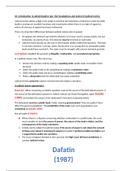
10. Introducton to administratve law: the foundatons and extent of judicial review
Judicial review allows a High Court judge to examine the lawfulness of decisions made by public
bodies carrying out its public functons and enactments where there is no right of appeal or
where all avenues of appeal have been exhausted.
There are important diferences between judicial review and an appeal;
On appeal, the claimant says that the decision of a lower court is wrong mainly, but not
exclusively, on points of law. This decision may be reversed or overruled.
Judicial review focuses on the way in which public bodies make their decisions. The basis
is not that a decision is wrong, unless the decision is so wrong that no reasonable public
body would have reached it. The claim must be brought with narrow technical grounds.
Lord Diplock classified the grounds as illegality, irratonality, and procedural impropriety.
In a judicial review case, the Court may;
Declare the decision void by making a quashing order (public body reconsiders their
decision)
Order the public body to do something by making a mandatory order
Order the public body not do so something by making a prohibitng order
Make a declaraton that the defendant has acted unlawfully.
Judicial review cannot be used to reverse/overrule/replace a decision.
Is judicial review appropriate?
Exam tp* When answering a problem queston, look at the source of the defendants powers. If
the source of the defendant’s powers is neither statute nor Royal Prerogatve, apply Datafn
(1987) and analyse the nature of the defendant’s functons comprehensively.
The defendant must be a public body. Public meaning governmental. They are public if they
afect the general populaton. The jurisdicton of the court over such organisatons was
considered by Datafn (1987).
Key principle of Datafn;
Where there is a dispute concerning whether a defendant is a public body, the court
must consider at least the source of power; the nature of the body’s dutes; and the
consequences of the body’s decisions.
A body can be subject to judicial review if its source of power is not solely the consent
of those over whom it exercises its powers provided it performs public law dutes and
it supported by public law sanctons.
The Court of Appeal decided in this case that the High Court did have jurisdicton to
conduct judicial review.
Dafatn
(1987)
Judicial review allows a High Court judge to examine the lawfulness of decisions made by public
bodies carrying out its public functons and enactments where there is no right of appeal or
where all avenues of appeal have been exhausted.
There are important diferences between judicial review and an appeal;
On appeal, the claimant says that the decision of a lower court is wrong mainly, but not
exclusively, on points of law. This decision may be reversed or overruled.
Judicial review focuses on the way in which public bodies make their decisions. The basis
is not that a decision is wrong, unless the decision is so wrong that no reasonable public
body would have reached it. The claim must be brought with narrow technical grounds.
Lord Diplock classified the grounds as illegality, irratonality, and procedural impropriety.
In a judicial review case, the Court may;
Declare the decision void by making a quashing order (public body reconsiders their
decision)
Order the public body to do something by making a mandatory order
Order the public body not do so something by making a prohibitng order
Make a declaraton that the defendant has acted unlawfully.
Judicial review cannot be used to reverse/overrule/replace a decision.
Is judicial review appropriate?
Exam tp* When answering a problem queston, look at the source of the defendants powers. If
the source of the defendant’s powers is neither statute nor Royal Prerogatve, apply Datafn
(1987) and analyse the nature of the defendant’s functons comprehensively.
The defendant must be a public body. Public meaning governmental. They are public if they
afect the general populaton. The jurisdicton of the court over such organisatons was
considered by Datafn (1987).
Key principle of Datafn;
Where there is a dispute concerning whether a defendant is a public body, the court
must consider at least the source of power; the nature of the body’s dutes; and the
consequences of the body’s decisions.
A body can be subject to judicial review if its source of power is not solely the consent
of those over whom it exercises its powers provided it performs public law dutes and
it supported by public law sanctons.
The Court of Appeal decided in this case that the High Court did have jurisdicton to
conduct judicial review.
Dafatn
(1987)