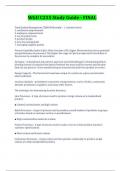
Final NR509 Study Guide 2024
Final Study Guide NR509 Final Study Guide Chapter 1 - Foundations for Clinical Proficiency -Know what should be listed under adult illnesses in health history (p.10) Medical, Surgical, OBGYN, Psychiatric -Know what is listed under present illness (p.9) Problems prompting the patients visit, including the onset of the problem, the setting in which it developed, its manifestations, and any treatments to date -Know what makes up the health history (subjective) (p.7) Identifying data and source of the history; reliability Chief complaint(s) Present Illness Past history Family history Personal and social history Review of Systems -Know how to prioritize patient complaints (p.37) List most active & serious problems first and their date of onset Problems can be symptoms, signs, past health events such as a hospital admission or surgery or diagnoses -Be able to figure out what is missing in an HPI (p.9) O.L.D.C.A.R.T -Know what subjective information is (p.6) What patient tells you -Know what objective information is (p.6) Examination findings, vital signs, laboratory data -Know the c-sections should be listed in surgeries (p.10) Surgical history- make sure you include date, indication, type of surgery. -Subjective info (ROS) (p.12) Goes under the review of systems Chapter 2 - Evaluating Clinical Evidence Evaluating Clinical Evidence Critical Thinking and Clinical Reasoning Differential Diagnoses Pathological and Physiological Processes Problem List Problem Prioritization Chapter 3 - Interviewing and the Health History -Know how to get a patient to open up when they seem upset (p.72) Effective reassurance-identifying and acknowledging patients feelings Meaningful reassurance-deal openly with concerns Validate the legitimacy of his or her emotional experience Moving closer or making physical contact -Know that you need permission of the patient to carry out the visit if someone is in the room (p.75) Whenever visitors are present, you are obligated to maintain the patients confidentiality -Know how to make a pelvic exam less intimidating (p.76) Avoid interviewing patient when she is already positioned for a pelvic exam -Know that if a patient returns from a country with malaria you still need to be selective of which patients you screen for malaria (p.66) Review page -Where to sit when interpreter in the room (p.90) Arrange seating so that you have eye contact with the patient, have the interpreter sit close or behind you (keeps you from turning your head back and forth) -Know the order of meeting a patient and conducting an interview (p.73)
Escuela, estudio y materia
- Institución
- Denver School Of Nursing
- Grado
- NR 509 (NR509)
Información del documento
- Subido en
- 12 de enero de 2024
- Número de páginas
- 23
- Escrito en
- 2023/2024
- Tipo
- Examen
- Contiene
- Preguntas y respuestas
Temas
-
study guide