Data Management Foundation C175 WGU Questions And Answers Rated A+ New Update Assured Satisfaction
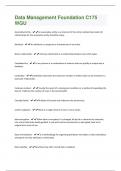
Associative Entity - An associative entity is an element of the entity-relationship model. All relationships for the associative entity should be many. Attribute - An attribute is a property or characteristic of an entity. Binary relationship - A binary relationship is a relationship between two entity types. Candidate Key - Is any column or a combination of columns that can qualify as unique key in database. Cardinality - Cardinality represents the maximum number of entities that can be involved in a particular relationship. Cartesian product - Usually the result of a missing join condition or a method of expanding the data of 1 table by the number of rows in the second table. Cascade Delete - Will delete all records that reference the primary key column subquery - Returns a single column of one or more values. data encryption - When data is encrypted, it is changed, bit by bit or character by character, into a form that looks totally garbled. It can and must be reconverted, or decrypted, back to its original form to be of use. Data normalization - Is a methodology for organizing attributes into tables so that redundancy among the non-key attributes is eliminated. Data volatility - Describes how often stored data is updated.Data Volume Assessment - Understanding of how much data will be in a database or a table within a database Database - A database is a collection of information that is organized so that it can easily be accessed, managed, and updated. DCL - Data control language is used to control access to data stored in a database. DDL - Data definition language - involves instructing the DBMS software on what tables will be in the database, what attributes will be in the tables, which attributes will be indexed, and so forth. Definer - Definer is a MySQL term where AuthID is the same for another DBMS Denormalization - The act of duplicating data in a database for performance or the preservation of historical information disaster recovery - Involves rebuilding an entire information system or significant parts of one after a catastrophic natural disaster such as a hurricane, tornado, earthquake, building collapse, or even a major fire. DML - Data manipulation language refers to the four basic operations that can and must be performed on data stored in any DBMS: data retrieval, data update, insertion of new records, and deletion of existing records. E-R model - An E-R model is a data model for describing a database in an abstract way. embedded mode - The SELECT command is embedded within the lines of a higher-level language program and functions as an input or "read" statement for the program. Entity - An entity is an object or event in our environment that we want to keep track of. Foreign Key - Is a field (or collection of fields) in one table that uniquely identifies a row of another table.Index - Used to help a DBMS find data quickly
Escuela, estudio y materia
- Institución
- Data Management Foundation C175 WGU
- Grado
- Data Management Foundation C175 WGU
Información del documento
- Subido en
- 9 de enero de 2024
- Número de páginas
- 7
- Escrito en
- 2023/2024
- Tipo
- Examen
- Contiene
- Preguntas y respuestas
Temas
-
data management foundation c175 wgu

Documento también disponible en un lote