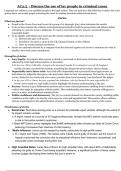
AC2.5 - Discuss the use of lay people in criminal cases
Laypeople are ordinary, non-qualified people in the legal system. They are used in in the belief that it makes the court
system fairer and avoids people criticising the court for making decisions behind closed doors.
Juries
What are jurors?
● Found in the Crown Court and is part of a group of 12 laypeople (jury) who determine the verdict
● To do so they evaluate the evidence and arguments presented by both the prosecution and defence before
retreating to a private room to deliberate. To reach a conviction the jury must be convinced beyond a
reasonable doubt.
● To be eligible, individuals must meet specific criteria outlined in the ‘Jury Act 1974’
○ Between the ages of 18 and 75
○ Residency of 5 years or more in the UK, Channel Islands or Isle of Mann
○ Have no recent criminal convictions
● Jurors are randomly selected by a computer from the electoral register and receive a summons for what is
usually a two-week court commitment.
Strengths of Juries
● Jury Equity: Jury Equity allows jurors to decide a case based on their sense of fairness and morality,
unbound by strict legal interpretations or precedent.
↳ In the case of Kay Gilderdale, charged with attempted murder for assisting her severely ill daughter's
suicide, the jury exercised this freedom, acquitting Kay despite the prosecution's chosen charge.
● Impartiality and a fairer trial: Jury trials offer impartiality and a perceived fairer legal process, as
individuals are judged by their peers who may better relate to their circumstances. The brevity of a jury's
service, limited to two weeks and a few cases, prevents them from becoming 'case-hardened' like judges.
↳ In the case of R vs Owen, the jury acquitted the defendant, who had harmed the man responsible for
Owen's son's death in a road traffic incident highlights the human understanding in the jury
● Secrecy: Secrecy in jury deliberations protects jurors from external pressures, enabling them to deliver
verdicts that might be unpopular with the public. This confidentiality also fosters a greater willingness to
serve as a juror, as deliberations remain private.
● Public confidence and democracy: The jury is a crucial element in a democratic society, instilling public
confidence in the right to be tried by one's peers for a fair and impartial trial. This practice allows ordinary
citizens to participate in the administration of justice, reinforcing the democratic nature of the system.
Weaknesses of Juries
● Racial bias: Such bias among jurors is a concern for potential unjust verdicts, although the extent of
its impact remains unclear.
↳ A report, based on a survey of 373 legal professionals, reveals that 95% believe racial bias plays
a role in the justice system's outcomes
↳ Black MP David Lammy highlights that BAME defendants often choose jury trials at Crown Court,
believing it increases their chances of a fair hearing.
● Media influence: Jurors can be swayed by media, particularly in high-profile cases
↳ R v Taylor and Taylor (1993). The sisters were initially found guilty of murder, but the Court of
Appeal overturned the conviction due to prejudicial influence from 'extensive, sensational, and
inaccurate' press coverage during their trial.
● High Acquittal Rates: Juries face criticism for high acquittal rates, with about 60% of defendants
pleading not guilty at Crown Court being acquitted. However, a significant portion of these cases
involves judges dismissing them before the jury is sworn in.
Laypeople are ordinary, non-qualified people in the legal system. They are used in in the belief that it makes the court
system fairer and avoids people criticising the court for making decisions behind closed doors.
Juries
What are jurors?
● Found in the Crown Court and is part of a group of 12 laypeople (jury) who determine the verdict
● To do so they evaluate the evidence and arguments presented by both the prosecution and defence before
retreating to a private room to deliberate. To reach a conviction the jury must be convinced beyond a
reasonable doubt.
● To be eligible, individuals must meet specific criteria outlined in the ‘Jury Act 1974’
○ Between the ages of 18 and 75
○ Residency of 5 years or more in the UK, Channel Islands or Isle of Mann
○ Have no recent criminal convictions
● Jurors are randomly selected by a computer from the electoral register and receive a summons for what is
usually a two-week court commitment.
Strengths of Juries
● Jury Equity: Jury Equity allows jurors to decide a case based on their sense of fairness and morality,
unbound by strict legal interpretations or precedent.
↳ In the case of Kay Gilderdale, charged with attempted murder for assisting her severely ill daughter's
suicide, the jury exercised this freedom, acquitting Kay despite the prosecution's chosen charge.
● Impartiality and a fairer trial: Jury trials offer impartiality and a perceived fairer legal process, as
individuals are judged by their peers who may better relate to their circumstances. The brevity of a jury's
service, limited to two weeks and a few cases, prevents them from becoming 'case-hardened' like judges.
↳ In the case of R vs Owen, the jury acquitted the defendant, who had harmed the man responsible for
Owen's son's death in a road traffic incident highlights the human understanding in the jury
● Secrecy: Secrecy in jury deliberations protects jurors from external pressures, enabling them to deliver
verdicts that might be unpopular with the public. This confidentiality also fosters a greater willingness to
serve as a juror, as deliberations remain private.
● Public confidence and democracy: The jury is a crucial element in a democratic society, instilling public
confidence in the right to be tried by one's peers for a fair and impartial trial. This practice allows ordinary
citizens to participate in the administration of justice, reinforcing the democratic nature of the system.
Weaknesses of Juries
● Racial bias: Such bias among jurors is a concern for potential unjust verdicts, although the extent of
its impact remains unclear.
↳ A report, based on a survey of 373 legal professionals, reveals that 95% believe racial bias plays
a role in the justice system's outcomes
↳ Black MP David Lammy highlights that BAME defendants often choose jury trials at Crown Court,
believing it increases their chances of a fair hearing.
● Media influence: Jurors can be swayed by media, particularly in high-profile cases
↳ R v Taylor and Taylor (1993). The sisters were initially found guilty of murder, but the Court of
Appeal overturned the conviction due to prejudicial influence from 'extensive, sensational, and
inaccurate' press coverage during their trial.
● High Acquittal Rates: Juries face criticism for high acquittal rates, with about 60% of defendants
pleading not guilty at Crown Court being acquitted. However, a significant portion of these cases
involves judges dismissing them before the jury is sworn in.