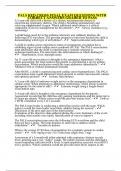
PALS RED CROSS FINAL EXAM QUESTIONS WITH CORRECT ANSWERS GRADED TO PASS
A 5-year-old child with a history of a chronic neuromuscular disease is experiencing respiratory distress. The child is breathing spontaneously and receiving supplemental oxygen. Which additional intervention is a critical component of airway management for this patient? - Airway clearance (e.g., suctioning) A child being cared for in the pediatric telemetry unit suddenly displays the following ECG waveform. The provider prepares to intervene because the child is demonstrating which type of arrhythmia? - Supraventricular tachycardia A child in cardiac arrest experiences return of spontaneous circulation but is exhibiting signs of post-cardiac arrest syndrome (PCAS). The PALS resuscitation team determines that the child is experiencing a systemic response to ischemia/reperfusion. The team bases this determination on which finding(s)? - Hypotension, fever, hyperglycemia An 11-year-old soccer player is brought to the emergency department. After a quick assessment, the team realizes this patient is experiencing a severe asthma exacerbation. Which medication would the team administer immediately? - Albuterol with or without ipratropium bromide After ROSC, a child is experiencing post-cardiac arrest hypoperfusion. The PALS resuscitation team would administer which element to restore intravascular volume and optimize preload? - Isotonic fluid boluses A 2-year-old child of unknown weight arrives at the emergency department in cardiac arrest. When preparing to administer medications, which action would be appropriate for the team to take? - Estimate weight using a length-based resuscitation tape. A 4-year-old child is brought to the emergency department by the parents. Assessment reveals that the child has only gasping respirations and the pulse rate is 65 beats per minute. Which action would the provider initiate first? - Deliver 1 BVM ventilation every 2 to 3 seconds. The PALS team leader is conducting a debriefing session with the team. Which topic(s) would the team leader most likely address during the session? - Discussion of the pros and cons of the interventions Evaluation of the objective data gathered during the event, Summary of the event, including what actions were taken, Identification of ways to improve The PALS resuscitation team notes the following ECG waveform and the child does not have a pulse. The team prepares to intervene to address which arrhythmia? - Torsades de pointes What is the correct IV/IO dose of epinephrine for a pediatric patient in cardiac arrest? - 0.01 mg/kg every 3 to 5 min (max single dose 1 mg) Assessment of a 3-month-old infant admitted with respiratory distress reveals fever, grunting and a wet, "junky" cough. The infant's parents said the child had a recent respiratory infection with a fever. A rapid respiratory syncytial virus (RSV) test is positive. Which condition would the provider most likely suspect as the cause? - Bronchiolitis A child is experiencing supraventricular tachycardia (SVT) with adequate perfusion and is to receive treatment. Which initial treatment would the provider administer? - Vagal maneuvers A healthcare provider notices petechiae on the arms and legs while performing a rapid skin assessment of a child with a high fever and respiratory distress. Based on this assessment, which condition should the provider consider? - Life-threatening systemic infection A 7-year-old patient with septic shock has received three balanced/buffered crystalloid fluid boluses (60-mL/kg) and reassessment reveals capillary refill of 3 seconds, diminished pulses, narrow pulse pressure and cool, mottled extremities. The emergency response team interprets these findings as indicating which type of septic shock? - Fluid-refractory A 30-month old child has been diagnosed with moderate croup. Which medication(s) would the provider administer? - Nebulized epinephrine, Corticosteroids A child exhibiting a narrow-complex tachycardia with adequate perfusion is to receive adenosine. The provider would be alert for which result after administering this medication? - Transient asystole A child experiencing bradycardia with inadequate perfusion despite supporting oxygenation and ventilation is receiving compressions. Despite these efforts, the child's status remains unchanged. Which medication would the emergency response team expect to administer next? - Epinephrine A child in the pediatric intensive care unit displays the following ECG waveform. The child has no pulse. The resuscitation team interprets this as which arrhythmia? - Monomorphic pulseless ventricular tachycardia A 15-year-old patient is being evaluated during a follow-up visit after being diagnosed with Lyme disease 2 months ago. A rhythm strip is obtained as shown below. The provider interprets this rhythm as indicating which arrhythmia? - First-degree atrioventricular (AV) block A healthcare provider is performing a primary assessment of a child in respiratory distress. The provider documents increased work of breathing when which findings are observed? - Nasal flaring Intercostal, substernal or suprasternal retractions Accessory muscle use A 4-year-old patient presents with tachycardia, tachypnea, cold extremities and weak pulses. Assessment also reveals an enlarged liver and neck vein distension. The provider interprets these assessment findings as suggesting which type of shock? - Cardiogenic A 6-year-old child is brought to the emergency department. The child has been experiencing extremely watery stools over the past several days. After completing the assessment, the healthcare provider suspects that the child may be experiencing shock. Which type of shock would the provider most likely suspect? - Hypovolemic A child is experiencing shock. The emergency response team prepares for imminent cardiac arrest when assessment reveals which finding(s)? - Bradycardia Diminished central pulses Hypotension Primary assessment of a 10-year-old child reveals septic shock. As part of the secondary assessment, if not already done as part of initial sepsis care, laboratory testing is completed to evaluate the child's status. Which laboratory tests would be ordered for this child? - Complete blood count (CBC) Lactate level Blood cultures A 10-year-old child has collapsed in the gym of the elementary school. The school nurse arrives and determines that the child is unresponsive. The school nurse then simultaneously checks for breathing and a central pulse, limiting this assessment to which time frame? - No more than 10 seconds A 2-year-old child arrives at the emergency department with the parents. The child is unresponsive, is not breathing and has no pulse. Two emergency department providers begin high-quality CPR. Which action(s) by the providers demonstrates high-quality CPR? - Compressing the chest about 2 inches Providing ventilations that last about 1 second each Giving 2 ventilations to every 15 compressions Allowing the chest to recoil fully after each compression The emergency response team is providing care to a preschooler who is experiencing shock. The primary goal, common to all types of shock, is to restore a favorable balance between tissue perfusion and metabolic demand with a focus on what? - Oxygen delivery and oxygen demand A 9-year-old patient is presenting with diminished breath sounds, bradycardia, slowed respiratory rate and a low O2 saturation level. The provider interprets these findings as indicating which condition? - Respiratory failure An 11-year-old child develops ventricular tachycardia with a pulse with inadequate perfusion. The PALS team would prepare the child for which intervention? - Synchronized electrical cardioversion
Escuela, estudio y materia
- Institución
- Pals
- Grado
- Pals
Información del documento
- Subido en
- 9 de enero de 2024
- Número de páginas
- 5
- Escrito en
- 2023/2024
- Tipo
- Examen
- Contiene
- Preguntas y respuestas
Temas
-
pals red cross final exam
-
pals red cross
-
pals red cross final exam questions

Documento también disponible en un lote