NCTRC Practice Exam Q's (with rationales) A+ Guaranteed.
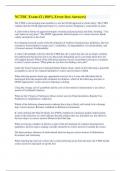
A CTRS asks a client to remember three items (e.g., dog, pencil, book). The CTRS states the three items and asks the client to repeat them. After a 5-minute conversation with the client, the CTRS asks the client to repeat the three items. Which of the following domains is the CTRS assessing? A. Affective B. Social C. Cultural D. Cognitive correct answers D. Cognitive "Cognitive examples of functional abilities include memory, orientation, attention span, reading ability, ability to follow directions and other mental functions that are prerequisites to leisure behavior." When documenting a client's progress toward treatment goals, subjective interpretation of the client's progress must be supported with A. assessment of data B. behavioral observations C. client comments D. input from the treatment team correct answers B. behavioral observations "In all cases, documentation and written records should focus on client behavior, rather than the specialist's perceptions or guesses. In each case, the specialist is responsible for selecting the most significant aspects of client behavior for documentation." A CTRS would use interventions such as yoga, deep breathing, and meditation with clients who need to improve A. stress management skills B. physical conditioning C. awareness of their emotional state D. mindful self-awareness correct answers A. stress management skills"Relaxation techniques are a means to deal with excess tension brought about by stress. In the section that follows, several methods for eliciting a state of relaxation are described. Covered are deep breathing, progressive relaxation training, autogenic training, imagery, meditation, yoga, laughter yoga, biofeedback, massage, stretching, and physical exercise." All of the following are techniques used in behavior management programs EXCEPT A. cognitive restructuring B. backward chaining C. aversion therapy D. resocialization correct answers D. resocialization "Table 3.6 Overview of Specific Behavior Management Techniques: Aversion therapy: developing an aversion to a stimulus by pairing that stimulus with vividly imagined noxious stimuli, Cognitive restructuring: changing maladaptive behavior by demonstrating the irrationality of the assumptions on which the behavior is based and teaching the person more adaptive self-talk, Backward chaining: instruction starts with the last step in a sequence and when the client has acquired the last step, the next to last step is taught and so on until the first task in the chain is accomplished." All of the following are appropriate behavioral objectives for therapeutic recreation EXCEPT A. Upon request, the client will sele
Escuela, estudio y materia
- Institución
- NCTRC Practice
- Grado
- NCTRC Practice
Información del documento
- Subido en
- 8 de enero de 2024
- Número de páginas
- 30
- Escrito en
- 2023/2024
- Tipo
- Examen
- Contiene
- Preguntas y respuestas
Temas
-
nctrc practice exam qs with rationales a guara

Documento también disponible en un lote