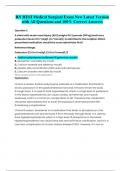
RN HESI Medical Surgical Exam New Latest Version with All Questions and 100% Correct Answers Question 1: A client with acute renal injury (AKI) weighs 110.3 pounds (50 kg) and has a potassium level of 6.7 mEq/L (6.7 mmol/L) is admitted to the hospital. Which prescribed medication should the nurse administer first? Reference Range: Potassium [3.5 to 5 mEq/L (3.5 to 5 mmol/L)] A. Sodium polystyrene sulfonate 15 grams by mouth. B. Sevelamer one tablet by mouth. C. Calcium acetate one tablet by mouth. D. Epoetin alfa, recombinant 2,500 units subcutaneously. E. Calcium acetate one tablet by mouth. Show correct answer and explanation Explanation Choice A reason: Sodium polystyrene sulfonate is a medication that binds to excess potassium in the gastrointestinal tract and removes it from the body through feces. It is used to treat hyperkalemia, which is a high level of potassium in the blood. Hyperk alemia can cause cardiac arrhythmias and muscle weakness, and it is a common complication of AKI. Therefore, this medication should be administered first to lower the potassium level and prevent life -
threatening complications. Choice B reason: Sevelamer is a medication that binds to phosphorus in the gastrointestinal tract and removes it from the body through feces. It is used to treat hyperphosphatemia, which is a high level of phosphorus in the blood. Hyperphosphatemia can cau se bone loss and soft tissue calcification, and it is a common complication of chronic kidney disease (CKD). However, it is not an urgent issue in AKI, and it does not affect the potassium level. Choice C reason: Calcium acetate is a medication that also binds to phosphorus in the gastrointestinal tract and removes it from the body through feces. It has the same effect and indication as sevelamer, but it also provides calcium supplementation. Howev er, it is not an urgent issue in AKI, and it does not affect the potassium level. Choice D reason: Epoetin alfa, recombinant is a medication that stimulates the production of red blood cells in the bone marrow. It is used to treat anemia, which is a low level of hemoglobin or red blood cells in the blood. Anemia can cause fatigue, weakn ess, and shortness of breath, and it is a common complication of CKD and AKI. However, it is not an urgent issue in AKI, and it does not affect the potassium level. Discussion Section Write a comment S Post Comment 0 Pulse Checks No comments Question 2: The nurse is preparing an older client for a magnetic resonance imaging (MRI) with contrast. Which laboratory value should the nurse report to the healthcare provider before the scan is performed? Reference Range: Glycosylated hemoglobin (A1C) [4% to 5.9%] Creatinine [0.5 to 1.1 mg/dL (44 to 97 umol/L)] Glucose [74 to 106 mg/dL (4.1 to 5.9 mmol/L)] Blood Urea Nitrogen (BUN) [10 to 20 mg/dL (3.6 to 7.1 mmol/L)] A. Fasting blood sugar of 200 mg/dL (11.1 mmol/L). B. Glycosylated hemoglobin A1c of 8%. C. Blood urea nitrogen of 22 mg/dL (7.9 mmol/L). D. Serum creatinine of 1.9 mg/dL (169 umol/L). Show correct answer and explanation Explanation Choice A reason: Fasting blood sugar of 200 mg/dL (11.1 mmol/L) indicates hyperglycemia, which is a high level of glucose in the blood. It can be caused by diabetes mellitus, stress, infection, or medication. Hyperglycemia can cause symptoms such as thirst , hunger, frequent urination, fatigue, and blurred vision. However, it does not affect the safety or accuracy of MRI with contrast. Choice B reason: Glycosylated hemoglobin A1c of 8% indicates poor glycemic control over the past three months. It can be caused by diabetes mellitus, chronic kidney disease, or hemoglobinopathy. Glycosylated hemoglobin A1c reflects the average blood glucos e level over the lifespan of red blood cells, which is about 120 days. However, it does not affect the safety or accuracy of MRI with contrast. Choice C reason: Blood urea nitrogen of 22 mg/dL (7.9 mmol/L) indicates mild azotemia, which is a high level of nitrogenous waste products in the blood. It can be caused by dehydration, high protein intake, gastrointestinal bleeding, or kidney impairment. Azotemia can cause symptoms such as nausea, vomiting, confusion, and lethargy. However, it does not affect the safety or accuracy of MRI with contrast. Choice D reason: Serum creatinine of 1.9 mg/dL (169 umol/L) indicates moderate renal insufficiency, which is a reduced ability of the kidneys to filter and excrete waste products and fluids from the body. It can be caused by diabetes mellitus, hypertension , glomerulonephritis, or nephrotoxic drugs. Renal insufficiency can cause symptoms such as edema, anemia, electrolyte imbalance, and acidosis. It can also increase the risk of contrast -induced nephropathy, which is a sudden deterioration of kidney function after exposure to contrast media used for imaging studies such as MRI. Contrast -induced nephropathy can lead to acute kidney injury, dialysis requirement, or even death. Therefore, serum creatinine should be reported to the healthcare provider before MRI with contrast to assess the risk and benefit of the procedure and to take preventive measures such as
threatening complications. Choice B reason: Sevelamer is a medication that binds to phosphorus in the gastrointestinal tract and removes it from the body through feces. It is used to treat hyperphosphatemia, which is a high level of phosphorus in the blood. Hyperphosphatemia can cau se bone loss and soft tissue calcification, and it is a common complication of chronic kidney disease (CKD). However, it is not an urgent issue in AKI, and it does not affect the potassium level. Choice C reason: Calcium acetate is a medication that also binds to phosphorus in the gastrointestinal tract and removes it from the body through feces. It has the same effect and indication as sevelamer, but it also provides calcium supplementation. Howev er, it is not an urgent issue in AKI, and it does not affect the potassium level. Choice D reason: Epoetin alfa, recombinant is a medication that stimulates the production of red blood cells in the bone marrow. It is used to treat anemia, which is a low level of hemoglobin or red blood cells in the blood. Anemia can cause fatigue, weakn ess, and shortness of breath, and it is a common complication of CKD and AKI. However, it is not an urgent issue in AKI, and it does not affect the potassium level. Discussion Section Write a comment S Post Comment 0 Pulse Checks No comments Question 2: The nurse is preparing an older client for a magnetic resonance imaging (MRI) with contrast. Which laboratory value should the nurse report to the healthcare provider before the scan is performed? Reference Range: Glycosylated hemoglobin (A1C) [4% to 5.9%] Creatinine [0.5 to 1.1 mg/dL (44 to 97 umol/L)] Glucose [74 to 106 mg/dL (4.1 to 5.9 mmol/L)] Blood Urea Nitrogen (BUN) [10 to 20 mg/dL (3.6 to 7.1 mmol/L)] A. Fasting blood sugar of 200 mg/dL (11.1 mmol/L). B. Glycosylated hemoglobin A1c of 8%. C. Blood urea nitrogen of 22 mg/dL (7.9 mmol/L). D. Serum creatinine of 1.9 mg/dL (169 umol/L). Show correct answer and explanation Explanation Choice A reason: Fasting blood sugar of 200 mg/dL (11.1 mmol/L) indicates hyperglycemia, which is a high level of glucose in the blood. It can be caused by diabetes mellitus, stress, infection, or medication. Hyperglycemia can cause symptoms such as thirst , hunger, frequent urination, fatigue, and blurred vision. However, it does not affect the safety or accuracy of MRI with contrast. Choice B reason: Glycosylated hemoglobin A1c of 8% indicates poor glycemic control over the past three months. It can be caused by diabetes mellitus, chronic kidney disease, or hemoglobinopathy. Glycosylated hemoglobin A1c reflects the average blood glucos e level over the lifespan of red blood cells, which is about 120 days. However, it does not affect the safety or accuracy of MRI with contrast. Choice C reason: Blood urea nitrogen of 22 mg/dL (7.9 mmol/L) indicates mild azotemia, which is a high level of nitrogenous waste products in the blood. It can be caused by dehydration, high protein intake, gastrointestinal bleeding, or kidney impairment. Azotemia can cause symptoms such as nausea, vomiting, confusion, and lethargy. However, it does not affect the safety or accuracy of MRI with contrast. Choice D reason: Serum creatinine of 1.9 mg/dL (169 umol/L) indicates moderate renal insufficiency, which is a reduced ability of the kidneys to filter and excrete waste products and fluids from the body. It can be caused by diabetes mellitus, hypertension , glomerulonephritis, or nephrotoxic drugs. Renal insufficiency can cause symptoms such as edema, anemia, electrolyte imbalance, and acidosis. It can also increase the risk of contrast -induced nephropathy, which is a sudden deterioration of kidney function after exposure to contrast media used for imaging studies such as MRI. Contrast -induced nephropathy can lead to acute kidney injury, dialysis requirement, or even death. Therefore, serum creatinine should be reported to the healthcare provider before MRI with contrast to assess the risk and benefit of the procedure and to take preventive measures such as