,Preface
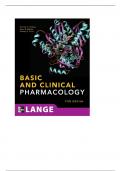
The eleventh edition of Basic & Clinical Pharmacology is a new book in two important ways. First,
the addition of new Associate Editors to the editorial group has increased currency, depth, and
breadth of coverage; second, conversion to fullcolor style has increased the clarity of presentation
and total information content. At the same time, the overall organization has been improved and
the educational content of previous editions has been expanded.
As in prior editions, the book is designed to provide a comprehensive, authoritative, and readable
pharmacology textbook for students in the health sciences. Frequent revision is necessary to keep
pace with the rapid changes in pharmacology and therapeutics; the 2–3 year revision cycle of the
printed text is among the best in the field and the availability of an online version provides even
greater currency. In addition to the full-color illustrations, other new features have been
introduced. The Case Study at the beginning of chapters and the Drug Summary Table at the end
of chapters will make the learning process even more interesting and efficient. The book also
offers special features that make it a useful reference for house officers and practicing clinicians.
Information is organized according to the sequence used in many pharmacology courses and in
integrated curricula: basic principles; autonomic drugs; cardiovascular-renal drugs; drugs with
important actions on smooth muscle; central nervous system drugs; drugs used to treat
inflammation, gout, and diseases of the blood; endocrine drugs; chemotherapeutic drugs;
toxicology; and special topics. This sequence builds new information on a foundation of
information already assimilated. For example, early presentation of autonomic nervous system
pharmacology allows students to integrate the physiology and neuroscience they have learned
elsewhere with the pharmacology they are learning and prepares them to understand the
autonomic effects of other drugs. This is especially important for the cardiovascular and central
nervous system drug groups. However, chapters can be used equally well in courses and curricula
that present these topics in a different sequence.
Within each chapter, emphasis is placed on discussion of drug groups and prototypes rather than
offering repetitive detail about individual drugs. Selection of the subject matter and the order of
its presentation are based on the accumulated experience of teaching this material to thousands
of medical, pharmacy, dental, podiatry, nursing, and other health science students.
Major features that make this book particularly useful in integrated curricula include sections that
specifically address the clinical choice and use of drugs in patients and the monitoring of their
effects—in other words, clinical pharmacology is an integral part of this text. Lists of the
commercial preparations available, including trade and generic names and dosage formulations,
are provided at the end of each chapter for easy reference by the house officer or practitioner
writing a chart order or prescription.
Significant revisions in this edition include:
A Case Study is used to open many chapters, providing an introduction to the clinical
applications of the drugs discussed. Explicit answers are provided at the end of some
, chapters but discussion of the concepts involved will be found in the text of all chapters.
A Drug Summary Table is placed at the conclusion of most chapters; these provide a
concise recapitulation of the most important drugs
Many new illustrations in full color provide significantly more information about drug
mechanisms and effects and help to clarify important concepts
Major revisions of the chapters on sympathomimetic, sympathoplegic, antipsychotic,
antidepressant, antidiabetic, anti-inflammatory, and antiviral drugs, prostaglandins, nitric
oxide, hypothalamic and pituitary hormones, and immunopharmacology
Continued expansion of the coverage of general concepts relating to newly discovered
receptors, receptor mechanisms, and drug transporters
Descriptions of important new drugs released through December 2008, including
numerous new immunopharmacologic agents
An important related educational resource is Katzung & Trevor's Pharmacology: Examination &
Board Review, eighth edition (Trevor AJ, Katzung BG, & Masters SB: McGraw-Hill, 2008). This
book provides a succinct review of pharmacology with over one thousand sample examination
questions and answers. It is especially helpful to students preparing for board-type examinations.
A more highly condensed source of information suitable for review purposes is USMLE Road Map:
Pharmacology, second edition (Katzung BG, Trevor AJ: McGraw-Hill, 2006).
This edition marks the 27th year of publication of Basic & Clinical Pharmacology. The widespread
adoption of the first ten editions indicates that this book fills an important need. We believe that
the eleventh edition will satisfy this need even more successfully. Spanish, Portuguese, Italian,
French, Indonesian, Japanese, Korean, and Turkish translations are available. Translations into
other languages are under way; the publisher may be contacted for further information.
I wish to acknowledge the prior and continuing efforts of my contributing authors and the major
contributions of the staff at Lange Medical Publications, Appleton & Lange, and more recently at
McGraw-Hill, and of our editors, Alison Kelley and Donna Frassetto. I also wish to thank my wife,
Alice Camp, for her expert proofreading contributions since the first edition.
Special thanks and recognition are due James Ransom, PhD, the long-time Senior Editor at Lange
Medical Publications, who provided major inspiration and invaluable guidance through the first
eight editions of the book. Without him, this book would not exist.
Suggestions and comments about Basic & Clinical Pharmacology are always welcome. They may
be sent to me at the Department of Cellular & Molecular Pharmacology, P.O. Box 0450, University
of California, San Francisco, CA 94143-0450.
Bertram G. Katzung, MD, PhD
San Francisco
February, 2009
,
The eleventh edition of Basic & Clinical Pharmacology is a new book in two important ways. First,
the addition of new Associate Editors to the editorial group has increased currency, depth, and
breadth of coverage; second, conversion to fullcolor style has increased the clarity of presentation
and total information content. At the same time, the overall organization has been improved and
the educational content of previous editions has been expanded.
As in prior editions, the book is designed to provide a comprehensive, authoritative, and readable
pharmacology textbook for students in the health sciences. Frequent revision is necessary to keep
pace with the rapid changes in pharmacology and therapeutics; the 2–3 year revision cycle of the
printed text is among the best in the field and the availability of an online version provides even
greater currency. In addition to the full-color illustrations, other new features have been
introduced. The Case Study at the beginning of chapters and the Drug Summary Table at the end
of chapters will make the learning process even more interesting and efficient. The book also
offers special features that make it a useful reference for house officers and practicing clinicians.
Information is organized according to the sequence used in many pharmacology courses and in
integrated curricula: basic principles; autonomic drugs; cardiovascular-renal drugs; drugs with
important actions on smooth muscle; central nervous system drugs; drugs used to treat
inflammation, gout, and diseases of the blood; endocrine drugs; chemotherapeutic drugs;
toxicology; and special topics. This sequence builds new information on a foundation of
information already assimilated. For example, early presentation of autonomic nervous system
pharmacology allows students to integrate the physiology and neuroscience they have learned
elsewhere with the pharmacology they are learning and prepares them to understand the
autonomic effects of other drugs. This is especially important for the cardiovascular and central
nervous system drug groups. However, chapters can be used equally well in courses and curricula
that present these topics in a different sequence.
Within each chapter, emphasis is placed on discussion of drug groups and prototypes rather than
offering repetitive detail about individual drugs. Selection of the subject matter and the order of
its presentation are based on the accumulated experience of teaching this material to thousands
of medical, pharmacy, dental, podiatry, nursing, and other health science students.
Major features that make this book particularly useful in integrated curricula include sections that
specifically address the clinical choice and use of drugs in patients and the monitoring of their
effects—in other words, clinical pharmacology is an integral part of this text. Lists of the
commercial preparations available, including trade and generic names and dosage formulations,
are provided at the end of each chapter for easy reference by the house officer or practitioner
writing a chart order or prescription.
Significant revisions in this edition include:
A Case Study is used to open many chapters, providing an introduction to the clinical
applications of the drugs discussed. Explicit answers are provided at the end of some
, chapters but discussion of the concepts involved will be found in the text of all chapters.
A Drug Summary Table is placed at the conclusion of most chapters; these provide a
concise recapitulation of the most important drugs
Many new illustrations in full color provide significantly more information about drug
mechanisms and effects and help to clarify important concepts
Major revisions of the chapters on sympathomimetic, sympathoplegic, antipsychotic,
antidepressant, antidiabetic, anti-inflammatory, and antiviral drugs, prostaglandins, nitric
oxide, hypothalamic and pituitary hormones, and immunopharmacology
Continued expansion of the coverage of general concepts relating to newly discovered
receptors, receptor mechanisms, and drug transporters
Descriptions of important new drugs released through December 2008, including
numerous new immunopharmacologic agents
An important related educational resource is Katzung & Trevor's Pharmacology: Examination &
Board Review, eighth edition (Trevor AJ, Katzung BG, & Masters SB: McGraw-Hill, 2008). This
book provides a succinct review of pharmacology with over one thousand sample examination
questions and answers. It is especially helpful to students preparing for board-type examinations.
A more highly condensed source of information suitable for review purposes is USMLE Road Map:
Pharmacology, second edition (Katzung BG, Trevor AJ: McGraw-Hill, 2006).
This edition marks the 27th year of publication of Basic & Clinical Pharmacology. The widespread
adoption of the first ten editions indicates that this book fills an important need. We believe that
the eleventh edition will satisfy this need even more successfully. Spanish, Portuguese, Italian,
French, Indonesian, Japanese, Korean, and Turkish translations are available. Translations into
other languages are under way; the publisher may be contacted for further information.
I wish to acknowledge the prior and continuing efforts of my contributing authors and the major
contributions of the staff at Lange Medical Publications, Appleton & Lange, and more recently at
McGraw-Hill, and of our editors, Alison Kelley and Donna Frassetto. I also wish to thank my wife,
Alice Camp, for her expert proofreading contributions since the first edition.
Special thanks and recognition are due James Ransom, PhD, the long-time Senior Editor at Lange
Medical Publications, who provided major inspiration and invaluable guidance through the first
eight editions of the book. Without him, this book would not exist.
Suggestions and comments about Basic & Clinical Pharmacology are always welcome. They may
be sent to me at the Department of Cellular & Molecular Pharmacology, P.O. Box 0450, University
of California, San Francisco, CA 94143-0450.
Bertram G. Katzung, MD, PhD
San Francisco
February, 2009
,