NRNP 6665 MIDTERM EXAM WITH COMPLETE SOLUTIONS
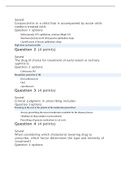
NRNP 6665 MIDTERM EXAM WITH COMPLETE SOLUTIONS Question 1 Which of the following is NOT consistent with good sleep hygiene? A Allow child to keep a cell phone at bedside. . B Establish bedtime routines and maintain consistently. . C Limit use of electronics in the evening i.e., television, . computer, etc. D Set and maintain a bedtime that will allow for adequate . sleep. Question 2 According to the APA which of the following are required to support a child’s DSM-5 diagnosis? A The child’s clinical presentation fulfills the specific symptom based . diagnostic criteria. B The child’s symptoms are not caused by other diagnoses or stressors. . C The child’s symptoms are impairing a child’s functioning in at least two . settings. D A and B . Question 3 Biofeedback, deep breathing, mindfulness, and progressive muscle relaxation are strategies that are typically used in which of the following therapies? A Relaxation therapy . B Social skills training . C Motivational . Interviewing D Applied behavioral . analysis Question 4 Which of the following antipsychotic medications have the greatest tendency to increaseappetite and body weight? A Aripiprazole (Abilify) . B Ziprasidone . (Geodon) C Haloperidol (Haldol) . D Risperidone . (Risperdal) Question 5 When assessing a child with disruptive or aggressive behavior, the clinician asks “Have you been thinking about or planning to hurt anyone?” to screen for which of the following diagnostic categories? A Safety . B Bullying . C Conduct disorder . D Oppositional defiant . disorder Question 6 The clinician assessing substance abuse in an adolescent asks, “Did you develop more moodor anxiety problems after you started using?” to screen for which of the following diagnostic possibilities? A Substance use disorder . B Substance withdrawal . C Substance tolerance . D Substance induced mental . disorder Question 7 When the patient lacks capacity to make a decision the nurse has the ethical responsibilityto do which of the following? A Become a surrogate decision maker for the patient. . B Consult a formally-designated surrogate for patient choices. . C Make safe choices for the patient based on the nurse’s beliefs . and values. D Continue to support all the patient’s choices until a surrogate . can be found. Question 8 When assessing a child who has presented with concerns of being anxious and worried, the provider asks the child “Do you get sudden surges of fear that make your body feel shaky oryour heart race?” to screen for which of the following common diagnostic possibilities? A Obsessive -compulsive . disorder B Posttraumatic stress . disorder C Panic disorder . D Separation anxiety . disorder Question 9 Which of the following antipsychotic medications has the greatest risk for weight gain and lipid changes? A Ziprasidone . (Geodon) B Aripiprazole . (Abilify) C Olanzapine . (Zyprexa) D Quetiapine . (Seroquel) Question 10 A period of at least one week in which both a manic episode and a major depressive episode occur almost daily is consistent with which diagnosis? A Bipolar II Disorder . B Cyclothymic Disorder . The theory that depression results from specific thought distortions is consistent with which of the following? C Bipolar I Disorder, mixed . episode D Bipolar I Disorder, cyclothymic . type Question 11 Which of the following is NOT true about symptomatology of anorexia nervosa? A Most aberrant behaviors directed toward losing weight occurs in secret. . B All patients have an intense fear of gaining weight and becoming obese. . C Most patients with anorexia nervosa will have no difficulty eating with their family in . public places. D Fear of gaining weight and becoming obese frequently contributes to the individual’s . lack of interest in and resistance to therapy/treatment. Question 12 Sleep-related hallucinations occurring at sleep onset are known as which of the following? A Hypnagogic . B Hypnopompic . C Complex . hallucinations D Paranormal . hallucinations Question 13 A Cognitive theory . B Psychosocial theory . C Psychodynamic theory . D Learned helplessness theory
Escuela, estudio y materia
- Institución
- NRNP 6665
- Grado
- NRNP 6665
Información del documento
- Subido en
- 6 de enero de 2024
- Número de páginas
- 33
- Escrito en
- 2023/2024
- Tipo
- Examen
- Contiene
- Preguntas y respuestas
Temas
-
nrnp 6665 midterm exam
-
nrnp 6665
-
nrnp 6665 midterm exam with complete solutions
-
nrnp 6665 midterm exam with