

Exam 2 study guide
Version 1
1. DNA replication
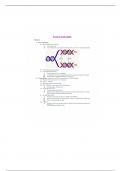
a. Occurs Semiconservatively
i. Half conserved
ii. one strand is the parent strand while the other is the new replicated strand.
b. Is initiated at unique origins
c. Proceeds bidirectionally
i. Each strand serves as a template
ii. Complementary base pairing determines the sequence of the new strand
iii. Each strand of the parental helix is conserved
2. Transcription- synthesis of an RNA molecule from a DNA template
a. Occurs in the nucleus in 5’ to 3’ direction
b. DNA → mRNA
c. RNA Polymerase- enzyme used
d. RNA Splicing- intron removal by spliceosomes
i. Occurs only in Eukaryotes
e. In PROKARYOTES:
i. Primary transcript=mRNA
ii. Polycistronic- group of genes in bacteria is often transcribed into a single
RNA molecule (contains multiple proteins)
f. In EUKARYOTES:
i. Primary transcript=precursor to mRNA (pre-mRNA)
ii. Before becoming the complete mRNA, must be modified (RNA Splicing)
iii. Moly- contains single protein
g. 3 Stages:
i. Initiation: RNA polymerase binds to the DNA at the promoter region and
the transcription bubble forms
, ii. Elongation: the RNA strand gets longer due to the adding of the
nucleotides
1. Happens in the 3’ → 5’ direction
vi. Termination: It keeps on transcribing till it gets the signal to stop.
3. Genetic code
a. Composed of nucleotide triplets: Three nucleotides in mRNA specify one amino
acid in the polypeptide product; thus, each codon contains 3 nucleotides
,
Version 1
1. DNA replication
a. Occurs Semiconservatively
i. Half conserved
ii. one strand is the parent strand while the other is the new replicated strand.
b. Is initiated at unique origins
c. Proceeds bidirectionally
i. Each strand serves as a template
ii. Complementary base pairing determines the sequence of the new strand
iii. Each strand of the parental helix is conserved
2. Transcription- synthesis of an RNA molecule from a DNA template
a. Occurs in the nucleus in 5’ to 3’ direction
b. DNA → mRNA
c. RNA Polymerase- enzyme used
d. RNA Splicing- intron removal by spliceosomes
i. Occurs only in Eukaryotes
e. In PROKARYOTES:
i. Primary transcript=mRNA
ii. Polycistronic- group of genes in bacteria is often transcribed into a single
RNA molecule (contains multiple proteins)
f. In EUKARYOTES:
i. Primary transcript=precursor to mRNA (pre-mRNA)
ii. Before becoming the complete mRNA, must be modified (RNA Splicing)
iii. Moly- contains single protein
g. 3 Stages:
i. Initiation: RNA polymerase binds to the DNA at the promoter region and
the transcription bubble forms
, ii. Elongation: the RNA strand gets longer due to the adding of the
nucleotides
1. Happens in the 3’ → 5’ direction
vi. Termination: It keeps on transcribing till it gets the signal to stop.
3. Genetic code
a. Composed of nucleotide triplets: Three nucleotides in mRNA specify one amino
acid in the polypeptide product; thus, each codon contains 3 nucleotides
,

