Legal Practice Course Civil Litigation (May 2019)
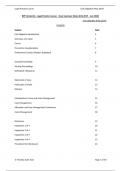
BPP University - Legal Practice Course – Own Summary Notes (Feb 2019 – Jun 2020)
Civil Litigation (May 2019)
Contents
Subject Page
Civil Litigation Introduction 4
Overview of a Claim 5
Courts 6
Pre-Action Considerations 7
Professional Conduct Matters (Updated) 8
Issuing Proceedings 9
Serving Proceedings 10
Defendant’s Response 11
Statement of Case 12
Particulars of Claim 13
Defence 14
Introduction to Case and Costs Management 15
Case Management 16
Allocation and Case Management Conference 17
Costs Management 18
Disclosure 19
Inspection 1 of 4 20
Inspection 2 of 4 21
Inspection 3 of 4 22
Inspection 4 of 4 23
Procedure (for Disclosure) 24
© Timothy John Tyne Page 1 of 50
,Legal Practice Course Civil Litigation (May 2019)
Evidence 25
Witness Evidence 1 of 2 26
Witness Evidence 2 of 2 27
Expert Evidence 28
Part 36 (Offer) 29
Settlement 30
Trial 31
Costs 32
Interim Applications: General Overview 33
Security for Costs 34
Summary Judgement 35
Interim Injunctions 1 of 2 36
Interim Injunctions 2 of 2 37
EU Regulations 1215/2012 1 of 2 38
EU Regulations 1215/2012 2 of 2 39
Common Law Rules 40
Alternative Dispute Resolution 41
Arbitration 42
Enforcement 43
Appeals 1 of 2 44
Appeals 2 of 2 45
Changes since 2019 46
Appendix: Internet links to various forms/documents 47
List of cases in chronological order with page it first appears 48
© Timothy John Tyne Page 2 of 50
,Legal Practice Course Civil Litigation (May 2019)
List of legislation in chronological order with page it first appears 49
Bibliography and References 50
© Timothy John Tyne Page 3 of 50
, Legal Practice Course Civil Litigation (May 2019)
Civil Litigation Introduction
Civil litigation is used to resolve civil (non-criminal) disputes in court.
Civil Procedure Rules (1998) CPR [1]
These rules along with some case law govern court procedure.
They are published by the UK Ministry of Justice on their website at
https://www.justice.gov.uk/courts/procedure-rules/civil/rules
Updated: Thursday, 14 December 2023
Most important is the Overriding Objective
CPR 1.1(1) “… enabling the court to deal with cases justly and at proportionate cost.” Amplified in
CPR 1.1(2) a) ”… parties on equal footing
b) … saving expense
c) … dealing … in ways which are proportionate –
i) to the… money …
ii) … importance …
iii) … complexity …
iv) … financial position of each party.
d) … expeditiously and fairly.
e) allotting … court’s resources …
f) enforcing compliance …” and
CPR 1.3 “The parties are required to help the court further the overriding objective.”
European Convention on Human Rights 1950 (ECHR 1950) was incorporated into English law by
The Human Rights Act 1998 (HRA 1998) [2]
The following rights were incorporated into English law and affect civil litigation.
ECHR 1950 Art. 6 Right to a fair trial (a special right)
Art. 8 Right to private and family life (a qualified right)
Prot. 1, Art. 1 Protection of property (a qualified right)
Notation used for Civil Procedure Rules
CPR 1.4(2)(a) means Civil Procedure Rules - Rule 1.4 (in Part 1) paragraph 2, sub-paragraph a
2A PD 3.1(b)(i) means Practice Direction Part 2A, paragraph 3.1, sub-paragraph b i
PD PCP 3(a) means Practice Direction – Pre-Action Conduct and Protocols, paragraph 3, sub-
paragraph a
Where (GL) appears in the Civil Procedure Rules it indicates the word or words preceding it are
defined in the Glossary.
© Timothy John Tyne Page 4 of 50
BPP University - Legal Practice Course – Own Summary Notes (Feb 2019 – Jun 2020)
Civil Litigation (May 2019)
Contents
Subject Page
Civil Litigation Introduction 4
Overview of a Claim 5
Courts 6
Pre-Action Considerations 7
Professional Conduct Matters (Updated) 8
Issuing Proceedings 9
Serving Proceedings 10
Defendant’s Response 11
Statement of Case 12
Particulars of Claim 13
Defence 14
Introduction to Case and Costs Management 15
Case Management 16
Allocation and Case Management Conference 17
Costs Management 18
Disclosure 19
Inspection 1 of 4 20
Inspection 2 of 4 21
Inspection 3 of 4 22
Inspection 4 of 4 23
Procedure (for Disclosure) 24
© Timothy John Tyne Page 1 of 50
,Legal Practice Course Civil Litigation (May 2019)
Evidence 25
Witness Evidence 1 of 2 26
Witness Evidence 2 of 2 27
Expert Evidence 28
Part 36 (Offer) 29
Settlement 30
Trial 31
Costs 32
Interim Applications: General Overview 33
Security for Costs 34
Summary Judgement 35
Interim Injunctions 1 of 2 36
Interim Injunctions 2 of 2 37
EU Regulations 1215/2012 1 of 2 38
EU Regulations 1215/2012 2 of 2 39
Common Law Rules 40
Alternative Dispute Resolution 41
Arbitration 42
Enforcement 43
Appeals 1 of 2 44
Appeals 2 of 2 45
Changes since 2019 46
Appendix: Internet links to various forms/documents 47
List of cases in chronological order with page it first appears 48
© Timothy John Tyne Page 2 of 50
,Legal Practice Course Civil Litigation (May 2019)
List of legislation in chronological order with page it first appears 49
Bibliography and References 50
© Timothy John Tyne Page 3 of 50
, Legal Practice Course Civil Litigation (May 2019)
Civil Litigation Introduction
Civil litigation is used to resolve civil (non-criminal) disputes in court.
Civil Procedure Rules (1998) CPR [1]
These rules along with some case law govern court procedure.
They are published by the UK Ministry of Justice on their website at
https://www.justice.gov.uk/courts/procedure-rules/civil/rules
Updated: Thursday, 14 December 2023
Most important is the Overriding Objective
CPR 1.1(1) “… enabling the court to deal with cases justly and at proportionate cost.” Amplified in
CPR 1.1(2) a) ”… parties on equal footing
b) … saving expense
c) … dealing … in ways which are proportionate –
i) to the… money …
ii) … importance …
iii) … complexity …
iv) … financial position of each party.
d) … expeditiously and fairly.
e) allotting … court’s resources …
f) enforcing compliance …” and
CPR 1.3 “The parties are required to help the court further the overriding objective.”
European Convention on Human Rights 1950 (ECHR 1950) was incorporated into English law by
The Human Rights Act 1998 (HRA 1998) [2]
The following rights were incorporated into English law and affect civil litigation.
ECHR 1950 Art. 6 Right to a fair trial (a special right)
Art. 8 Right to private and family life (a qualified right)
Prot. 1, Art. 1 Protection of property (a qualified right)
Notation used for Civil Procedure Rules
CPR 1.4(2)(a) means Civil Procedure Rules - Rule 1.4 (in Part 1) paragraph 2, sub-paragraph a
2A PD 3.1(b)(i) means Practice Direction Part 2A, paragraph 3.1, sub-paragraph b i
PD PCP 3(a) means Practice Direction – Pre-Action Conduct and Protocols, paragraph 3, sub-
paragraph a
Where (GL) appears in the Civil Procedure Rules it indicates the word or words preceding it are
defined in the Glossary.
© Timothy John Tyne Page 4 of 50