Overview of Critical Care nursing (Chapters 1-5) with Verified answers
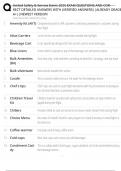
Overview of Critical Care nursing (Chapters 1-5) with Verified answers AACN Certification Corporation oversees CORRECT ANSWERS the critical care certification process Advanced directive CORRECT ANSWERS Witnessed written document or oral statement in which instructions are given by a person to express desires related to health *care decisions*. The directive may include, but is not limited to, the designation of a health care surrogate, a living will, or an anatomic gift Agitated (RASS) CORRECT ANSWERS frequent non-purposeful movements; fights ventilator 2+ Alert and Calm will get you a (RASS) score of CORRECT ANSWERS 0 Anxiety CORRECT ANSWERS a state marked by apprehension, agitation, autonomic arousal, fearful withdrawal, or any combination of these; a prolonged state of apprehension in response to a real or perceived fear autonomy CORRECT ANSWERS states that all persons should be free to govern their lives to the greatest degree possible; this means to respect their freedom of choice and to allow them to make their own Beneficence CORRECT ANSWERS the duty to provide benefits to others when in a position to do so and to help balance harms and benefits Built Environment CORRECT ANSWERS physical layout of a critical care unit has a subtle but profound effect on patients, families, and the critical care team CCRN certification is available for CORRECT ANSWERS nurses who provide care of critically ill adult, pediatric, or neonatal populations CCRN-E credential is available for CORRECT ANSWERS nurses working in the eICUs Combative (RASS) CORRECT ANSWERS overly combative or violent; immediate danger to staff 4+ Competence (or capacity) CORRECT ANSWERS refers to a person's ability to understand information regarding a proposed medical or nursing treatment; it is a legal term and is determined in court Deep Sedation (RASS) CORRECT ANSWERS no response to voice, but any movement to physical stimulation -4 Delirium (acute brain dysfunction) CORRECT ANSWERS characterized by an acutely changing or fluctuating mental status, inattention, disorganized thinking, and altered levels of consciousness Developmental Assessment CORRECT ANSWERS includes information related to the family's developmental stages, tasks, and attachments Do not resuscitate (DNR) order CORRECT ANSWERS A medical order that prohibits the use of cardiopulmonary resuscitation and emergency cardiac care to reverse signs of clinical death. The DNR order may or may not be specified in patients' advance directives Drowsy (RASS) CORRECT ANSWERS not full alert, but has sustained (>10 sec) wakening, with eye contact, to loud voice -1 Dyssynchrony CORRECT ANSWERS the patient "fights" with the mechanical ventilator which can result in further alveolar damage and the endotracheal or tracheostomy tube creases a "choking" sensation and increased anxiety ethical dilemma CORRECT ANSWERS is a difficult problem or situation in which conflict arise during the process of making morally justifiable decisions Family assessment (Calgary family assessment model) three categories CORRECT ANSWERS Structural, Developmental, and Functional Fast (sharp) pain signals are transmitted to the spinal cord by CORRECT ANSWERS slowly conducting, thinly myelinated A-delta afferent fibers Fidelity CORRECT ANSWERS requires that one has a moral duty to be faithful to the commitments made to others Functional Assessment CORRECT ANSWERS reveals how family members function and behave in relation to one another Hospice Care CORRECT ANSWERS is generally reserved for those with a prognosis of less than 6 months to live and is usually in place of aggressive life-sustaining or restorative care Hospice CORRECT ANSWERS is a model of care that emphasizes comfort rather than a cure and views dying as a normal human process Hyperactive delirium CORRECT ANSWERS Agitation, restlessness, attempts to remove catheters or tubes, hitting, biting, and/or emotional lability Hypoactive delirium CORRECT ANSWERS Withdrawal, flat affect, apathy, lethargy, and/or decreased responsiveness Identify and treat cause(s) of delirium or altered mental status CORRECT ANSWERS o Infection or sepsis o Dehydration, hypoglycemia o Sleep deprivation o Alcohol, benzodiazepine, or home medication withdrawal o Medications: anticholinergics, benzodiazepines, opiates, steroids Informed Consent CORRECT ANSWERS based on the principle of autonomy; competent adults have the right to self-determination or to make decisions regarding their acceptance or rejection of treatment Justice CORRECT ANSWERS requires that health care resources be distributed fairly and equitably among groups of people Light Sedation (RASS) CORRECT ANSWERS briefly awakens (<10 sec) with eye contact to loud voice -2 Living will CORRECT ANSWERS A witnessed written document or oral statement voluntarily executed by a person that expresses the person's *instructions concerning life-prolonging procedures* Mixed delirium CORRECT ANSWERS Concurrent or sub-sequential appearance of some features of both hyperactive and hypoactive delirium Moderate Sedation (RASS) CORRECT ANSWERS any movement (but no eye contact) to loud voice -3 Modifiable risk factors for delirium CORRECT ANSWERS - Alcohol, narcotic, benzodiazepine dependence - Medication-induced coma - Uncontrolled pain - Cigarette smoking - Immobility - Sleep deprivation Moral distress CORRECT ANSWERS occurs when the nurse knows the ethically appropriate action to take but is unable to act on it or when the nurse acts in a manner contrary to personal and professional values Non modifiable risk factors for delirium CORRECT ANSWERS - Baseline cognitive impairment - Baseline hypertension - Advanced age (>70) - Respiratory failure Nonmaleficence CORRECT ANSWERS the explicit duty to not inflict harm on others intentionally Pain CORRECT ANSWERS an unpleasant sensory and emotional experience associated with actual or potential tissue damage; subjective experience; the patient becomes the true authority on the pain that is being experienced Palliation CORRECT ANSWERS is the provision of care interventions that are designed to relieve symptoms of illness or injury that negatively affect the quality of life of the patient or family Patient Self-Determination Act CORRECT ANSWERS this act requires that all health care facilities that receive Medicare and Medicaid funding inform their patients about their right to initiate an advanced directive and the right to consent to or refuse medical treatment Patients in ICU three top stressors CORRECT ANSWERS ♣ Being in pain Not being able to sleep Financial worries PCCN is for CORRECT ANSWERS nurses who provide acute care in progressive care, telemetry, and similar units Proxy CORRECT ANSWERS A competent adult who has not been expressly designated to make health care decisions for an incapacitated person, but is authorized by state statute to make health care decisions for the person Restless (RASS) CORRECT ANSWERS anxious or apprehensive but movements are not aggressive or vigorous 1+ Sensory deprivation has been connected to an increase in ... and what could decrease this? CORRECT ANSWERS - perceptual disturbances such as hallucinations, especially in older adults - Providing stimulation by interacting with the patient and encouraging visitation of friends and family can decrease its occurrence. Sensory overload could be a result of CORRECT ANSWERS The noise level alone is enough stimulation to cause a patient discomfort and sleep deprivation, and it is a major factor contributing to sensory overload Slow (burning;chronic) pain is transmitted by CORRECT ANSWERS the unmyelinated polymodal C fibers, which are activated by a variety of high-intensity mechanical, chemical, hot, and cold stimulus Somatic Pain CORRECT ANSWERS results from irritation or damage to the nervous system Spontaneous Awakening Trials (SAT) and Spontaneous Breathing Trials (SBT) CORRECT ANSWERS - Decrease sedatives until the patient is responsive - If the patient passes the SBT, consider extubating Structural Assessment CORRECT ANSWERS done upon admission, and it identifies immediate family, extended family, and the decision makers Surrogate CORRECT ANSWERS A competent adult designated by a person to make health care decisions should that person become incapacitated Terminal weaning CORRECT ANSWERS consist of titration of ventilator support to minimal levels, removal of the ventilator but not the artificial airway, or complete extubation The American Association of Critical-Care Nurses (AACN) hs developed a framework for dealing with moral distress known as the CORRECT ANSWERS • Ask • Affirm • Assess • Act The family bundle is based on what 5 concepts CORRECT ANSWERS - evaluate - plan - involve - communicate - support Three cultural questions to be asked CORRECT ANSWERS - What are your specific religious and spiritual practices? - What are your beliefs about illness (and death)? - What is most important to you and your family at this time? To identify an ethical dilemma what must be met? CORRECT ANSWERS ♣ More than one solution must exist There is no clear "right" or "wrong" Each solution must carry equal weight and must be ethically defensible Unarousable (RASS) CORRECT ANSWERS no response to voice or physical stimulation -5 Value pneumonic for communication with family CORRECT ANSWERS • Value what the family tells you • Acknowledge family emotions • Listen to the family members • Understand the patient as a person • Elicit (ask) questions of family members Veracity CORRECT ANSWERS states that persons are obligated to tell the truth in their communication with others Very Agitated (RASS) CORRECT ANSWERS pulls on or removes tubes or catheters or has aggressive behavior towards staff 3+ Visceral Pain CORRECT ANSWERS diffuse, poorly localized, and often referred What elements must be present for a person to consent or decline treatment CORRECT ANSWERS o Competence o Voluntariness - without coercion o Disclosure of information withheld therapies in hospice CORRECT ANSWERS • Vasopressors • Antibiotics • Blood and blood products • Dialysis • Nutritional support
Escuela, estudio y materia
- Institución
- Overview of Critical Care nursing
- Grado
- Overview of Critical Care nursing
Información del documento
- Subido en
- 23 de diciembre de 2023
- Número de páginas
- 8
- Escrito en
- 2023/2024
- Tipo
- Examen
- Contiene
- Preguntas y respuestas
Temas
-
overview of critical care nursing