BTEC Applied Science Unit 1 Biology
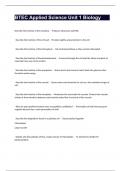
BTEC Applied Science Unit 1 Biology Describe the function of the nucleolus - Produces ribosomes and RNA Describe the function of the cell wall - Provides rigidity and protection to the cell Describe the function of the chloroplasts - Site of photosynthesis as they contain chlorophyll Describe the function of the plasmodesmata - A channel through the cell wall the allows transport of materials from one cell to another Describe the function of the amyoplasts - Stores starch and converts starch back into glucose when the plant needs energy Describe the function of the vacuole - Stores water and chemicals for cell use. Also maintains turgor of cell Describe the function of the tonoplasts - Membrane the surrounds the vacuole. Protects the vacuole, isolates it from harmful substances and controls water flow in and out of the vacuole Why are gram positive bacteria more susceptible to antibiotics? - Permeable cell wall whereas gram negative bacteria has a semi-permeable cell wall Describe the adaptations found in a palisade cell - Closely packed together Chloroplasts Large vacuole Explain why the palisade cell has a large amount of chloroplasts - To absorb lots of light for photosynthesis Explain why palisade cells are closely packed together - To form a continuous layer in the leaf Explain why palisade cells have a large vacuole - To maintain turgor (pushes against the cell wall to maintain rigid shape) Describe the adaptations of a root hair cell - Root hair shape Large vacuole Thin cellulose walls Explain why root hair cells have an elongated section known as the root hair - Increased surface area for maximum movement of water into the cell Explain why root hair cells have a large vacuole - Contains cell sap with low water potential to encourage water into the cell Explain why root hair cells have thin cellulose walls - Encourage movement of water and minerals into the cell. Short distance for osmosis and diffusion Describe the adaptations of a sperm cell - Lots of mitochondria Shaped head containing acrosome (with enzymes) Haploid nucleus Tail for movement Explain why a sperm cell has an undulipodium (tail) - To allow the sperm to move to the egg Explain why sperm cells contain large numbers of mitochondria - To produce the large amounts of energy needed for movement Explain why sperm cells have a shaped head - To push through the protective layer of the egg cell
Escuela, estudio y materia
- Institución
- BTEC Applied Science Unit 1 Biology
- Grado
- BTEC Applied Science Unit 1 Biology
Información del documento
- Subido en
- 21 de diciembre de 2023
- Número de páginas
- 11
- Escrito en
- 2023/2024
- Tipo
- Examen
- Contiene
- Preguntas y respuestas
Temas
-
btec
-
btec applied science unit 1 biology

Documento también disponible en un lote