

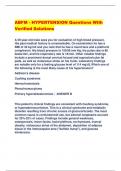
ABFM - HYPERTENSION Questions With Verified Solutions A 39 -year-old male sees you for evaluation of high bloo d pressure. His past medical history is unremarkable. On examination he has a BMI of 32 kg/m2 and you note that he has a round face and a plethoric complexion. His blood pressure is 150/98 mm Hg, his pulse rate is 88 beats/min, and his respiratory rate is 16/min. Other notable findings include a prominent dorsal cervical fat pad and supraclavicular fat pads, as well as violaceous striae on his trunk. Laboratory findings are notable only for a fasting glucose level of 114 mg/dL.Which one of the following is the most likely cause of his hypertension? Addison's disease Cushing syndrome Hemochromatosis Pheochromocytoma Primary hyperaldosteronism - ANSWER B This patient's clinical findings are consistent with Cushing syndrome, or hyperadrenocorticism. This is a clinical syndrome and metabolic disorder resulting from chronic excess of glucocorticoids. The most common cause is corticosteroid use, but adrenal neoplasms account for 20% -25% of cases. Findings include general weakness, osteoporosis, moon facies, facia l plethora, ecchymoses, truncal obesity, violaceous striae of the abdomen, deposition of adipose tissue in the interscapular area ("buffalo hump"), and glucose intolerance. You diagnose stage 2 hypertension in a 54 -year-old male. His past medical history is otherwise unremarkable and a physical examination is notable for mild AV nicking on funduscopic examination. A baseline EKG reveals evidence of left ventricular hypertrophy.Which one of the following classes of antihypertensive agents has NOT been show n to produce a regression of left ventricular hypertrophy? ACE inhibitors β-Blockers Calcium channel blockers Direct vasodilators Thiazide diuretics - ANSWER D In patients with left ventricular hypertrophy, studies have shown a reduction in left ventricu lar mass in those treated with ACE inhibitors, diuretics, calcium channel blockers, and β -blockers, with the most consistent reduction achieved with ACE inhibitors and the least with β-blockers. Regression of left ventricular hypertrophy has not been demon strated with direct vasodilators such as hydralazine and minoxidil. According to currently accepted criteria, hypertension in children is defined as repeated blood pressure measurements at or above a threshold of which one of the following percentiles fo r age, sex, and height? 80th 85th 90th 95th 99th - ANSWER D In children and adolescents, hypertension is defined as blood pressure at or above the 95th percentile for age, sex, and height, on repeated measurements. Which one of the following conditions is associated with isolated systolic hypertension? Aortic stenosis Hypothyroidism Paget's disease Renovascular hypertension Severe osteoporosis - ANSWER C Isolated elevation of systolic blood pressure can be secondar y to conditions associated with elevated cardiac output, such as anemia, Paget's disease, hyperthyroidism, arteriovenous fistula, and aortic insufficiency. A 59 -year-old African -American male with a history of hypercholesterolemia and gout sees you for a health maintenance visit. A physical examination is notable only for a blood pressure of 144/85 mm Hg.Laboratory FindingsLDL -cholesterol............82 mg/dLHDL -cholesterol............47 mg/dLSerum triglycerides............134 mg/dLLiver panel............n ormalSerum creatinine............1.7 mg/dL (N 0.7-1.3)Estimated glomerular filtration rate............56 mL/min/1.73 m2Which one of the following does the JNC 8 panel recommend as initial management of this patient's blood pressure elevation? Lifestyle me asures only An ACE inhibitor A calcium channel blocker Hydralazine Hydrochlorothiazide - ANSWER B The JNC 8 panel recommends the initiation of pharmacologic treatment to lower blood pressure in patients ≥18 years of age with a systolic blood pressure ≥14 0 mm Hg or a diastolic blood pressure ≥90 mm Hg if they have chronic kidney disease (CKD), defined as an estimated or measured glomerular filtration rate (GFR) <60 mL/min/1.73 m2. Treatment is recommended for patients of any age with these blood pressure v alues who also have albuminuria, defined as >30 mg of albumin/g of creatinine regardless of GFR (SOR C).Although a thiazide diuretic or a calcium channel blocker is generally recommended as first -line antihypertensive therapy in African -Americans, for pati ents ≥18 years of age who have CKD, the JNC 8 panel recommends initial (or add -on) antihypertensive treatment with an ACE inhibitor or angiotensin receptor blocker to improve kidney outcomes, regardless of ethnicity or diabetes status (SOR B).The 2017 Amer ican College of Cardiology/American Heart Association hypertension guidelines similarly recommend use of an ACE inhibitor in patients with stage 3 CKD, as well as in patients who have stages 1 or 2 CKD with albuminuria >300 mg/day. A 67 -year-old male wit h a history of hypertension and type 2 diabetes has inadequately controlled blood pressure. His current medications are lisinopril (Prinivil, Zestril), 40 mg daily; hydrochlorothiazide, 25 mg daily; and extended -release metformin (Glucophage XR), 1500 mg daily. Laboratory testing reveals a hemoglobin A1c of 6.8%, normal serum electrolytes, a serum creatinine level of 1.0 mg/dL (N 0.6 -1.5), and a urinary albumin/creatinine ratio of 80 mg/g (N <30).Which one of the following agents should be AVOIDED in this p atient? Aliskiren (Tekturna) Atenolol (Tenormin)
Examen
ABFM - HYPERTENSION Questions With Verified Solutions
Puntuación
Vendido
-
Páginas
55
Grado
A+
Subido en
21-12-2023
Escrito en
2023/2024
ABFM - HYPERTENSION Questions With Verified Solutions A 39-year-old male sees you for evaluation of high blood pressure. His past medical history is unremarkable. On examination he has a BMI of 32 kg/m2 and you note that he has a round face and a plethoric complexion. His blood pressure is 150/98 mm Hg, his pulse rate is 88 beats/min, and his respiratory rate is 16/min. Other notable findings include a prominent dorsal cervical fat pad and supraclavicular fat pads, as well as violaceous striae on his trunk. Laboratory findings are notable only for a fasting glucose level of 114 mg/dL.Which one of the following is the most likely cause of his hypertension? Addison's disease Cushing syndrome Hemochromatosis Pheochromocytoma Primary hyperaldosteronism - ANSWER B This patient's clinical findings are consistent with Cushing syndrome, or hyperadrenocorticism. This is a clinical syndrome and metabolic disorder resulting from chronic excess of glucocorticoids. The most common cause is corticosteroid use, but adrenal neoplasms account for 20%-25% of cases. Findings include general weakness, osteoporosis, moon facies, facial plethora, ecchymoses, truncal obesity, violaceous striae of the abdomen, deposition of adipose tissue in the interscapular area ("buffalo hump"), and glucose intolerance. You diagnose stage 2 hypertension in a 54-year-old male. His past medical history is otherwise unremarkable and a physical examination is notable for mild AV nicking on funduscopic examination. A baseline EKG reveals evidence of left ventricular hypertrophy.Which one of the following classes of antihypertensive agents has NOT been shown to produce a regression of left ventricular hypertrophy? ACE inhibitors β-Blockers Calcium channel blockers Direct vasodilators Thiazide diuretics - ANSWER D In patients with left ventricular hypertrophy, studies have shown a reduction in left ventricular mass in those treated with ACE inhibitors, diuretics, calcium channel blockers, and β-blockers, with the most consistent reduction achieved with ACE inhibitors and the least with β-blockers. Regression of left ventricular hypertrophy has not been demonstrated with direct vasodilators such as hydralazine and minoxidil. According to currently accepted criteria, hypertension in children is defined as repeated blood pressure measurements at or above a threshold of which one of the following percentiles for age, sex, and height? 80th 85th 90th 95th 99th - ANSWER D In children and adolescents, hypertension is defined as blood pressure at or above the 95th percentile for age, sex, and height, on repeated measurements. Which one of the following conditions is associated with isolated systolic hypertension? Aortic stenosis Hypothyroidism Paget's disease Renovascular hypertension Severe osteoporosis - ANSWER C Isolated elevation of systolic blood pressure can be secondary to conditions associated with elevated cardiac output, such as anemia, Paget's disease, hyperthyroidism, arteriovenou
Mostrar más
Leer menos
Institución
ABFM - HYPERTENSION
Grado
ABFM - HYPERTENSION
Ups! No podemos cargar tu documento ahora. Inténtalo de nuevo o contacta con soporte.
Escuela, estudio y materia
- Institución
- ABFM - HYPERTENSION
- Grado
- ABFM - HYPERTENSION
Información del documento
- Subido en
- 21 de diciembre de 2023
- Número de páginas
- 55
- Escrito en
- 2023/2024
- Tipo
- Examen
- Contiene
- Preguntas y respuestas
Temas
-
abfm hypertension questions with verified so
-
abfm hypertension questions with verified solut
Vista previa del contenido
$14.49
Accede al documento completo:
100% de satisfacción garantizada
Inmediatamente disponible después del pago
Tanto en línea como en PDF
No estas atado a nada

Documento también disponible en un lote
Package deal
bundle for ABFM ITE EXAM TEST QUESTIONS WITH CORRECT ANSWERS | VERIFIED
6
2023
$ 97.44
Más información
