Escrito por estudiantes que aprobaron Inmediatamente disponible después del pago Leer en línea o como PDF ¿Documento equivocado? Cámbialo gratis 4,6 TrustPilot
logo-home
Examen

Quiz 4- Cardiovascular Questions & Answers

Puntuación
-
Vendido
-
Páginas
20
Grado
A+
Subido en
20-12-2023
Escrito en
2023/2024

Quiz 4- Cardiovascular Questions & Answers 1. Which of the following conditions is the most immediately at risk for serious complications? a. Unstable angina b. Prinzmetal angina c. STEMI d. NSTEMI 2. Thromboangiitis obliterans (Buergers disease) is an autoimmune condition that is: a. A result of over activation of the intrinsic and extrinsic clotting system systemically b. Characterized by attacks of vasospasm in the small arteries and arterioles of the fingers and toes c. Strongly associated with smoking d. Associated with janeway lesions and Oslers Nodes 3. Which of the following is not a systemic disease that is associated with Raynaud's Phenomenon? a. Congestive heart failure b. Collagen vascular diseases such as scleroderma c. Pulmonary hypertension d. Myxedema or smoking 4. Rheumatic fever, and subsequent heart complications in 10% of individuals is left untreated arises from: a. Bacteria, fungi, rickettes or viral infections b. Sterile, autoimmune reaction (no infection involved) c. Dyslipidemia d. Group A beta-hemolytic strep pharyngitis 5. Which of the following is NOT a primary factor in determining preload? a. Venous return during diastole b. End systolic volume c. Total peripheral (systemic) resistance d. All of the above are primary factors of preload 6. Which of the following statements are incorrect? a. The mean arterial pressure is the average force of pushing blood through the systemic circuit. b. The pulse pressure is the difference between systolic and diastolic pressures c. A decrease in aortic compliance increases its stiffness and thus can lead to an increase in pulse pressures d. Prostacyclins, which are diminished by NSAIDs, are vasoconstrictors. 7. Which of the following is incorrect regarding the isometric contraction phase of the cardiac cycle? a. Blood does not flow through the heart at this time. b. The atria are contracting c. The valves are closed d. It occurs during ventricular systole 8. The resistance of movement of blood from the left ventricle to the aorta is termed the: a. Ejection fraction b. Compliance c. Preload d. Afterload 9.Natriuretic peptides act by: a. Stimulates secretion of Na+ (and thus decreases urine volume) from the kidneys B. Stimulated the release of Na+ (thus increases urine volume) from the kidneys C. Increases vascular smooth muscle contraction (vasoconstriction D. Stimulates increased heart rate, contractility, and cardiac output 10. The double layered serous membrane surrounding the heart that functions to minimize friction from the heart movement is the: A. Myocardium B. Endocardium C. Peritoneum D. Pericardium 11. Prinzmetal angina is a. A transient ischemia of the myocardium that occurs unpredictably b. Myocardial ischemia that may not cause detectable symptoms c. Ischemia that occurs after a predictable amount of exercise d. The rupture of an unstable plaque 12. Progressive venous distension of the head and upper extremities resulting from growth of a cancerous tumor on the right mainstem bronchus is best described clinically as: A. Deep vein thrombosis B. Spinal shock C. Superior vena cava syndrome D. Carcinoid syndrome 13. The most common cause of aneurysm is A. External Hematoma B. Atherosclerosis with hypertension C. Genetics D. Congestive heart failure 14. An atherosclerotic area that has ruptured is termed A. Fibrous plaque B. Complicated plaque C. Fatty streak D. Aneurysm 15. The PR interval represents the time from: A. The onset of atrial systole to the completion of atrial diastole B. The onset of atrial systole to the onset of ventricular diastole C. The onset of atrial systole to the onset of ventricular diastole D. The onset of atrial systole to the onset of ventricular systole 16. The circumflex artery off of the left coronary artery A. Left atrium and ventricle B. The two atria C. The two ventricles D. The aorta and the pulmonary artery 17. The structure that connect the leaflets/cusps and help to prevent prolapse of the AV valves is the A. Chordae tendineae and papillary muscles B. Cardiomyocytes C. Interventricular septu D. Coronary ostia A. mitral valve prolapse would be heard during A. Ventricular systole B. Atrial systole C. Isovolumetric relaxation phase D. Ventricular diastole 19. Hypertensive crisis (malignant hypertension) is best defined as: A. An advancing failure of systemic circulation as the heart weakens B. Rapidly progressive hypertension with a diastolic pressure of 140 mmHg or more C. A pulse pressure of greater than 60 D. Blood pressure readings consistently greater than 140/90 mmHg 20. Intermittent claudication is: A. Caused by coronary artery disease B. A sign of peripheral artery dis

Mostrar más Leer menos
Institución
Grado

Vista previa del contenido

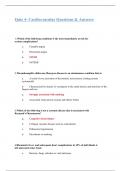
Quiz 4- Cardiovascular Questions & Answers


1. Which of the following conditions is the most immediately at risk for
serious complications?

a. Unstable angina

b. Prinzmetal angina

c. STEMI

d. NSTEMI


2. Thromboangiitis obliterans (Buergers disease) is an autoimmune condition that is:

a. A result of over activation of the intrinsic and extrinsic clotting system
systemically

b. Characterized by attacks of vasospasm in the small arteries and arterioles of the
fingers and toes

c. Strongly associated with smoking

d. Associated with janeway lesions and Oslers Nodes


3. Which of the following is not a systemic disease that is associated with
Raynaud's Phenomenon?

a. Congestive heart failure

b. Collagen vascular diseases such as scleroderma

c. Pulmonary hypertension

d. Myxedema or smoking


4. Rheumatic fever, and subsequent heart complications in 10% of individuals is
left untreated arises from:

a. Bacteria, fungi, rickettes or viral infections

,b. Sterile, autoimmune reaction (no infection involved)

, c. Dyslipidemia

d. Group A beta-hemolytic strep pharyngitis


5. Which of the following is NOT a primary factor in determining preload?

a. Venous return during diastole

b. End systolic volume

c. Total peripheral (systemic) resistance

d. All of the above are primary factors of preload


6. Which of the following statements are incorrect?

a. The mean arterial pressure is the average force of pushing blood through the
systemic circuit.

b. The pulse pressure is the difference between systolic and diastolic pressures

c. A decrease in aortic compliance increases its stiffness and thus can lead to an
increase in pulse pressures

d. Prostacyclins, which are diminished by NSAIDs, are vasoconstrictors.


7. Which of the following is incorrect regarding the isometric contraction phase of
the cardiac cycle?

a. Blood does not flow through the heart at this time.

b. The atria are contracting

c. The valves are closed

d. It occurs during ventricular systole
Escuela, estudio y materia

Grado

Información del documento

Subido en
20 de diciembre de 2023
Número de páginas
20
Escrito en
2023/2024
Tipo
Examen
Contiene
Preguntas y respuestas

Temas

$15.49
Accede al documento completo:

¿Documento equivocado? Cámbialo gratis Dentro de los 14 días posteriores a la compra y antes de descargarlo, puedes elegir otro documento. Puedes gastar el importe de nuevo.
Escrito por estudiantes que aprobaron
Inmediatamente disponible después del pago
Leer en línea o como PDF


Documento también disponible en un lote

Conoce al vendedor

Seller avatar
Los indicadores de reputación están sujetos a la cantidad de artículos vendidos por una tarifa y las reseñas que ha recibido por esos documentos. Hay tres niveles: Bronce, Plata y Oro. Cuanto mayor reputación, más podrás confiar en la calidad del trabajo del vendedor.
Cowell Chamberlain College Of Nursng
Seguir Necesitas iniciar sesión para seguir a otros usuarios o asignaturas
Vendido
513
Miembro desde
6 año
Número de seguidores
483
Documentos
850
Última venta
1 mes hace
EXAMS GURU

SCORE As

4.0

91 reseñas

5
46
4
15
3
18
2
4
1
8

Recientemente visto por ti

Por qué los estudiantes eligen Stuvia

Creado por compañeros estudiantes, verificado por reseñas

Calidad en la que puedes confiar: escrito por estudiantes que aprobaron y evaluado por otros que han usado estos resúmenes.

¿No estás satisfecho? Elige otro documento

¡No te preocupes! Puedes elegir directamente otro documento que se ajuste mejor a lo que buscas.

Paga como quieras, empieza a estudiar al instante

Sin suscripción, sin compromisos. Paga como estés acostumbrado con tarjeta de crédito y descarga tu documento PDF inmediatamente.

Student with book image

“Comprado, descargado y aprobado. Así de fácil puede ser.”

Alisha Student

Preguntas frecuentes