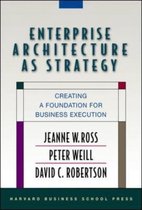
Enterprise Architecture as strategy
Chapter 1
What makes a company more effective: IT systems to digitize and automate their core
processes, make tough decisions around what to execute and not. Relative to their
competitors, these companies have higher profitability, experience a faster time to market,
and get more value from their IT investments. They have better access to shared customer
data, lower risk of mission-critical systems failures, and 80 percent higher senior
management satisfaction with technology. Yet, they have 25 percent lower IT costs.
To focus management attention on higher-order processes, managers need to limit the time
they spend on what should be routine activities. They need to automate routine tasks so
those tasks are performed reliably and predictably without requiring any thought. The best
companies go beyond routine processes and digitize capabilities that distinguish them from
their competitors. A foundation for execution is the IT infrastructure and digitized business
processes automating a company's core capabilities. As with human development, a
company's foundation for execution evolve.
Traditional logic: management defines strategic direction, then the IT unit designs IT-
enabled solutions to support that and finally the IT unit provides architecture and
technology to implement the solutions. Three problems:
1. Strategy is not always clear enough to act upon
2. The company implements the strategy sequential and in pieces
3. IT is always the bottleneck since it’s responding to the previous steps
The foundation for execution results from carefully selecting which processes and IT
systems to standardize and integrate. Companies must master three key disciplines:
1. Operating model the necessary level of business process integration and
standardization for delivering goods and services to customers.
2. Enterprise architecture the organizing logic for business processes and IT
infrastructure, based on operating
model. Long term view
3. IT engagement model the system
of governance mechanisms that
ensure business and IT projects
achieve both local and companywide
objectives.
, Chapter 2
An operating model enables rapid implementation of a range of strategic initiatives. But that
same operating model will fail to support initiatives that are inconsistent with the
assumptions it's built on. Thus, the operating model is a choice about what strategies are
going to be supported. A company without a clear model brings no automated, preexisting,
low-cost capabilities to a new strategic goal. Instead, with each new strategic initiative the
company must begin anew.
Standardization of business processes and related systems means defining exactly how a
process will be executed regardless of who is performing the process or where. It delivers
efficiency and predictability across the company. In exchange, extensive standardization
limits local innovation and sometimes requires new expensive systems.
Integration links the efforts of organizational units through shared data. This sharing of data
can be between processes to enable end-to-end transaction processing, or across processes
to allow the company to present a single face to customers. The benefits of integration
include increased efficiency, coordination, transparency, and agility. The biggest challenge of
integration is usually around data. End-to-end integration requires companies to develop
standard definitions and formats. This can be time-consuming.
Chapter 1
What makes a company more effective: IT systems to digitize and automate their core
processes, make tough decisions around what to execute and not. Relative to their
competitors, these companies have higher profitability, experience a faster time to market,
and get more value from their IT investments. They have better access to shared customer
data, lower risk of mission-critical systems failures, and 80 percent higher senior
management satisfaction with technology. Yet, they have 25 percent lower IT costs.
To focus management attention on higher-order processes, managers need to limit the time
they spend on what should be routine activities. They need to automate routine tasks so
those tasks are performed reliably and predictably without requiring any thought. The best
companies go beyond routine processes and digitize capabilities that distinguish them from
their competitors. A foundation for execution is the IT infrastructure and digitized business
processes automating a company's core capabilities. As with human development, a
company's foundation for execution evolve.
Traditional logic: management defines strategic direction, then the IT unit designs IT-
enabled solutions to support that and finally the IT unit provides architecture and
technology to implement the solutions. Three problems:
1. Strategy is not always clear enough to act upon
2. The company implements the strategy sequential and in pieces
3. IT is always the bottleneck since it’s responding to the previous steps
The foundation for execution results from carefully selecting which processes and IT
systems to standardize and integrate. Companies must master three key disciplines:
1. Operating model the necessary level of business process integration and
standardization for delivering goods and services to customers.
2. Enterprise architecture the organizing logic for business processes and IT
infrastructure, based on operating
model. Long term view
3. IT engagement model the system
of governance mechanisms that
ensure business and IT projects
achieve both local and companywide
objectives.
, Chapter 2
An operating model enables rapid implementation of a range of strategic initiatives. But that
same operating model will fail to support initiatives that are inconsistent with the
assumptions it's built on. Thus, the operating model is a choice about what strategies are
going to be supported. A company without a clear model brings no automated, preexisting,
low-cost capabilities to a new strategic goal. Instead, with each new strategic initiative the
company must begin anew.
Standardization of business processes and related systems means defining exactly how a
process will be executed regardless of who is performing the process or where. It delivers
efficiency and predictability across the company. In exchange, extensive standardization
limits local innovation and sometimes requires new expensive systems.
Integration links the efforts of organizational units through shared data. This sharing of data
can be between processes to enable end-to-end transaction processing, or across processes
to allow the company to present a single face to customers. The benefits of integration
include increased efficiency, coordination, transparency, and agility. The biggest challenge of
integration is usually around data. End-to-end integration requires companies to develop
standard definitions and formats. This can be time-consuming.