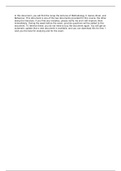
In this document, you will fnd the recap the lectures of Methodology 3: Genes, Brain, and
Behaviour. This document is one of the two documents provided for this course, the other
being the literature. If you fnd any mistakes, please notify me and I will improve them
immediately. During the week before the exam, practise questions will be added to this
document. To retrieve these, you do not need to buy the document again. You will get an
automatic update that a new document is available, and you can download this for free. I
wish you the best for studying and for the exam.
,Content
A. Lecture 1: null hypothesis........................................................................................................................3
B. Lecture 2: Distributonss t-tests and parameters.......................................................................................6
C. Lecture 3: Alpha and Bèta levels...............................................................................................................9
D. Lecture 4: ANOVA I.................................................................................................................................13
E. Lecture 5: ANOVA II................................................................................................................................16
F. Lecture 6: Confdence in correlatons.....................................................................................................19
G. Lecture 7: Regression Analysis with multple variables..........................................................................22
H. Practse eeam.........................................................................................................................................25
I. Answers...................................................................................................................................................29
, A. Lecture 1: null hypothesis
Introduction
Say a researcher wants to look at an active life style and obesity. He can see how many
people with an active life style have obesity (descriptive research), he can see if an active
life style infuences obesity (experimental research) and he can see if there is any kind of
relationship between those two (relational research).
Relational research
In a relational research, the researcher can look at the average minutes someone is active
during a day and his or her weight. His hypothesis will be “There is a relationship between
activity levels and obesity”. These variables can be put into a scatter plot. Every data point
in these plots are two measures of a single person: both the weight and the average minutes
someone is active during the day. A regression line can be used to express the relationship
between the two variables: the higher the weight, the lower the average of minutes someone
is active during the day. This is called a correlation. However, this does not mean that there
is a causal relationship between an active life style and obesity.
Experimental research
The researches hypothesises that activity levels will reduce obesity. This hypothesis specifes
a causal relationship and the only way to test this is to perform an experiment. The
researcher can use diferent techniques:
Manipulating the independent variable;
Measuring the efect on the dependent variable;
Controlling other variables.
An important factor for experimental designs such as those, is the high internal validity. A
high internal validity means that no other variables can infuence the independent variable.
These variables are called confounds. If no confounds can infuence the independent
variable, then the independent variable – in this case, activity levels – must be the variable
that reduces the dependent variable – in this case, obesity.
The independent variable can be divided in diferent levels. So, activity levels will be divided
in less than 30 minutes of activity per day or more than 30 minutes of activity per day.
Next, an operational defnition should be chosen for both the dependent and independent
variable. For the dependent variable, BMI can be used: if someone scores above a BMI of 25,
someone is overweight. For the independent variable, this is somewhat more difcult.
Activity levels can be measured in diferent ways, such as amount of steps someone is taking
per day, minutes of moderately activity, or minutes of high activity. Important factors are a
high representativeness for the construct. Therefore, minutes of moderately activity seems
to be a reasonable operational defnition.
Thirdly, a sample should be drawn from the population of interest and therefore, a
population of interest should be chosen. In this case, this can be Dutch adults with obesity.
Samples can be drawn in diferent ways. A random sample is a random sample taken from
the whole population. A stratifed sample is a random sample taken of a predetermined
group of people. So, a researcher decides to form strata, groups, of people living in big
cities, small cities, the country, etc. Afterwards, he picks random people of these strata. A
last sample is a convenience sample, samples taken from a smaller group that is already
available. If a research like this is performed, there is an interest in a relationship between
variables that will probably be the same for most people. There is no interest in an absolute
population parameter. Therefore, a random sample is not obligatory.
Last, participants should be assigned to a certain experimental condition: one group is going
to move as they did, and another group is encouraged to move more than 30 minutes per
Behaviour. This document is one of the two documents provided for this course, the other
being the literature. If you fnd any mistakes, please notify me and I will improve them
immediately. During the week before the exam, practise questions will be added to this
document. To retrieve these, you do not need to buy the document again. You will get an
automatic update that a new document is available, and you can download this for free. I
wish you the best for studying and for the exam.
,Content
A. Lecture 1: null hypothesis........................................................................................................................3
B. Lecture 2: Distributonss t-tests and parameters.......................................................................................6
C. Lecture 3: Alpha and Bèta levels...............................................................................................................9
D. Lecture 4: ANOVA I.................................................................................................................................13
E. Lecture 5: ANOVA II................................................................................................................................16
F. Lecture 6: Confdence in correlatons.....................................................................................................19
G. Lecture 7: Regression Analysis with multple variables..........................................................................22
H. Practse eeam.........................................................................................................................................25
I. Answers...................................................................................................................................................29
, A. Lecture 1: null hypothesis
Introduction
Say a researcher wants to look at an active life style and obesity. He can see how many
people with an active life style have obesity (descriptive research), he can see if an active
life style infuences obesity (experimental research) and he can see if there is any kind of
relationship between those two (relational research).
Relational research
In a relational research, the researcher can look at the average minutes someone is active
during a day and his or her weight. His hypothesis will be “There is a relationship between
activity levels and obesity”. These variables can be put into a scatter plot. Every data point
in these plots are two measures of a single person: both the weight and the average minutes
someone is active during the day. A regression line can be used to express the relationship
between the two variables: the higher the weight, the lower the average of minutes someone
is active during the day. This is called a correlation. However, this does not mean that there
is a causal relationship between an active life style and obesity.
Experimental research
The researches hypothesises that activity levels will reduce obesity. This hypothesis specifes
a causal relationship and the only way to test this is to perform an experiment. The
researcher can use diferent techniques:
Manipulating the independent variable;
Measuring the efect on the dependent variable;
Controlling other variables.
An important factor for experimental designs such as those, is the high internal validity. A
high internal validity means that no other variables can infuence the independent variable.
These variables are called confounds. If no confounds can infuence the independent
variable, then the independent variable – in this case, activity levels – must be the variable
that reduces the dependent variable – in this case, obesity.
The independent variable can be divided in diferent levels. So, activity levels will be divided
in less than 30 minutes of activity per day or more than 30 minutes of activity per day.
Next, an operational defnition should be chosen for both the dependent and independent
variable. For the dependent variable, BMI can be used: if someone scores above a BMI of 25,
someone is overweight. For the independent variable, this is somewhat more difcult.
Activity levels can be measured in diferent ways, such as amount of steps someone is taking
per day, minutes of moderately activity, or minutes of high activity. Important factors are a
high representativeness for the construct. Therefore, minutes of moderately activity seems
to be a reasonable operational defnition.
Thirdly, a sample should be drawn from the population of interest and therefore, a
population of interest should be chosen. In this case, this can be Dutch adults with obesity.
Samples can be drawn in diferent ways. A random sample is a random sample taken from
the whole population. A stratifed sample is a random sample taken of a predetermined
group of people. So, a researcher decides to form strata, groups, of people living in big
cities, small cities, the country, etc. Afterwards, he picks random people of these strata. A
last sample is a convenience sample, samples taken from a smaller group that is already
available. If a research like this is performed, there is an interest in a relationship between
variables that will probably be the same for most people. There is no interest in an absolute
population parameter. Therefore, a random sample is not obligatory.
Last, participants should be assigned to a certain experimental condition: one group is going
to move as they did, and another group is encouraged to move more than 30 minutes per