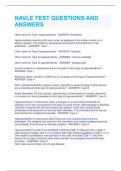
NAVLE TEST QUESTIONS AND ANSWERS
NAVLE TEST QUESTIONS AND ANSWERS Other name for Type I hypersensitivity - ANSWER- Immediate Hypersensitivity reactions that occur when re-exposure of an antigen results in an allergic reaction. The antigen is presented and causes B cell production of IgE antibodies. - ANSWER- Type I Other name for Type II hypersensitivity - ANSWER- Cytotoxic Other name for Type III hypersensitivity - ANSWER- Immune-mediated Other name for Type IV hypersensitivity - ANSWER- Delayed type Vaccine reaction or anaphylaxis are an example of what type of hypersensitivity? - ANSWER- Type I Blood transfusion reaction or IMHA are an example of what type of hypersensitivity? - ANSWER- Type II IMPA, glomerulonephritis, anterior uveitis, vasculitis or systemic lupus erythematosus are an example of what type of hypersensitivity? - ANSWER- Type III Atopic dermatitis, TB test reaction, granulomatous inflammation or contact dermatitis (i.e. poison ivy) are an example of what type of hypersensitivity? - ANSWER- Type IV Hypersensitivity rxn that occurs when an antigen on a cell surface binds with an antibody and is then recognized by the body as being foreign. Macrophages or dendritic cells then recognize the cell and "present the antigen" which then causes B cell proliferation and production of IgG and IgM antibodies. The antibodies bind to the cell and activate the complement cascade - ANSWER- Type II Hypersensitivity rxn that occurs when there are more antigens than there are antibodies. The antigens float around in the circulation and multiple antigens may bind one antibody, thus forming an immune complex. - ANSWER- Type III Hypersensitivity rxn that is cell-mediated. Cytotoxic CD8+ T cells and CD4+ helper T cells recognize antigen that is in a complex with major histocompatibility complex 1 or 2. This results in proliferation and activation of the cells. Activated CD8+ T cells then destroy the antigen containing cells while activated macrophages release hydrolytic enzymes. - ANSWER- Type IV Note: takes several days, why it's aka delayed Concentrated USG for large animals - ANSWER- >1.025 Concentrated USG for dogs - ANSWER- > 1.035 Concentrated USG for cats - ANSWER- > 1.045 Isosthenuria range - ANSWER- 1.008-1.015 Hyposthenuria - ANSWER- <1.008 What are the major causes of diarrhea in Unweaned & Early Post-Weaning Pigs? - ANSWER- *CCC-THRE* 1. Clostridium perfringens types A & C 2. Clostridium dificile 3. Coccidia (Isospora suis most commonly) 4. Transmissible gastroenteritis (TGE) 5. Hypoglycemia 6. Rotavirus 7. E. coli (colibacillosis) Time frame for Clostridium perfringens infection in pigs - ANSWER- Types A & C 1-7 days of age Time frame for Clostridium dificile infection in pigs - ANSWER- 1-2 days of age Time frame for Coccidia infection in pigs - ANSWER- 5-15 days of age Time frame for TGE infection in pigs - ANSWER- All ages within unweaned & early weaning life stages At what age are pigs weaned? - ANSWER- Between 3-4 weeks Time frame for Rotavirus infection in pigs - ANSWER- All ages within unweaned & early weaning life stages Time frame for E. coli infection in pigs - ANSWER- 1-14 days of age & again during the 1st 2 weeks post-weaning (~4-6 wks of age) Pathologic lesions of C. perfringens in piglet - ANSWER- Dark red small intestines with hemorrhage C perfringens types A in piglets has (low/high) morbidity & (low/high) mortality - ANSWER- high, low C perfringens types C in piglets has (low/high) morbidity & (low/high) mortality - ANSWER- high, high T/F: C dificile in piglets have bloody diarrhea - ANSWER- False - pasty yellow to watery diarrhea C dificile in piglets has (low/high) morbidity & (low/high) mortality - ANSWER- variable, low Pathognomonic lesion for E. coli in piglets? - ANSWER- Tail necrosis Which of the major causes of diarrhea in piglets do you see poorly digested feed? - ANSWER- Rotavirus TGE in swine is caused by what organism? - ANSWER- A coronavirus Rotavirus in piglets has (low/high) morbidity & (low/high) mortality - ANSWER- variable, low TGE in piglets has (low/high) morbidity & (low/high) mortality - ANSWER- *Depends If enzootic (endemic) = low, low If epizootic = high, high Which of the major causes of diarrhea in piglets do you see curds of undigested milk? - ANSWER- TGE T/F: Piglet coccidiosis is caused only by Isospora suis - ANSWER- False, most commonly Isospora but also can be Eimeria spp Which of the major causes of piglet diarrhea can you see vomiting? - ANSWER- TGE Major causes of diarrhea in Growing & Finishing pigs - ANSWER- *LB-SAT* 1. Lawsonia intracellularis 2. Brachyspira hyodysenteriae 3. Salmonella 4. Ascaris suum (roundworms) 5. Trichuris (whipworms) What disease is also called proliferative enteritis in pigs? - ANSWER- La
Escuela, estudio y materia
- Institución
- NAVLE TE
- Grado
- NAVLE TE
Información del documento
- Subido en
- 14 de diciembre de 2023
- Número de páginas
- 15
- Escrito en
- 2023/2024
- Tipo
- Examen
- Contiene
- Preguntas y respuestas
Temas
-
navle test questions and answ
-
navle test questions and answers

Documento también disponible en un lote