Discuss research into the effects of anxiety on eyewitness testimony
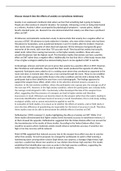
Anxiety is an unpleasant emotional state where we fear that something bad is going to happen.
People are often anxious in stressful situation. For example, witnessing a crime or being interviewed
as a witness. Anxiety is often accompanied by physiological symptoms – sweaty palms, shallow
breath, elevated pulse, etc. Research has also demonstrated that anxiety can often have a profound
effect on EWT.
Christianson and Hubinette conducted a study to demonstrate that anxiety has a negative effect on
accuracy of EWT. 58 witnesses to bank robberies in Sweden, who were either victims who had been
threatened or bystanders, were questioned between 4 and 15 months after the incident. However,
their results were the opposite of what they had expected. All the witnesses had generally good
memories of the event, with more than 75% accurate recall. They found that anxiety had actually
aided recall, rather than causing inaccuracies, as the higher anxiety condition, those who were
actually threatened, had the highest recall. This therefore implies that anxiety can have a positive
effect on EWT rather than a negative effect. Additionally, the fact that this is a field study means that
it has a higher ecological validity thus demonstrating how it can be applied to EWT in real life.
Contrastingly, Johnson and Scott set out to prove that anxiety has a positive effect on EWT. However,
like Christianson and Hubinette, they found that their results produced the opposite of what they
expected. Participants were asked to sit in a waiting room where they overheard an argument in the
room next door. A moment later, they saw a man running through the room. Those in one condition
saw the man with a greasy pen while those in the other condition saw him with a bloody knife. The
participants had to then identify the man from a set of photographs. The findings appeared to
support the weapon focus effect, which refers to the attention directed toward a weapon in a
situation. In the low anxiety condition, where the participants saw a greasy pen, the average recall of
the man was 49%. However, in the high anxiety condition, where the participants saw a bloody knife,
the average recall dropped to 33%. Conclusively, Loftus developed the idea of the weapon focus
effect, suggesting that the presence of a weapon can lead to higher anxiety and therefore
inaccuracies in recall. Witnesses can become drawn to the weapon rather than the culprit, leading to
inaccurate identification and lower levels of accuracy in recall. Nonetheless, this is a lab study, lacking
ecological validity, and so cannot exclusively be applied to real life.
In evaluation of both studies, it is unsure as to whether the effects of anxiety, a lab or field study or
even the time difference of questioning are responsible for the levels of accuracy in recall. Therefore,
these studies may not be able to demonstrate the definite effects of anxiety on EWT.
Deffenbacher (1983) reviewed 21 studies highlighting the effects of anxiety on EWT. While 10 of
these studies demonstrated that higher anxiety levels increased accuracy in eyewitness memory, 11
of them showed the opposite. Deffenbacher suggested that the Yerkes-Dodson effect can account for
the inconsistencies in the results of these studies. According to the Yerkes-Dodson effect, there
would be occasions where moderate anxiety would enhance eyewitness accuracy. If anxiety is too
high or too low, accuracy will be reduced.
Pickel (1998) suggested that reduced accuracy due to the weapon focus effect was due to surprise
rather than anxiety. To test his proposal, he arranged for participants to watch a thief entering a
hairdressing salon carrying either scissors (high threat, low surprise), a handgun (high threat, high
surprise), a wallet (low threat, low surprise) or raw chicken (low threat, high surprise). The results
established that identification was more accurate in the high surprise conditions, supporting the
notion that the weapon focus effect is due to surprise not anxiety.
Anxiety is an unpleasant emotional state where we fear that something bad is going to happen.
People are often anxious in stressful situation. For example, witnessing a crime or being interviewed
as a witness. Anxiety is often accompanied by physiological symptoms – sweaty palms, shallow
breath, elevated pulse, etc. Research has also demonstrated that anxiety can often have a profound
effect on EWT.
Christianson and Hubinette conducted a study to demonstrate that anxiety has a negative effect on
accuracy of EWT. 58 witnesses to bank robberies in Sweden, who were either victims who had been
threatened or bystanders, were questioned between 4 and 15 months after the incident. However,
their results were the opposite of what they had expected. All the witnesses had generally good
memories of the event, with more than 75% accurate recall. They found that anxiety had actually
aided recall, rather than causing inaccuracies, as the higher anxiety condition, those who were
actually threatened, had the highest recall. This therefore implies that anxiety can have a positive
effect on EWT rather than a negative effect. Additionally, the fact that this is a field study means that
it has a higher ecological validity thus demonstrating how it can be applied to EWT in real life.
Contrastingly, Johnson and Scott set out to prove that anxiety has a positive effect on EWT. However,
like Christianson and Hubinette, they found that their results produced the opposite of what they
expected. Participants were asked to sit in a waiting room where they overheard an argument in the
room next door. A moment later, they saw a man running through the room. Those in one condition
saw the man with a greasy pen while those in the other condition saw him with a bloody knife. The
participants had to then identify the man from a set of photographs. The findings appeared to
support the weapon focus effect, which refers to the attention directed toward a weapon in a
situation. In the low anxiety condition, where the participants saw a greasy pen, the average recall of
the man was 49%. However, in the high anxiety condition, where the participants saw a bloody knife,
the average recall dropped to 33%. Conclusively, Loftus developed the idea of the weapon focus
effect, suggesting that the presence of a weapon can lead to higher anxiety and therefore
inaccuracies in recall. Witnesses can become drawn to the weapon rather than the culprit, leading to
inaccurate identification and lower levels of accuracy in recall. Nonetheless, this is a lab study, lacking
ecological validity, and so cannot exclusively be applied to real life.
In evaluation of both studies, it is unsure as to whether the effects of anxiety, a lab or field study or
even the time difference of questioning are responsible for the levels of accuracy in recall. Therefore,
these studies may not be able to demonstrate the definite effects of anxiety on EWT.
Deffenbacher (1983) reviewed 21 studies highlighting the effects of anxiety on EWT. While 10 of
these studies demonstrated that higher anxiety levels increased accuracy in eyewitness memory, 11
of them showed the opposite. Deffenbacher suggested that the Yerkes-Dodson effect can account for
the inconsistencies in the results of these studies. According to the Yerkes-Dodson effect, there
would be occasions where moderate anxiety would enhance eyewitness accuracy. If anxiety is too
high or too low, accuracy will be reduced.
Pickel (1998) suggested that reduced accuracy due to the weapon focus effect was due to surprise
rather than anxiety. To test his proposal, he arranged for participants to watch a thief entering a
hairdressing salon carrying either scissors (high threat, low surprise), a handgun (high threat, high
surprise), a wallet (low threat, low surprise) or raw chicken (low threat, high surprise). The results
established that identification was more accurate in the high surprise conditions, supporting the
notion that the weapon focus effect is due to surprise not anxiety.