Child Obesity Exam 2 Questions With Correct Answers.
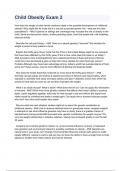
Child Obesity Exam 2 How does the weight of other family members relate to the possible development of childhood obesity? Why might this be (note that it is not just a possible genetic link - what are the other possibilities?) - ANS If parents or siblings are overweight may increase the risk of obesity in the child; Same socioeconomic status, similar parenting styles, food that people eat, role modeling, physical activity Describe the set-point theory - ANS There is a natural (genetic) "set-point" that dictates the weight a person's body prefers to be at Explain the thrifty gene theory (note that the Pima in the United States might be one example that have been affected by this thrifty gene) If this is true, what does this mean to us today? - ANS Ancestors were hunter/gatherers who experienced times of feast and times of famine, could they have developed a gene to help them store calories for when food was scarce? Problem-Although may have been advantage at time, today's world has overabundance of food, some don't have access, may be more effective at gaining and keeping weight How does the Israeli Sand Rat model tell us more about the thrifty gene theory? - ANS Normally rat eats plants and insects & experiences times of famines and stays healthy, when exposed to unlimited food easily develops obesity and type II diabetes; shows how when has access to food eats as much as can and then maintains the weight What is an ob/ob mouse? What is leptin? What does this tell us? Can we apply this information to humans - ANS Ob/ob mice have genetic mutation that affects their body's ability to produce leptin; Leptin regulates appetite, tells body it's had enough to eat and without this signal food intake would be unlimited and leads to weight gain; Can apply this to humans because people who don't have this could explain why obese Discuss what twin and adoption studies might tell us about the genetic contribution to childhood obesity - ANS Like to observe identical twins b/c genetically same, compare weights in attempts to see what influence genetics may have on body, there is a greater chance of identical twins having similar BMI and waist size, genetic contribution for weight may be 77%, very low weight relationship in adoptive relatives, obesity has increased greatly in just the last 30 years
Escuela, estudio y materia
- Institución
- Pediatric Obesity Pathology
- Grado
- Pediatric Obesity Pathology
Información del documento
- Subido en
- 12 de diciembre de 2023
- Número de páginas
- 6
- Escrito en
- 2023/2024
- Tipo
- Examen
- Contiene
- Preguntas y respuestas
Temas
-
child obesity exam 2

Documento también disponible en un lote