RNSG 1216 Final Review Exam Questions With Correct Answers
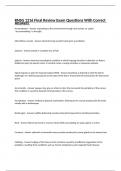
Accomodation - Answer responding to the environment through new activity. ex- pupils "accommodating" to the light. Adventitious sounds - Answer abnormal lung sounds heard upon auscultation. alopecia - Answer partial or complete loss of hair aphasia - Answer abnormal neurological condition in which language function is defective or absent. Related to injury to speech center in cerebral cortex, causing receptive or expressive aphasia. Apical impulse or point of maximal impulse (PMI) - Answer heartbeat as listened to with the bell or diaphragm of a stethoscope placed on the apex of the heart. Around the left miclavicular 5th intercostal space. Arcus Senilis - Answer opaque ring, gray or white in color, that surrounds the periphery of the cornea. The condition is caused by deposits of fat granules in the cornea. Auscultation - Answer method of physical examination; listening to the sounds produced by the body, usually with a stethoscope. Borborygmi - Answer audible abdominal sounds produced by hyperactive intestinal peristalsis. Bruit - Answer Abnormal sound or murmur heard while auscultating an organ, gland, or artery. Cerumen - Answer yellowish or brownish waxy secretion produced by sweat glands in the external ear. Clubbing - Answer bulging of the tissues at the nail base caused by insufficient oxygenation at the periphery, resulting from conditions such as chronic emphysema and congenital heart disease. conjunctivitis - Answer highly contagious eye infection. The crusty drainage that collects on eyelid margins can easily spread from one eye to another. Cyanosis - Answer bluish discoloration of the skin and mucous membranes caused by an excess of deoxygenated hemoglobin in the blood or a structural defect in the hemoglobin molecule. Distention - Answer enlarged or swollen from internal pressure Dysrhythmia - Answer deviation from the normal pattern of the heartbeat Edema - Answer abnormal accumulation of fluid in interstitial spaces of tissues Entropion - Answer condition in which the eyelid turns inward to the eye. Erythema - Answer redness or inflammation of the skin or mucous membranes that is a result of dilation and congestion of superficial capillaries; ex sunburn. excroiation - Answer injury to the surface of the skin caused by abrasion goniometer - Answer instrument for precise measurement of angles hypertonicity - Answer excessive tension of the arterial walls or muscles hypotonicity - Answer reduced tension of the arterial walls or muscles indurated - Answer hardening of a tissue, particularly the skin, because of edema or inflammation inspection - Answer method of physical examination by which the patient is visually systematically examined for appearance, structure, function and behavior. integumentary system - Answer the skin and its appendages acting to protect the body from various kinds of damage. Includes hair, skin, nails, and sudoriferous glands, sebaceous glands, and ceruminous glands. Jaundice - Answer yellow discoloration of the skin, mucous membranes, and sclera caused by greater than normal amounts of bilirubin in the blood Kyphosis - Answer exaggeration of the posterior curvature of the thoracic spine. lordosis - Answer increased lumbar curvature malignancy - Answer cancerous, abnormal cells divide without control and can invade nearby tissues and can spread throughout the body. Murmurs - Answer blowing or whooshing sounds created by changes in blood flow through the heart or abnormalities in valve closure Nystagmus - Answer involuntary, rhythmical oscillation of the eyes, occurs as a result of local injury to eye muscles and supporting structures or a disorder of the cranial nerves inverting the muscles. olfaction - Answer sense of smell orthopnea - Answer abnormal condition in which a person must sit or stand to breath comfortably osteoporosis - Answer disorder characterized by abnormal rarefaction of bone, occurring most frequently in postmenopausal women, sedentary or immobilized individuals, or patients on long term steroid therapy Ototoxicity - Answer having harmful effect on the eighth cranial nerve (acoustic) or the organs of hearing or balance. Palpation - Answer the fingers and hands of the examiner are applied to the patient's body to feel body parts underlying the skin. Percussion - Answer The location, size and density of a body part is determined by the tone obtained from the striking of short, sharp taps of the finger Peristalsis - Answer Rhythmical contractions of the intestine that propel gastric contents through the length of the gastrointestinal tract. PERRLA - Answer acronym for "pupils are equal, round and reactive to light and accommodation". the acronym is recorded in the physical exam if the eye and pupil assessment is normal Petechiae - Answer tiny purple or red spots that appear on skin as minute hemorrhages within dermal layers
Escuela, estudio y materia
- Institución
- RNSG 1216
- Grado
- RNSG 1216
Información del documento
- Subido en
- 11 de diciembre de 2023
- Número de páginas
- 12
- Escrito en
- 2023/2024
- Tipo
- Examen
- Contiene
- Preguntas y respuestas
Temas
-
rnsg 1216 final review exam
-
rnsg 1216 final review exam questions with correct
-
accomodation responding to the environment through
-
adventitious sounds abnormal lung sounds heard upo

Documento también disponible en un lote