ANCC FNP Board Questions And Answers
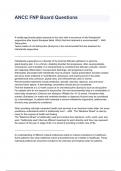
ANCC FNP Board Questions And Answers A middle-age female patient presents to the clinic with a recurrence of mild hidradenitis suppurativa after topical therapies failed. Which first-line treatment is recommended? - ANS Tetracycline Twelve weeks of oral tetracycline (Sumycin) is the recommended first-line treatment for hidradenitis suppurativa. __________________________________________________ Hidradenitis suppurativa is a disorder of the terminal follicular epithelium in apocrine gland-bearing skin. It is a chronic, disabling disorder that progresses, often causing keloids, contractures, and immobility. It is characterized by comedone-like follicular occlusion, chronic and relapsing inflammation, mucopurulent discharge, and progressive scarring. Arthropathy associated with hidradenitis may be present. Typical presentation includes nodules and sinus tracts (inflamed or noninflamed), abscesses, and scarring found in the axilla, genitofemoral area, perineum, gluteal area, and inframammary area in women. Recommended treatments include antibiotics, steroids, retinoids, dapsone, and anti-tumor necrosis factor agents. A dermatology consultation should also be considered. First-line treatment is a 12‑week course of an oral tetracycline (Sumycin) such as doxycycline. For patients who do not respond to doxycycline, the next recommended step is a combination of twice-daily clindamycin (Cleocin) and rifampicin (Rifadin) for 10-12 weeks. If treatment fails, acitretin (Soriatane, for males and nonfertile females) or dapsone (Aczone) may be considered by a dermatologist. In patients with moderate to severe hidradenitis suppurativa, adalimumab (Humira) may possibly be considered. When providing culturally competent health care services to an American Indian elder, the nurse practitioner understands which is traditionally true? - ANS The "Medicine Wheel" is used by many for the purpose of health and healing The "Medicine Wheel" is traditionally used and contains four directions; north, south, east, and west. Traditionally each tribe has different meanings for each direction and they may represent the season of the year or stage of life. It is aimed at providing a holistic view of life. ________________________________________ An understanding of different cultural preferences leads to cultural competence in healthcare. Some patients may value traditional culture and preferences as it relates to healthcare. These individual preferences should be included in the interview and treatment plan for patients. Traditionally, the American Indian culture values a holistic approach to health care integrating the person, lifestyle, environment, family, and religion. Patients adhering to these traditional cultural practices often feel that illness is due to a lack of harmony with the physical body, mind, spirit, and emotions. Patients may seek care from western medicine for specific ailments while also consulting with traditional healers for spiritual guidance. Healthcare providers should seek to understand relevant cultural factors and assess each individual's healthcare literacy in order to provide culturally competent care. The nurse practitioner sees an older adult patient in the clinic with the primary report of hearing loss and a sensation of fullness in the right ear. The nurse practitioner suspects conductive hearing loss. Which could contribute to this? - ANS Cerumen, commonly called earwax, is a combination of secretions and sloughed epithelial cells that protects the ears from infection, water, and insects. It is normally expelled from the ear canal through natural jaw movement. When this self-cleaning process fails, cerumen can become impacted. Cerumen impaction occludes the ear canal and can press against the tympanic membrane, resulting in conductive hearing loss. _________________________________________ Conductive hearing is the transition of sound from the external and middle ear to the inner ear. Conductive hearing loss is caused by pro
Escuela, estudio y materia
- Institución
- Chamberlain College Of Nursing
- Grado
- ANCC FNP
Información del documento
- Subido en
- 11 de diciembre de 2023
- Número de páginas
- 16
- Escrito en
- 2023/2024
- Tipo
- Examen
- Contiene
- Preguntas y respuestas
Temas
-
ancc fnp board questions

Documento también disponible en un lote