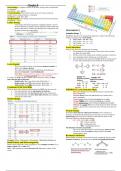
Chapter 8
Ionic Bonding: A complete transfer of electrons, usually when a metal bonds
to a nonmetal.
EXAMPLES - CaF2, MgSO4
Covalent Bonding: When electron pairs are shared within a molecule,
usually when a nonmetal bonds to a nonmetal.
EXAMPLES - Cl2O, NCl3, H2O
Metallic Bonding: The sharing of delocalized electrons by fixed metal nuclei.
EXAMPLES - Ag, Cu
Lattice Energy
- Is the energy (in kJ/mol) required to completely separate 1 mol of
an ionic solid into its gaseous ions (by separation of the cations and
anions in the lattice). It affects the melting point, boiling point, and
the heats of fusion and vaporization.
- XY (s) › X+ (g) + Y- (g) (EXAMPLE: NaCl (s) › Na+ (g) + Cl- (g))
= ∆𝑯𝒍𝒂𝒕𝒕𝒊𝒄𝒆 = +788 kJ/mol
EXAMPLE: Based on electronegativity differences, which of the following
would you predict to have ionic bonds?
A. NaCl (∆EN = 3.0 - 0.9 = 2.1)
B. SnCl4 (∆EN = 3.0 - 1.8 = 1.2)
C. AlCl3 (∆EN = 3.0 - 1.5 = 1.5)
D. All of the above
Lewis Structures
Steps to draw the Lewis Structure for an element.
1. Set up skeleton with single bonds (Central atom is the atom that
can make the most bonds).
2. Fill the octets of the outside atoms with the lone pairs of electrons.
3. Any remaining valence electrons go on central atom.
4. Once all electrons are used, form multiple bonds to central atom if
it is not “full” (meaning it has not reached its 8-electron limit).
Lewis Symbol
- The Lewis symbol consists of the element chemical symbol & a
dot for each valence electron.
- The valence electrons that do not participate in bonding (not
shared) are lone pairs or non-bonding pairs.
- Octet Rule: Atoms tend to lose, gain, or share electrons in order to
surrounded by 8 valence electrons (full s and p subshells).
To achieve an octet with the available valence electrons, atoms can share
more than one pair of electrons.
- Single bonds: Share one electron pair. Bond order = 1
- Double bonds: Share two electron pairs. Bond order = 2
- Triple bonds: Share three electron pairs. Bond order = 3
Exceptions to the Octet Rule
There are three times when ions and molecules do NOT obey the octet rule: IMPORANT Lewis Structure Hints
1. Ions and molecules with an odd number of electrons. - Hydrogen always forms only one bond (never central) and is
2. Ions and molecules with less than an octet on the central atom. always peripheral.
3. Ions and molecules with more than eight electrons (an expanded - Fluorine always forms only one bond (never central) and is
octet) on the central atom. always peripheral.
Bond Enthalpy - Oxygen usually forms 2 bonds and always has an octet.
- Nitrogen usually forms 3 bonds and always has an octet.
- Carbon almost always forms 4 bonds and always has an octet.
- Halogens are usually outer (not central) atoms and form one bond
(when Cl, Br, and I are central atom, they will form more than one
bond).
Formal Charge
Sometimes more than one valid Lewis structure can be written for a
molecule. To determine the dominant Lewis structure, you need to find the
formal charge. Draw the Lewis structure of the molecule, then use the
following formula to find the formal charge:
- FC = #VE - [1/2 (#BE) + #NBE]
o VE = valence electrons
o BE = bonding electrons
o NBE = nonbonding electrons
The dominant structure is generally:
- The one in which the atoms have formal charges closest to zero.
- The one in which the negative charge resides on the most
electronegative atom.
Resonance Structures
When multiple structures can be used to describe a molecule, they are called
resonance structures. Resonance forms are not real bonding depictions.
Formula: Δ𝐻rxn = [D(reactant) + D(reactant)] - [D(product)+D(product)]
Bond Polarity and Electronegativity
Bonds can be found with a range of polarities, from nonpolar covalent (F2) to
polar covalent (HF) to ionic (LiF).
ΔEN: < 0.5 (nonpolar covalent) between 0.5 & 1.6 (polar covalent) > 2.0
(ionic)
Ionic Bonding: A complete transfer of electrons, usually when a metal bonds
to a nonmetal.
EXAMPLES - CaF2, MgSO4
Covalent Bonding: When electron pairs are shared within a molecule,
usually when a nonmetal bonds to a nonmetal.
EXAMPLES - Cl2O, NCl3, H2O
Metallic Bonding: The sharing of delocalized electrons by fixed metal nuclei.
EXAMPLES - Ag, Cu
Lattice Energy
- Is the energy (in kJ/mol) required to completely separate 1 mol of
an ionic solid into its gaseous ions (by separation of the cations and
anions in the lattice). It affects the melting point, boiling point, and
the heats of fusion and vaporization.
- XY (s) › X+ (g) + Y- (g) (EXAMPLE: NaCl (s) › Na+ (g) + Cl- (g))
= ∆𝑯𝒍𝒂𝒕𝒕𝒊𝒄𝒆 = +788 kJ/mol
EXAMPLE: Based on electronegativity differences, which of the following
would you predict to have ionic bonds?
A. NaCl (∆EN = 3.0 - 0.9 = 2.1)
B. SnCl4 (∆EN = 3.0 - 1.8 = 1.2)
C. AlCl3 (∆EN = 3.0 - 1.5 = 1.5)
D. All of the above
Lewis Structures
Steps to draw the Lewis Structure for an element.
1. Set up skeleton with single bonds (Central atom is the atom that
can make the most bonds).
2. Fill the octets of the outside atoms with the lone pairs of electrons.
3. Any remaining valence electrons go on central atom.
4. Once all electrons are used, form multiple bonds to central atom if
it is not “full” (meaning it has not reached its 8-electron limit).
Lewis Symbol
- The Lewis symbol consists of the element chemical symbol & a
dot for each valence electron.
- The valence electrons that do not participate in bonding (not
shared) are lone pairs or non-bonding pairs.
- Octet Rule: Atoms tend to lose, gain, or share electrons in order to
surrounded by 8 valence electrons (full s and p subshells).
To achieve an octet with the available valence electrons, atoms can share
more than one pair of electrons.
- Single bonds: Share one electron pair. Bond order = 1
- Double bonds: Share two electron pairs. Bond order = 2
- Triple bonds: Share three electron pairs. Bond order = 3
Exceptions to the Octet Rule
There are three times when ions and molecules do NOT obey the octet rule: IMPORANT Lewis Structure Hints
1. Ions and molecules with an odd number of electrons. - Hydrogen always forms only one bond (never central) and is
2. Ions and molecules with less than an octet on the central atom. always peripheral.
3. Ions and molecules with more than eight electrons (an expanded - Fluorine always forms only one bond (never central) and is
octet) on the central atom. always peripheral.
Bond Enthalpy - Oxygen usually forms 2 bonds and always has an octet.
- Nitrogen usually forms 3 bonds and always has an octet.
- Carbon almost always forms 4 bonds and always has an octet.
- Halogens are usually outer (not central) atoms and form one bond
(when Cl, Br, and I are central atom, they will form more than one
bond).
Formal Charge
Sometimes more than one valid Lewis structure can be written for a
molecule. To determine the dominant Lewis structure, you need to find the
formal charge. Draw the Lewis structure of the molecule, then use the
following formula to find the formal charge:
- FC = #VE - [1/2 (#BE) + #NBE]
o VE = valence electrons
o BE = bonding electrons
o NBE = nonbonding electrons
The dominant structure is generally:
- The one in which the atoms have formal charges closest to zero.
- The one in which the negative charge resides on the most
electronegative atom.
Resonance Structures
When multiple structures can be used to describe a molecule, they are called
resonance structures. Resonance forms are not real bonding depictions.
Formula: Δ𝐻rxn = [D(reactant) + D(reactant)] - [D(product)+D(product)]
Bond Polarity and Electronegativity
Bonds can be found with a range of polarities, from nonpolar covalent (F2) to
polar covalent (HF) to ionic (LiF).
ΔEN: < 0.5 (nonpolar covalent) between 0.5 & 1.6 (polar covalent) > 2.0
(ionic)