2. Methods in Developmental Biology
Prof. Dr. Callaerts
We start with a single fertilized egg that through consecutive developmental stages gives rise to a
free living individual. Then we look at a number at methods how to look at these embryos. To go on
how we can manipulate these embryos in terms of manual manipulation. We then look at transcripts
and proteins as major factors to determination of cell fate. We also look at gene and gene networks
that allow us to study gene regulation. First we have to look at how genes function through various
possible experiments LOF, GOF, transgenesis and genome function.
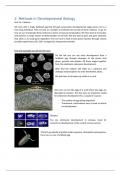
First of 8 examples we will see this class
On the left you can see early development from a
fertilized egg through cleavages to the prawn chip
phase, gastrula and planula. All those stages together
from the planktonic embryonic development.
After that the embryo will settle on a substrate and
undergo metamorphosis to enter the Benthic phase.
We look here at Acropora sp. which is a coral.
Here you can see the eggs of a snail where the eggs are
deposited in clusters. This has been an important model
for embryonic development for a couple of reasons:
- The number of eggs being deposited
- Translucent: observations easy to look at effects
on development
Octopus.
You see embryonic development in octopus. Used for
research on development of the central nervous system.
The first genetically tractable model organism, drosophila melanogaster.
Here you can see a fertilized egg.
, C. Elegans (nematode)
Completely transparent important for studying cell number and
programmed cell death.
Developing chicken.
Accessibility very easy to study variety of things on developing embryo.
Xenopus laevis.
A large number of eggs being deposited. Easy to do manipulations on these eggs.
Important for research about dolly the sheep and induced pluripotent stem cells.
Developing mouse.
Important question what do all these examples have in common? All of them start from a simple
fertilized egg which then through cell divisions, organization of germ layers, movement of germ
layers eventually gives rise to a ordered multi cellular body.
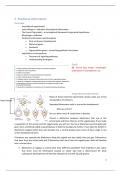
How to organize the development from a “simple” fertilized egg into an
exquisitely ordered multicellular body?
- Observe & describe developmental stages
o Careful observation extremely important!
- What are the mechanisms that govern development?
, Goals of methods in Developmental Biology
- To know and understand different approaches to look at embryos
- To know and understand different approaches to manipulate embryos
- To know approaches to study gene expression and protein localization
- To know and understand different methods to study gene regulation
- To be able to identify and apply methods to study gene regulation
- To know and understand different methods to study gene function
- To be able to identify and apply methods to study gene function
- To have insight into how comparative and evolutionary approaches can give insight in
developmental processes
Don’t need to know all the fine details of the different methods, for that you had the course
methods. Important to know for this stage of the development I can use this kind of microscopy and
so on!
Looking at embryos
Various ways to look at embryos at different levels of resolution.
Looking at embryos: at different levels
- Histology: in early days. Lots of documents in archives. And also dissections of embryos
which might not be available today.
- Reconstruction from archive data to form a reconstruction of an embryo
- Microscopy: fixed material observing at one given point in time
- dissection microscope: allows to do easy manipulations of developing embryos
lowest resolution
- light/epifluorescence microscope: in situ hybridization, localization of protein.
- confocal laser microscopy (possible to analyze any type of embryo): much better
resolution!
- Live imaging: light sheet microscopy – live 3D, adaptive light sheet microscopy – live 4D
- Value of live imaging: real time & see things you otherwise wouldn’t see, such as
subtle changes you wouldn’t get to see starting from fixed material. Alternatively
there are also structures sensitive to fixation they are no longer visual after
fixation!
- Development in progress!
- Live 4D (4 dimensions, also time!) look in even more detail in how for example
morphogenic movements are taking place.
Prof. Dr. Callaerts
We start with a single fertilized egg that through consecutive developmental stages gives rise to a
free living individual. Then we look at a number at methods how to look at these embryos. To go on
how we can manipulate these embryos in terms of manual manipulation. We then look at transcripts
and proteins as major factors to determination of cell fate. We also look at gene and gene networks
that allow us to study gene regulation. First we have to look at how genes function through various
possible experiments LOF, GOF, transgenesis and genome function.
First of 8 examples we will see this class
On the left you can see early development from a
fertilized egg through cleavages to the prawn chip
phase, gastrula and planula. All those stages together
from the planktonic embryonic development.
After that the embryo will settle on a substrate and
undergo metamorphosis to enter the Benthic phase.
We look here at Acropora sp. which is a coral.
Here you can see the eggs of a snail where the eggs are
deposited in clusters. This has been an important model
for embryonic development for a couple of reasons:
- The number of eggs being deposited
- Translucent: observations easy to look at effects
on development
Octopus.
You see embryonic development in octopus. Used for
research on development of the central nervous system.
The first genetically tractable model organism, drosophila melanogaster.
Here you can see a fertilized egg.
, C. Elegans (nematode)
Completely transparent important for studying cell number and
programmed cell death.
Developing chicken.
Accessibility very easy to study variety of things on developing embryo.
Xenopus laevis.
A large number of eggs being deposited. Easy to do manipulations on these eggs.
Important for research about dolly the sheep and induced pluripotent stem cells.
Developing mouse.
Important question what do all these examples have in common? All of them start from a simple
fertilized egg which then through cell divisions, organization of germ layers, movement of germ
layers eventually gives rise to a ordered multi cellular body.
How to organize the development from a “simple” fertilized egg into an
exquisitely ordered multicellular body?
- Observe & describe developmental stages
o Careful observation extremely important!
- What are the mechanisms that govern development?
, Goals of methods in Developmental Biology
- To know and understand different approaches to look at embryos
- To know and understand different approaches to manipulate embryos
- To know approaches to study gene expression and protein localization
- To know and understand different methods to study gene regulation
- To be able to identify and apply methods to study gene regulation
- To know and understand different methods to study gene function
- To be able to identify and apply methods to study gene function
- To have insight into how comparative and evolutionary approaches can give insight in
developmental processes
Don’t need to know all the fine details of the different methods, for that you had the course
methods. Important to know for this stage of the development I can use this kind of microscopy and
so on!
Looking at embryos
Various ways to look at embryos at different levels of resolution.
Looking at embryos: at different levels
- Histology: in early days. Lots of documents in archives. And also dissections of embryos
which might not be available today.
- Reconstruction from archive data to form a reconstruction of an embryo
- Microscopy: fixed material observing at one given point in time
- dissection microscope: allows to do easy manipulations of developing embryos
lowest resolution
- light/epifluorescence microscope: in situ hybridization, localization of protein.
- confocal laser microscopy (possible to analyze any type of embryo): much better
resolution!
- Live imaging: light sheet microscopy – live 3D, adaptive light sheet microscopy – live 4D
- Value of live imaging: real time & see things you otherwise wouldn’t see, such as
subtle changes you wouldn’t get to see starting from fixed material. Alternatively
there are also structures sensitive to fixation they are no longer visual after
fixation!
- Development in progress!
- Live 4D (4 dimensions, also time!) look in even more detail in how for example
morphogenic movements are taking place.