CPCE Career Development 100%ACCURATE GRADE A+ GUARANTEED
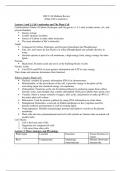
5 influential career theories of today 1) Donald Super 2) John Holland 3) Linda Gottfredson 4) John Krumboltz 5) Mark Savickas Actuarial theory Structure of individual - needs, traits, interests - examples: trait-factor and needs based Developmental career theory career development as occurring over time, usually through stages - example: self-concept and need Donald Super Developmental approach to career - labeled himself as differential developmental social phenomenological psychologist - Developmental approach to careers Donald Super - characterized as life span, life space Early Super 1940s - 1960s - included vocational development stages and vocational development tasks Vocational development stages a. growth (birth to 14-15) b. exploratory (15-24) c. establishment (25-44) d. maintenance (45-64) e. decline (65+) later changed to decline to disengagement Vocational development tasks a. crystallization (ages 14-18) b. specification (18-21) c. Implementation (21-24) d. stabilization (24-35 e. consolidation (35+) Career maturity later renamed it career adaptability Later Super - 1970s Super viewed career development as more holistic 9 major roles we play in life child, student, citizen, spouse, homemaker, parent, worker, leisurite and pensioner 4 theaters where roles are played out home, community, school, and workplace Archway Model Super developed - many determinants that comprise one's self-concept Pillars of Archway model 1) one pillar represents factors and variables within the individual that influence career development such as needs, aptitudes, interests and achievements 2) Other pillar includes external factors such as family, community, and labor market. Top of each arch between 2 pillars is the self of the individual Career Pattern Study Super is responsible - examined vocational behavior of 9th graders all the way into their 30s. John Holland acturial or structural in approach (RIASEC) R - Realistic I - Investigative A - Artistic S - Social E - Enterprising C - Conventional Every person ha all six types in varying amounts Vocational Preference Inventory & Self-Directed Search John Holland RIASEC Theory John Holland - hexagon to explain Linda Gottfredson 1980s - Circumscription (narrow down selection) and Compromise (opt out of unavailable or inappropriate occupations) 4 stages - individual development 1) Orientation to size and power (3-5) 2) Orientation to sex roles (6-8) 3) Orientation to social valuation (9-13) 4) Orientation to internal unique self (14+) John Krumboltz LTCC - Learning theory of career Counseling - he used Bandura's social learning theory to identify the principal concepts. Zone of acceptable alternatives occupations within range are consistent with the individuals self concept LTCC - Career Development and decision making involve 1) Genetic endowments and special abilities 2) environmental conditions and events 3) Instrumental and associative learning experience 4) Task approach skills The Career Beliefs Inventory Krumboltz - used to identify clients' mental barriers. Unplanned Happenstance Krumboltz - Unplanned and chance events that might influence individuals' career development Ginzberg, ginsburg, Axelrad, and Herma 1951 - believed occupational choice progresed through 3 periods 1) fantasy (birth-11) 2) tentative (11-17) 3) realistic (17+) Ann roe Needs Approach - believed genetic factors, environmental experiences and parent-child relations influenced the needs structure each child developed Needs roe believed that careers were chosen to meet _____. Roe Field-by-level classification of occupations (6 levels and 8 fields) Reardon, Lenz, Sampson & Peterson Cognitive information processing (CIP) Social Cognitive Theory Bandura Constructivism & contextualism Constructivist approach - suggests that individuals construct their own reality or truth Contextualism - implies that career development is a constant interplay Goal for career counselor encourage client to make meaning of his or her situation. Mark Savickas Postmodern career counseling approach based on career construction theory H.B. Gelatt focuses on decision making process (5 steps) 1) recognize need to make a decision 2) Collect data and look at courses of action 3) Besides looking at courses of action, examine potential outcomes CONTINUED.....
Escuela, estudio y materia
- Institución
- CPCE Career Development
- Grado
- CPCE Career Development
Información del documento
- Subido en
- 4 de diciembre de 2023
- Número de páginas
- 7
- Escrito en
- 2023/2024
- Tipo
- Examen
- Contiene
- Preguntas y respuestas
Temas
-
actuarial theory
-
early super
-
5 influential career theories of today
-
developmental career theory