CETA REAL FINAL Exam QUESTIONS & ANSWERS UPDATED
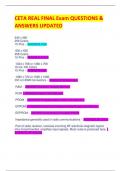
CETA REAL FINAL Exam QUESTIONS & ANSWERS UPDATED 640 x 480 256 Colors 15 Pins - ANSWER VGA 800 x 600 256 Colors 15 Pins - ANSWER SVGA 1024 x 768 or 1366 x 768 16 mil, HD Colors 15 Pins - ANSWER XGA 1280 x 720 or 1920 x 1080 DVI or HDMI Connectors - ANSWER Widescreen RAM - ANSWER Random Access Memory ROM - ANSWER Read Only Memory PROM - ANSWER Programmable Read Only Memory EPROM - ANSWER Electrical Programmable Read Only Memory EEPROM - ANSWER Electrically Erasable PROM Impedance generally used in radio communications - ANSWER 50 Ohms Part of radio receiver, receives incoming RF electrical-magnetic signal. Very broad banded, amplifies input signals. Most noise is produced here. - ANSWER RF Section Part of radio receiver, heterodynes received signal with signal produced by local oscillator circuit. Output contains the sum and difference frequencies. - ANSWER Mixer Part of radio receiver, uses a set frequency throughout. Amplifies desired tuned frequency. - ANSWER IF Section Commonly used FM Radio Frequency - ANSWER 10.7 MHz Commonly used Television Frequency - ANSWER 44 MHz Commonly used Short Wave Radio Frequencies - ANSWER 1.6, 3.35, 9, and 40 MHz Part of radio receiver, made of a diode; rectifies incoming RF signal. - ANSWER Detector Circuit Part of radio receiver, samples the signal at the detector and develops a control voltage that is fed back to the first IF Amp. Ideally, amplifies weak incoming signals and attenuates strong ones, allowing a constant, desirable output volume. - ANSWER AGC/AVC Section Part of radio receiver, audio amplification network that drives speakers. The load must match the radio's circuitry with proper impedance matching. - ANSWER AF Section Used as reference and as a comparison in measuring "gain" of another antenna. - ANSWER Dipole "Beam" antenna that focuses all of its energy in a narrow beamwidth. The more director elements present, the higher the gain rating and narrower beam width. - ANSWER Yagi Approximately 30-50 miles above the earth, most prevalent during daylight hours. Absorbs radio signals under 10 MHz. - ANSWER D Layer Approximately 60-90 miles above the earth, picks and chooses both High Frequency and Very High Frequency signals to reflect back to earth based on frequency used and time of day. - ANSWER E Layer Approximately 250 miles and above the earth, reflects most High Frequency signals back to the earth. - ANSWER F Layer 30-300 Hertz - ANSWER Extremely Low Frequency 300 Hertz-3 Kilohertz - ANSWER Super Low Frequency 3 Kilohertz-30 Kilohertz - ANSWER Very Low Frequency 30 Kilohertz-300 Kilohertz - ANSWER Low Frequency 300 Kilohertz-3 Megahertz - ANSWER Medium Frequency 3 Megahertz-30 Megahertz - ANSWER High Frequency 30 Megahertz-300 Megahertz - ANSWER Very High Frequency 300 Megahertz-3 Gigahertz - ANSWER Ultra High Frequency 3 Gigahertz-30 Gigahertz - ANSWER Super High Frequency 30 Gigahertz-300 Gigahertz - ANSWER Extremely High Frequency Frequencies below ____ can be propagated via surface waves over grea
Escuela, estudio y materia
- Institución
- CETA REAL FI
- Grado
- CETA REAL FI
Información del documento
- Subido en
- 4 de diciembre de 2023
- Número de páginas
- 9
- Escrito en
- 2023/2024
- Tipo
- Examen
- Contiene
- Preguntas y respuestas
Temas
-
ceta real final exam questions answers u
-
ceta real final exam questions answers updated

Documento también disponible en un lote