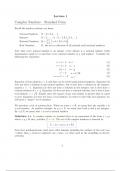
Lecture 1
Complex Numbers – Standard Form
Recall the number systems you know:
Natural Numbers: N = {1, 2, 3, . . .}
Integers: Z = {.
n .a. , 3, 2, 1, 0, 1,o2, 3, . . .}
Rational Numbers: Q = a, b 2 Z, b 6= 0
b
Real Numbers: R, the set or collection of all rational and irrational numbers
Note that every natural number is an integer, every integer is a rational number (with
denominator equal to 1) and that every rational number is a real number. Consider the
following five equations:
x+3=5 (1)
x+4=3 (2)
2x = 1 (3)
x2 = 2 (4)
x2 = 2 (5)
Equation (1) has solution x = 2, and thus can be solved using natural numbers. Equation (2)
does not have a solution in the natural numbers, but it does have a solution in the integers,
namely x = 1. Equation (3) does not have a solution in the integers, but it does have a
rational solution of x = 12 . Equation (4) does not have a rational solution, but it does a have
p
real solution: x = 2. Finally, since the square of any real number is greater than or equal
to zero, Equation (5) does not have a real solution. In order to solve this last equation, we
will need a “larger” set of numbers.
We introduce a bit of notation here. When we write x 2 R, we mean that the variable x is
a real number. As another example, by p, q 2 Z, we mean that both p and q are integers.
By x 2/ N, we mean that x is not a natural number.
Definition 1.1. A complex number in standard form is an expression of the form x + yj
where x, y 2 R and j satisfies j 2 = 1. The set of all complex numbers is denoted by
C = {x + yj | x, y 2 R}.
Note that mathematicians (and most other humans including the authors of the text) use
i rather than j, however engineers use j since i is often used in the modelling of electric
networks.
2
,Example 1.2.
• 3 = 3 + 0j 2 C
• 4j = 0 + 4j 2 C
• 3 + 4j 2 C
• sin(⇡/7) + ⇡ ⇡ j 2 C
In fact, every x 2 R can be expressed as x = x + 0j 2 C, so every real number is a complex
number. However, not every complex number is real, for example, 3 + 4j 2 / R.
We introduce a little bit more notation here. We just mentioned that every real number is a
complex number. We denote this by R ✓ C and say that R is a subset of C. We also showed
that not every complex number is a real number, which we denote by C 6✓ R and say that
C is not a subset of R. From the definitions of natural numbers, integers, rational numbers,
real numbers and complex numbers, we have
N✓Z✓Q✓R✓C
Definition 1.3. Let z = x + yj 2 C with x, y 2 R. We call x the real part of z and we call
y the imaginary part of z:
x = Re(z) (sometimes written as R(z))
y = Im(z) (sometimes written as I(z))
If y = 0, then z = x is purely real (we normally just say “real”). If x = 0, then z = yj is
purely imaginary.
Example 1.4.
• Re(3 4j) = 3
• Im(3 4j) = 4
It is important to note that Im(3 4j) 6= 4j. By definition, for any z 2 C we have
Re(z), Im(z) 2 R, that is, both the real and imaginary parts of a complex number are real
numbers.
Having defined complex numbers, we now look at how the basic algebraic operations of
addition, subtraction, multiplication and division are defined.
Definition 1.5. Two complex numbers z = x + yj and w = u + vj with x, y, u, v 2 R are
equal if and only if x = u and y = v, that is, if and only if Re(z) = Re(w) and Im(z) = Im(w).
In words, two complex numbers are equal if they have the same real parts and the same
imaginary parts.
3
,Definition 1.6. Let x + yj and u + vj be two complex numbers in standard form. We define
addition, subtraction and multiplication as
(x + yj) + (u + vj) = (x + u) + (y + v)j
(x + yj) (u + vj) = (x u) + (y v)j
(x + yj)(u + vj) = (xu yv) + (xv + yu)j
To add two complex numbers, we simply add the real parts and add the imaginary parts.
Subtraction is done similarly. With our definition of multiplication, we can verify that
j 2 = 1:
j 2 = (j)(j) = (0 + 1j)(0 + 1j) = (0(0) 1(1)) + (0(1) + 1(0))j = 1 + 0j = 1
There is no need to memorize the formula for multiplication of complex numbers. Using the
fact that j 2 = 1, we can simply do a binomial expansion:
(x + yj)(u + vj) = xu + xvj + yuj + yvj 2
= xu + xvj + yuj yv
= (xu yv) + (xv + yu)j
Example 1.7. Let z = 3 2j and w = 2 + j. Compute z + w, z w and zw. Express
your answers in standard form.
Solution. We have
z + w = (3 2j) + ( 2 + j) = 1 j
z w = (3 2j) + ( 2 + j) = 5 3j
zw = (3 2j)( 2 + j) = 6 + 3j + 4j 2j 2 = 6 + 3j + 4j + 2 = 4 + 7j
We see that addition, subtraction and multiplication are similar to that of real numbers, just
a little more complicated. We now look at division of complex numbers.
Example 1.8. Let z = x + yj be a nonzero complex number. Show that
1 x y
= 2 j.
z x + y2 x2 + y2
Solution. Since z is nonzero, x and y cannot both be zero. It follows that x yj 6= 0. We
have
✓ ◆
1 1 1 x yj x yj x yj x y
= = = 2 2 2
= 2 2
= 2 2
j.
z x + yj x + yj x yj x xyj + yxj y j x +y x +y x + y2
2
1
Since x, y are not both zero, x2 + y 2 > 0, which guarantees that z
is defined.
4
, Notice that when we divide by a nonzero complex number x + yj, we multiply both the
numerator and denominator by x yj. This is because (x + yj)(x yj) = x2 + y 2 2 R,
which allows us to put the quotient into standard form. We can now divide any complex
number by any nonzero complex number.
Example 1.9. With z = 3 2j and w = 2 + j, compute z/w in standard form.
Solution. We have
✓ ◆
z 3 2j 3 2j 2 j 6 3j + 4j + 2j 2 8+j 8 1
= = = 2
= = + j.
w 2+j 2+j 2 j 4 + 2j 2j j 4+1 5 5
Example 1.10. Express
(1 2j) (3 + 4j)
5 6j
in standard form.
Solution. We carry out our operations as we would with real numbers.
(1 2j) (3 + 4j) 2 6j
=
5 6j 5 6j
✓ ◆
2 6j 5 + 6j
=
5 6j 5 + 6j
10 12j 30j 36j 2
=
25 + 36
26 42j
=
61
26 42
= j
61 61
Note that for z 2 C, we have z 1 = z, and for any integer k 2, z k = z(z k 1 ). For z 6= 0
(here, 0 = 0 + 0j), z = 1. As usual, 0 is undefined. For any z 2 C with z 6= 0, we have
0 0
z k = z1k for any positive integer k. In particular, z 1 = z1 for z 6= 0.
We now summarize the rules of arithmetic in C. Notice that we’ve used some of these rules
already.
Theorem 1.11 (Properties of Arithmetic in C). Let u, v, z 2 C. Then
(1) (u + v) + z = u + (v + z) addition is associative
(2) u + v = v + u addition is commutative
(3) z + 0 = z 0 is the additive identity
(4) z + ( z) = 0 z is the additive inverse of z
5
Complex Numbers – Standard Form
Recall the number systems you know:
Natural Numbers: N = {1, 2, 3, . . .}
Integers: Z = {.
n .a. , 3, 2, 1, 0, 1,o2, 3, . . .}
Rational Numbers: Q = a, b 2 Z, b 6= 0
b
Real Numbers: R, the set or collection of all rational and irrational numbers
Note that every natural number is an integer, every integer is a rational number (with
denominator equal to 1) and that every rational number is a real number. Consider the
following five equations:
x+3=5 (1)
x+4=3 (2)
2x = 1 (3)
x2 = 2 (4)
x2 = 2 (5)
Equation (1) has solution x = 2, and thus can be solved using natural numbers. Equation (2)
does not have a solution in the natural numbers, but it does have a solution in the integers,
namely x = 1. Equation (3) does not have a solution in the integers, but it does have a
rational solution of x = 12 . Equation (4) does not have a rational solution, but it does a have
p
real solution: x = 2. Finally, since the square of any real number is greater than or equal
to zero, Equation (5) does not have a real solution. In order to solve this last equation, we
will need a “larger” set of numbers.
We introduce a bit of notation here. When we write x 2 R, we mean that the variable x is
a real number. As another example, by p, q 2 Z, we mean that both p and q are integers.
By x 2/ N, we mean that x is not a natural number.
Definition 1.1. A complex number in standard form is an expression of the form x + yj
where x, y 2 R and j satisfies j 2 = 1. The set of all complex numbers is denoted by
C = {x + yj | x, y 2 R}.
Note that mathematicians (and most other humans including the authors of the text) use
i rather than j, however engineers use j since i is often used in the modelling of electric
networks.
2
,Example 1.2.
• 3 = 3 + 0j 2 C
• 4j = 0 + 4j 2 C
• 3 + 4j 2 C
• sin(⇡/7) + ⇡ ⇡ j 2 C
In fact, every x 2 R can be expressed as x = x + 0j 2 C, so every real number is a complex
number. However, not every complex number is real, for example, 3 + 4j 2 / R.
We introduce a little bit more notation here. We just mentioned that every real number is a
complex number. We denote this by R ✓ C and say that R is a subset of C. We also showed
that not every complex number is a real number, which we denote by C 6✓ R and say that
C is not a subset of R. From the definitions of natural numbers, integers, rational numbers,
real numbers and complex numbers, we have
N✓Z✓Q✓R✓C
Definition 1.3. Let z = x + yj 2 C with x, y 2 R. We call x the real part of z and we call
y the imaginary part of z:
x = Re(z) (sometimes written as R(z))
y = Im(z) (sometimes written as I(z))
If y = 0, then z = x is purely real (we normally just say “real”). If x = 0, then z = yj is
purely imaginary.
Example 1.4.
• Re(3 4j) = 3
• Im(3 4j) = 4
It is important to note that Im(3 4j) 6= 4j. By definition, for any z 2 C we have
Re(z), Im(z) 2 R, that is, both the real and imaginary parts of a complex number are real
numbers.
Having defined complex numbers, we now look at how the basic algebraic operations of
addition, subtraction, multiplication and division are defined.
Definition 1.5. Two complex numbers z = x + yj and w = u + vj with x, y, u, v 2 R are
equal if and only if x = u and y = v, that is, if and only if Re(z) = Re(w) and Im(z) = Im(w).
In words, two complex numbers are equal if they have the same real parts and the same
imaginary parts.
3
,Definition 1.6. Let x + yj and u + vj be two complex numbers in standard form. We define
addition, subtraction and multiplication as
(x + yj) + (u + vj) = (x + u) + (y + v)j
(x + yj) (u + vj) = (x u) + (y v)j
(x + yj)(u + vj) = (xu yv) + (xv + yu)j
To add two complex numbers, we simply add the real parts and add the imaginary parts.
Subtraction is done similarly. With our definition of multiplication, we can verify that
j 2 = 1:
j 2 = (j)(j) = (0 + 1j)(0 + 1j) = (0(0) 1(1)) + (0(1) + 1(0))j = 1 + 0j = 1
There is no need to memorize the formula for multiplication of complex numbers. Using the
fact that j 2 = 1, we can simply do a binomial expansion:
(x + yj)(u + vj) = xu + xvj + yuj + yvj 2
= xu + xvj + yuj yv
= (xu yv) + (xv + yu)j
Example 1.7. Let z = 3 2j and w = 2 + j. Compute z + w, z w and zw. Express
your answers in standard form.
Solution. We have
z + w = (3 2j) + ( 2 + j) = 1 j
z w = (3 2j) + ( 2 + j) = 5 3j
zw = (3 2j)( 2 + j) = 6 + 3j + 4j 2j 2 = 6 + 3j + 4j + 2 = 4 + 7j
We see that addition, subtraction and multiplication are similar to that of real numbers, just
a little more complicated. We now look at division of complex numbers.
Example 1.8. Let z = x + yj be a nonzero complex number. Show that
1 x y
= 2 j.
z x + y2 x2 + y2
Solution. Since z is nonzero, x and y cannot both be zero. It follows that x yj 6= 0. We
have
✓ ◆
1 1 1 x yj x yj x yj x y
= = = 2 2 2
= 2 2
= 2 2
j.
z x + yj x + yj x yj x xyj + yxj y j x +y x +y x + y2
2
1
Since x, y are not both zero, x2 + y 2 > 0, which guarantees that z
is defined.
4
, Notice that when we divide by a nonzero complex number x + yj, we multiply both the
numerator and denominator by x yj. This is because (x + yj)(x yj) = x2 + y 2 2 R,
which allows us to put the quotient into standard form. We can now divide any complex
number by any nonzero complex number.
Example 1.9. With z = 3 2j and w = 2 + j, compute z/w in standard form.
Solution. We have
✓ ◆
z 3 2j 3 2j 2 j 6 3j + 4j + 2j 2 8+j 8 1
= = = 2
= = + j.
w 2+j 2+j 2 j 4 + 2j 2j j 4+1 5 5
Example 1.10. Express
(1 2j) (3 + 4j)
5 6j
in standard form.
Solution. We carry out our operations as we would with real numbers.
(1 2j) (3 + 4j) 2 6j
=
5 6j 5 6j
✓ ◆
2 6j 5 + 6j
=
5 6j 5 + 6j
10 12j 30j 36j 2
=
25 + 36
26 42j
=
61
26 42
= j
61 61
Note that for z 2 C, we have z 1 = z, and for any integer k 2, z k = z(z k 1 ). For z 6= 0
(here, 0 = 0 + 0j), z = 1. As usual, 0 is undefined. For any z 2 C with z 6= 0, we have
0 0
z k = z1k for any positive integer k. In particular, z 1 = z1 for z 6= 0.
We now summarize the rules of arithmetic in C. Notice that we’ve used some of these rules
already.
Theorem 1.11 (Properties of Arithmetic in C). Let u, v, z 2 C. Then
(1) (u + v) + z = u + (v + z) addition is associative
(2) u + v = v + u addition is commutative
(3) z + 0 = z 0 is the additive identity
(4) z + ( z) = 0 z is the additive inverse of z
5