Test Bank Women’s Health Care in Advanced Practice Nursing 2nd Edition
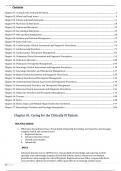
Test Bank Women’s Health Care in Advanced Practice Nursing 2nd EditionTable of Contents Chapter 1 Women and Their Health ........................................................................................................ 2 Chapter 2 Women as Health Care Providers ........................................................................................ 7 Chapter 3 Women and Health Care ....................................................................................................... 10 Chapter 4 Health Care for Vulnerable Populations ........................................................................... 12 Chapter 5 Legal Issues in Women’s Health Care ............................................................................... 15 Chapter 6 Feminist Frameworks for Advanced Practice With Women ........................................ 18 Chapter 7 Women’s Bodies ..................................................................................................................... 22 Chapter 8 Young Women’s Health ........................................................................................................ 25 Chapter 9 Midlife Women’s Health ...................................................................................................... 29 Chapter 10 Older Women’s Health ....................................................................................................... 32 Chapter 11 Well Woman’s Health .......................................................................................................... 35 Chapter 12 Mental Health ...................................................................................................................... 39 Chapter 13 Nutrition for Women ......................................................................................................... 43 Chapter 14 Healthy Practices: Physical Activity .............................................................................. 46 Chapter 15 Healthy Practices: Sleep ................................................................................................... 50 Chapter 16 Genetics and Women’s Health .......................................................................................... 53 Chapter 17 Women and the Workplace ............................................................................................... 55 Chapter 18 Health Considerations for Women Caregivers ............................................................. 59 Chapter 19 Women’s Sexual Health ..................................................................................................... 62 Chapter 20 Primary Care of Lesbian, Gay, Bisexual, and Transgender Individuals ................... 65 Chapter 21 Fertility Self-Management and Shared Management ................................................ 67 Chapter 22 Preconception Counseling ................................................................................................... 71 Chapter 23 Prenatal Care and Anticipating Birth ............................................................................. 75 Chapter 24 Breast Health Considerations ......................................................................................... 78 Chapter 25 Caring for the Transgender Patient............................................................................... 82 Chapter 26 Sexual Health Problems and Dysfunctions ................................................................... 85 1 | P a g eChapter 27 Vulvar and Vaginal Health ................................................................................................. 89 Chapter 28 Perimenstrual and Pelvic Symptoms and Syndromes .................................................. 92 Chapter 29 Urologic and Pelvic Floor Health Problems ................................................................... 96 Chapter 30 Sexually Transmitted Diseases ...................................................................................... 100 Chapter 31 Women and HIV/AIDS ..................................................................................................... 103 Chapter 32 Human Papillomavirus ........................................................................................................ 107 Chapter 33 Gynecologic Cancers .......................................................................................................... 110 Chapter 34 Menopause ........................................................................................................................... 113 Chapter 35 Osteoporosis ...................................................................................................................... 117 Chapter 36 The Challenge of Unintended Pregnancies .................................................................. 119 Chapter 37 Infertility ........................................................................................................................... 123 Chapter 38 High-Risk Childbearing ..................................................................................................... 125 Chapter 39 Intrapartum and Postpartum Care ................................................................................ 130 Chapter 40 Mental Health Challenges ................................................................................................ 135 Chapter 41 Substance Abuse and Women ......................................................................................... 138 Chapter 42 Gender-Based Violence and Women’s Health.............................................................. 142 Chapter 43 Cardiovascular Disease in Women .................................................................................. 146 Chapter 44 Endocrine-Related Problems ........................................................................................... 150 Chapter 45 Chronic Illness and Women ............................................................................................. 154 Chapter 46 Care of Women With Disabilities .................................................................................. 156 Chapter 1 Women and Their Health The United States ranks 50th in the world for maternal mortality and 41st among industrialized nations for 1. infant mortality rate. When developing programs to assist in decreasing these rates, which factor would most likely need to be addressed as having the greatest impact? A) Resolving all language and cultural differences B) Assuring early and adequate prenatal care C) Providing more extensive womens 2 | P a g eshelters D)Encouraging all women to eat a balanced diet 2. When integrating the principles of family-centered care, the nurse would include which of the following? A)Childbirth is viewed as a procedural event B) Families are unable to make informed choices C) Childbirth results in changes in relationships D) Families require little information to make appropriate decisions When preparing a teaching plan for a group of first-time pregnant women, the nurse expects to review 3. how maternity care has changed over the years. Which of the following would the nurse include when discussing events of the 20th century? A) Epidemics of puerperal fever B) Performance of the first cesarean birth C) Development of the x-ray to assess pelvic size D) Creation of free-standing birth centers 4. After teaching a group of students about pregnancy-related mortality, the instructor determines that additional teaching is needed when the students identify which condition as a leading cause? A) Hemorrhage B) Embolism C) Obstructed labor D)Infection The nurse is working with a group of community health members to develop a plan to address the special 5. health needs of women. Which of the following conditions would the group address as the major problem? A) Smoking B) Heart disease C) Diabete s D)Cancer 6. When assessing a family for possible barriers to health care, the nurse would consider which factor to be most important? A) Language B) Health care workers attitudes C) Transportati on D)Finances 7. After teaching a group of nursing students about the issue of informed consent. Which of the following, if identified by the student, would indicate an understanding of a violation of informed consent? A) Performing a procedure on a 15-year-old without consent B) Serving as a witness to the signature process C) Asking whether the client understands what she is signing D) Getting verbal consent over the phone for emergency procedures 8. The nurse is trying to get consent to care for an 11-year-old boy with diabetic ketoacidosis. His parents are out of town on vacation, and the child is staying with a neighbor. Which action 3 | P a g ewould be the priority? A) Getting telephone consent with two people listening to the verbal consent B) Providing emergency care without parental consent C) Contacting the childs aunt or uncle to obtain their consent D)Advocating for termination of parental rights for this situation 9. After teaching nursing students about the basic concepts of family-centered care, the instructor determines that the teaching was successful when the students state which of the following? A) Childbirth affects the entire family, and relationships will change. B) Families are not capable of making health care decisions for themselves. C) Mothers are the family members affected by childbirth. D)Childbirth is a medical procedure. A nursing instructor is preparing a class discussion on the trends in health care and health care delivery the past several centuries. When discussing the changes during the past century, which of the following would the instructor be least likely to include? A) Disease prevention B) Health promotion C) Wellness D) Analysis of morbidity and mortality A nurse is assigned to care for an Asian American client. The nurse develops a plan of care with the standing that based on this clients cultural background, the client most likely views illness as which of the following? A) Caused by supernatural forces. B) A punishment for sins. C) Due to spirits or demons. D) From an imbalance of yin and yang A nurse is developing a plan of care for a woman to ensure continuity of care during pregnancy, labor, childbirth. Which of the following would be most important for the nurse to incorporate into that plan? A) Adhering to strict, specific routines B) Involving a pediatric physician C) Educating the client about the importance of a support person D) Assigning several nurses as a support team 13. A nursing instructor is preparing a class discussion on case management in maternal and newborn health care. Which of the following would the instructor include as a key component? Select all that apply. A) Advocacy B) Coordination C) Communication D) Resource management E) Event managed care 14.After teaching a group of students about the concept of maternal mortality, the instructor 4 | P a g edetermines that additional teaching is needed when the students state which of the following? A) The rate includes accidental causes for deaths. B) It addresses pregnancy-related causes. C) The duration of the pregnancy is not a concern. D) The time frame is typically for a specified year. A group of students are reviewing the historical aspects about childbirth. The students demonstrate standing of the information when they identify the use of twilight sleep as a key event during which time frame? A) 1700s B) 1800s C) 1900s D) 2000s 16. A nurse is providing care to a woman who has just delivered a healthy newborn. Which action would least likely demonstrate application of the concept of family-centered care? A) Focusing on the birth as a normal healthy event for the family B) Creating opportunities for the family to make informed decisions C) Encouraging the woman to keep her other children at home D) Fostering a sense of respect for the mother and the family 17. When discussing fetal mortality with a group of students, a nurse addresses maternal factors. Which of the following would the nurse most likely include? Select all that apply. A) Chromosomal abnormalities B) Malnutrition C) Preterm cervical dilation D) Underlying disease condition E) Poor placental attachment 18. A nurse is preparing a presentation for a local community group about health status and childrens health. Which of the following would the nurse include as one of the most significant measures? A) Fetal mortality rate B) Neonatal mortality rate C) Infant mortality rate D) Maternal mortality rate A group of students are reviewing an article describing information related to indicators for womens h and the results of a national study. Which of the following would the students identify as being satisfactory for women? Select all that apply. A) Smoking cessation B) Colorectal cancer screening C) Violence against women D) Health insurance coverage E) Mammograms 20. A nurse is preparing a presentation for a local womens group about heart disease and women. Which of the following would the nurse expect to address when discussing measures to promote health. 5 | P a g eA) Women have similar symptoms as men for a heart attack. B) Heart disease is no longer viewed as a mans disease. C) Women experiencing a heart attack are at greater risk for dying. D) Heart attacks in women are more easily diagnosed. 21.A nurse is working to develop a health education program for a local community to address breast cancer awareness. Which of the following would the nurse expect to include when describing this problem to the group? Select all that apply. A) White women have higher rates of breast cancer than African American women. B) African American women are more likely to die from breast cancer at any age. C) Survival at any stage is worse among white women. D) Women living in South America have the highest rates of breast cancer. E) Breast cancer is the leading cause of cancer mortality in women. A group of nursing students are reviewing information about factors affecting maternal, newborn, and s health. The students demonstrate understanding of the information when they identify which of the following deficiencies as being associated with poverty? Select all that apply. A) Literacy B) Employment opportunities C) Mobility D) Political representation E) Skills Answer Key 1. B 2. C 3. D 4. B 5. B 6. D 7. A 8. A 9. A 10. D 11.D 12.C 13.A, B, C, D 14.A 15.C 16.C 17.B, C, D 18.C 6 | P a g e19.B, E 20.C 21. A, B 22. A, B, C, D, E Chapter 2 Women as Health Care Providers 1. Which health occupation has the highest percentage of women? A. Pharmacists B. Physical therapists C. Registered nurses D. Dentalhygien ists Answer: D 2. Which health occupation has the lowest percentage of women? A. Physicians B. Dentists C. Pharmacists D. Physical therapists Answer: B 3. Which health profession has the largest number of workers? A. Health aides B. Physicians C. Licensed practical nurses D. Registered nurses Answer: D 4. Which of the following are certifications available in advanced practice registered nursing? (Select allthat apply.) A. Certified nurse midwife B. Certified registered nurse anesthetist C. Certified nurse pharmacologist D. Clinical nurse specialist E. Nurse practitioner 7 | P a g eAnswer: A, B, D, E 5. What level of education is required to become a licensed practical nurse? A. 2-year master’s degree (in addition to a 4-year bachelor’s degree) B. 4-year bachelor’s degree C. 2-year associate’sdegree D. 1-year certificate or diploma Answer: D 6. What percentage of physicians and surgeons in the United States in 2014 were women? A. 27% B. 37% C. 47% D. 57% Answer: B 7. What medical specialty has the highest percentage of women? A. General pediatrics B. Obstetrics and gynecology C. Orthopedic surgery D. Urolo gy Answer: A 8. On an average, the income of female physicians is what percentage of that of malephysicians? A. 59% B. 79% C. 99% D. 109% Answer: A 9. What level of education is required to become a pharmacist? A. 6-year doctorate degree B. 2-year master’s degree (in addition to a 4-year bachelor’s degree) C. 4-year bachelor’s degree D. 2-year associate’sdegree Answer: A 8 | P a g e10. Which of the following is the median income of dentists in the United States (2012)? A. $89,310 B. $109,310 C. $129,310 D. $149,310 Answer: D 11. Which of the following are the current trends in dentistry? (Select all that apply.) A. More specialists than generalists B. Research linking oral health to overallhealth C. Focus on treatment of disease rather than prevention D. Expected growth of 18% from 2014 to 2024 E. Increasing demand for dental implants, bridges, and cosmetic services Answer: B, D, E 12. Which allied health occupation is projected to be the fastest growing? A. Health information technicians B. Nursing aides C. Occupational therapists D. Paramed ics Answer: A 13. One in five workers in which of the following allied health occupation is at or below the federal poverty level? A. Medical assistant B. Home health aide C. Radiology technician D. Speech-language pathologist Answer: B 14. Veronica is a registered nurse who pours herself into her job. She works long hours without complaint and strives to do her best. Often, she maintains a cheerful, caring, and kind demeanor on the outside while feeling exhausted and frustrated on the inside. The effort it takes to maintain this front before her patients results in a lot of stress. This phenomenon can best be described as which of the following? A. Identity crisis B. Psychological disparity C. Emotional dissonance D. Gender discrimination 9 | P a g eAnswer: C 15. Tests of implicit racial bias among health professionals have revealed which of the following? A. An unconscious preference for Whites over Blacks B. Use of racially charged, derogatorylanguage C. Sharing of racist jokes D. Lower pay for racial minorities Answer: A Chapter 3 Women and Health Care 1. To enhance women’s health care in the 21st century, researchers should do which of the following? (Select all that apply.) A. Design studies in collaboration with women B. Analyze changes in women’s health data relative to men’s C. Include homogeneous populations of women in studies D. Translate research findings into clinical and public health practice E. Focus on treatment approaches equallyapplicable to men and women Answer: A, B, D 2. Historically, gender has been defined by which of the following? (Select all that apply.) A. Self-identification B. Appropriateroles C. Division oflabor D. Economicpower E. Political influence Answer: B, C, D, E 3. Hammarstrӧm et al. propose a model of sex and gender that includes which of the following concepts? (Select all that apply.) A. Binary sexuality based on one’schromosomes B. Sex, interacting with gender, as a continuum C. Biologically determined sex based on the effects of sex hormones on reproductive organ development D. Sex and gender as an integration of body, mind, and context E. Intersectionality and embodiment as factors significantlyaffecting sex and gender Answer: B, D, E 10 | P a g e4. Which of the following is the best example of how gender bias has affected the health and health care of women? A. Similar rates of mental illness being found in men and women B. Treatment outcomes among women varying based on patient compliance C. Association of patient income level with type of diagnosis D. Disproportionatelymore psychotropic medications being prescribed to women than men Answer: D 5. Krieger has proposed which of the following regarding sex, gender, and health? (Select all that apply.) A. Gender and sex played no significant role in determining health outcomes for women B. Gender relations influence the expression and the interpretation of biological traits C. Sex-linked biological characteristics contribute to gender differentials in health D. Traditional perspectives on gender and sex have resulted in better health outcomes for women than for men E. Equitable gender relationships have resulted in similar health outcomes in men and women Answer: B, C 6. When did women’s health scholarship begin toflourish? A. 1960s B. 1970s C. 1980s D. 1990s Answer: B 7. Which of the following were the goals included in the report “Women’s Health Research: Progress, Pitfalls, and Promise,” which was published by the Office of Research on Women’s Health in 2010? (Select all that apply.) A. Increase sex similarities research in basic sciences studies B. Incorporate findings of sex and gender differences in the design of new technologies C. Create strategic alliances to maximize domestic and global impact of women’s health research D. Develop and implement new social networking technologies to promote men’s health and wellness research E. Employinnovative strategies to build a well-trained, diverse, and vigorous women’s health research workforce Answer: B, C, E 8. The National Institutes of Health (NIH) Revitalization Act of 1993 mandated that the NIH do which of the following? A. Expand health insurance coverage for women B. Include women and minorities in clinicalresearch C. Research and develop new women-specific medications 11 | P a g eD. Decrease infection rates during obstetric surgeries Answer: B 9. Historical examples of gender bias in medical textbooks include which of the following? (Select all that apply.) A. Portrayals of women as inherentlysick B. A recommendation that women simulate orgasms if not orgasmic with their husbands C. Portrayals of women patients as being intellectually superior to their male physicians D
Escuela, estudio y materia
- Institución
- Chamberlian School Of Nursing
- Grado
- Desconocido
Información del documento
- Subido en
- 2 de diciembre de 2023
- Número de páginas
- 158
- Escrito en
- 2023/2024
- Tipo
- Examen
- Contiene
- Desconocido
Temas
-
test bank