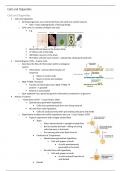
Cells and Organelles
Cells and Organelles
• Cells and organelles
o All living organisms are constructed from cells with very similar features
▪ Cells = basic building blocks of all living things
o Cells come in a variety of shapes and sizes
▪ E.g.
•
▪ About 200 cell types in the human body
▪ 37 trillion cells in the body
▪ 100 billion neurons in the brain
▪ 96 million cells die every minute – replaced by newly generated cells
• Central Dogma of life – Francis Crick
o Describes the flow of information within a biological
system
▪ Information = precise determination of
sequence
• Bases in nucleic acids
• Bases in amino acid residues
o DNA → RNA → protein
▪ Transfer of information from DNA → RNA →
protein – is possible
▪ Reverse is not possible
o Each organism has a particular genetic information contained in its genome
• History of science
o “Generation of life” – Louis Pasteur 1959
▪ Spontaneous generation hypothesis
• Cells arise spontaneously from non-living material
▪ All-cells-from-cells hypothesis
• Cells are produced only when pre-existing cells grow and divide
o Experiments to determine which hypothesis was true – Louis Pasteur 1959
▪ Pasteur experiment with straight-necked flask
• Steps
o Place nutrient broth in straight-necked flask
o Boil to sterilise the flask – killing any living
cells that were in the broth
o Pre-existing cells enter flask from air
• Prediction of 2 hypothesis
o Spontaneous generation hypothesis
▪ Cells will appear in broth
• As cells spontaneously
generated in the broth
o All-cells-from-cells hypothesis
▪ Cells will appear in broth
• As cells entered from the air
and divided
• Results
,Cells and Organelles
o Cells appeared in broth = both hypotheses supported
▪ Pasteur experiment with swan-necked flash
• Steps
o Place nutrient broth in swan-necked flash
o Boil to sterilise the flash – killing any living
cells that were in the broth
o Condensation settles in swan neck
o Pre-existing cells from air are trapped in
swan neck
• Prediction of 2 hypothesis
o Spontaneous generation hypothesis
▪ Cells will appear in broth
• As cells spontaneously generated in the broth
o All-cells-from-cells hypothesis
▪ Cells will not appear in broth
• As cells from the air cannot enter and divide
• Results
o Cells were not present in the broth =
rejecting spontaneous hypothesis
▪ Conclusion
• Cells arise from pre-existing cells – not spontaneously from non-living material
o “Cell Theory” – Louis Pasteur 1860
▪ Living organisms are made of cells
▪ Cells are the basic organisational unit of all organisms
▪ All cells come from pre-existing cells + generated by growth and division of pre-existing cells
o Light microscopy – ability to observe living cells at a high magnification
▪
• How big is a cell and its components?
o
,Cells and Organelles
• Prokaryotes and eukaryotes
o 2 types of cells
▪ Prokaryotic cells
▪ Eukaryotic cells
o 2 types of organisms
▪ Prokaryotes – made up of prokaryotic cells
▪ Eukaryotes – made up of eukaryotic cells
• Structure of prokaryotic cells
o General structure
▪ Genome (DNA) lies freely in cell
▪ Surrounded by a plasma membrane
▪ No internal compartmentalisation – no
internal membranes
▪ 0.1-1m in size
▪ Phototrophs or organo/chemolithotrophic
o Photosynthetic (phototrophic) bacteria – cyanobacteria
▪
▪ Filament is composed of different types of cells
• H – heterocyst
o Where nitrogen fixation occurs
▪ Conversion of atmospheric nitrogen → ammonia
• S – spore
o Highly resistance structures to environmental conditions
• V – vegetative cell
o Thylakoids – internal membranes
▪ Where photosynthesis occurs – providing a larger surface area =
maximising carbon fixation
▪ Phototrophic = converts light energy into organic compounds
▪ Photosynthesis – occurs in vegetative cells
• Using CO2 and H2O
• Producing O2
▪ Nitrogen fixation – occurs in heterocyst
• Enzyme – nitrogenase = sensitive to oxygen
o Inactive in the presence of oxygen → photosynthesis and nitrogen fixation
occur in different cells = compartmentalisation
• Structure of eukaryotic cells – plants, animals, fungi, protozoa
o General structure
▪ Membrane-bound nucleus
▪ Additional membrane-bound structures = organelles
▪ Cytoplasm
▪ Cytoskeletal elements
o Fine structure of a liver cell using electron microscopy
▪ Plasma membrane
▪ Nucleus
▪ Endoplasmic reticulum
▪ Lysosomes
▪ Peroxisomes
▪ Mitochondria
, Cells and Organelles
▪ Ribosomes
o Major features of eukaryotic cells
▪
• Nucleus
o Contains linear DNA
o Site of DNA and RNA synthesis
o Enclosed by the nuclear envelope
▪ Paths in the envelope = allow movement of substance in and out of
the nucleus
• Nucleolus
o Compartment within the nucleus
o rRNA genes, rRNA, ribosomal proteins, ribosome subunit assembly
• Cytoplasm
o Contains organelles and cytosol
• Cytosol
o Place for many essential chemical reactions and protein synthesis
• Endoplasmic reticulum
o Membrane closed labyrinthine space
o Produces lipids and functions as Ca2+ store
o Rough ER
▪ Contains ribosomes for protein synthesis
• Golgi apparatus
o Stacks of flattened membrane
o Receives lipids and proteins from ER → modifies them → dispatches them
to other parts or the exterior of the cell
• Mitochondria
o Surrounded by double membrane – inner and outer membrane
o Contain mitochondrial DNA – circular
o Consume oxygen to oxidise food molecules and produce cellular energy
o Releases CO2
• Chloroplasts
o In plants and algae only
o Consume CO2 and use sunlight to produce sugar and oxygen
• Lysosomes
Cells and Organelles
• Cells and organelles
o All living organisms are constructed from cells with very similar features
▪ Cells = basic building blocks of all living things
o Cells come in a variety of shapes and sizes
▪ E.g.
•
▪ About 200 cell types in the human body
▪ 37 trillion cells in the body
▪ 100 billion neurons in the brain
▪ 96 million cells die every minute – replaced by newly generated cells
• Central Dogma of life – Francis Crick
o Describes the flow of information within a biological
system
▪ Information = precise determination of
sequence
• Bases in nucleic acids
• Bases in amino acid residues
o DNA → RNA → protein
▪ Transfer of information from DNA → RNA →
protein – is possible
▪ Reverse is not possible
o Each organism has a particular genetic information contained in its genome
• History of science
o “Generation of life” – Louis Pasteur 1959
▪ Spontaneous generation hypothesis
• Cells arise spontaneously from non-living material
▪ All-cells-from-cells hypothesis
• Cells are produced only when pre-existing cells grow and divide
o Experiments to determine which hypothesis was true – Louis Pasteur 1959
▪ Pasteur experiment with straight-necked flask
• Steps
o Place nutrient broth in straight-necked flask
o Boil to sterilise the flask – killing any living
cells that were in the broth
o Pre-existing cells enter flask from air
• Prediction of 2 hypothesis
o Spontaneous generation hypothesis
▪ Cells will appear in broth
• As cells spontaneously
generated in the broth
o All-cells-from-cells hypothesis
▪ Cells will appear in broth
• As cells entered from the air
and divided
• Results
,Cells and Organelles
o Cells appeared in broth = both hypotheses supported
▪ Pasteur experiment with swan-necked flash
• Steps
o Place nutrient broth in swan-necked flash
o Boil to sterilise the flash – killing any living
cells that were in the broth
o Condensation settles in swan neck
o Pre-existing cells from air are trapped in
swan neck
• Prediction of 2 hypothesis
o Spontaneous generation hypothesis
▪ Cells will appear in broth
• As cells spontaneously generated in the broth
o All-cells-from-cells hypothesis
▪ Cells will not appear in broth
• As cells from the air cannot enter and divide
• Results
o Cells were not present in the broth =
rejecting spontaneous hypothesis
▪ Conclusion
• Cells arise from pre-existing cells – not spontaneously from non-living material
o “Cell Theory” – Louis Pasteur 1860
▪ Living organisms are made of cells
▪ Cells are the basic organisational unit of all organisms
▪ All cells come from pre-existing cells + generated by growth and division of pre-existing cells
o Light microscopy – ability to observe living cells at a high magnification
▪
• How big is a cell and its components?
o
,Cells and Organelles
• Prokaryotes and eukaryotes
o 2 types of cells
▪ Prokaryotic cells
▪ Eukaryotic cells
o 2 types of organisms
▪ Prokaryotes – made up of prokaryotic cells
▪ Eukaryotes – made up of eukaryotic cells
• Structure of prokaryotic cells
o General structure
▪ Genome (DNA) lies freely in cell
▪ Surrounded by a plasma membrane
▪ No internal compartmentalisation – no
internal membranes
▪ 0.1-1m in size
▪ Phototrophs or organo/chemolithotrophic
o Photosynthetic (phototrophic) bacteria – cyanobacteria
▪
▪ Filament is composed of different types of cells
• H – heterocyst
o Where nitrogen fixation occurs
▪ Conversion of atmospheric nitrogen → ammonia
• S – spore
o Highly resistance structures to environmental conditions
• V – vegetative cell
o Thylakoids – internal membranes
▪ Where photosynthesis occurs – providing a larger surface area =
maximising carbon fixation
▪ Phototrophic = converts light energy into organic compounds
▪ Photosynthesis – occurs in vegetative cells
• Using CO2 and H2O
• Producing O2
▪ Nitrogen fixation – occurs in heterocyst
• Enzyme – nitrogenase = sensitive to oxygen
o Inactive in the presence of oxygen → photosynthesis and nitrogen fixation
occur in different cells = compartmentalisation
• Structure of eukaryotic cells – plants, animals, fungi, protozoa
o General structure
▪ Membrane-bound nucleus
▪ Additional membrane-bound structures = organelles
▪ Cytoplasm
▪ Cytoskeletal elements
o Fine structure of a liver cell using electron microscopy
▪ Plasma membrane
▪ Nucleus
▪ Endoplasmic reticulum
▪ Lysosomes
▪ Peroxisomes
▪ Mitochondria
, Cells and Organelles
▪ Ribosomes
o Major features of eukaryotic cells
▪
• Nucleus
o Contains linear DNA
o Site of DNA and RNA synthesis
o Enclosed by the nuclear envelope
▪ Paths in the envelope = allow movement of substance in and out of
the nucleus
• Nucleolus
o Compartment within the nucleus
o rRNA genes, rRNA, ribosomal proteins, ribosome subunit assembly
• Cytoplasm
o Contains organelles and cytosol
• Cytosol
o Place for many essential chemical reactions and protein synthesis
• Endoplasmic reticulum
o Membrane closed labyrinthine space
o Produces lipids and functions as Ca2+ store
o Rough ER
▪ Contains ribosomes for protein synthesis
• Golgi apparatus
o Stacks of flattened membrane
o Receives lipids and proteins from ER → modifies them → dispatches them
to other parts or the exterior of the cell
• Mitochondria
o Surrounded by double membrane – inner and outer membrane
o Contain mitochondrial DNA – circular
o Consume oxygen to oxidise food molecules and produce cellular energy
o Releases CO2
• Chloroplasts
o In plants and algae only
o Consume CO2 and use sunlight to produce sugar and oxygen
• Lysosomes