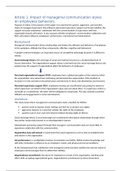
Article 1. Impact of managerial communication styles
on employees behaviors.
Purpose of article the purpose of this paper is to examine the passive, aggressive, and assertive
styles of managers/supervisors that influence perceived supervisory support and to test whether the
support increases employees’ satisfaction with the communication of supervisors and their
organisation-based self-esteem. It also assesses whether employees’ communication satisfaction and
their self-esteem influence employees’ performance, commitment and absenteeism.
Background
Managerial communication drives relationships and frames the attitudes and behaviors of employees
in the workplace. Attitude has three components: affective, cognitive and behavioral.
A people-centered strategy is an important source of competitive advantage because it is difficult to
imitate.
Social exchange theory: the exchange of social and material resources is a fundamental form of
human interaction. The organizational support theory is derived from the social exchange theory and
explains how the support of organizations affect the behaviors of employees.
Perceived organizational support (POS): employees form a global perception of the extent to which
the organization cares about their well-being and demonstrates appreciation. POS manifests in
increase in in-role and extra-role performance and decrease in stress and absenteeism and turnover.
Perceived supervisory support (PSS): employees develop an overall belief concerning the extent to
which supervisors on behalf of the organizations value and care about them. If a supervisor confers a
social gift on a subordinate, the latter will feel obligated to reciprocate. PSS also cultivate in positive
attitudes and engagements in extra role behaviors.
Literature
This study shows three management communication styles classified by Heffner:
passive (avoid to express needs, feelings and feel shy to protect own rights)
aggressive (express in a way that violates the rights of the employee)
assertive (act in one’s own best interest without denying rights of others).
Social exchange theory social exchanges are considered bi-directional relationships through which
two parties reciprocally transact in an interdependent manner.
Subordinates perceiving support through their managers’ communication style are more likely to
experience satisfaction with the communication.
Organization-base self-esteem is constructed from past experiences such as task accomplishments
and failures in the organization.
Job performance is a multipliable function of motivation and ability. Ability involves knowledge and
skill while motivation is influence by an employee’s needs, and physical and social conditions.
At the interpersonal level, satisfaction with managerial communication satisfies the intrinsic needs of
employees and encourages them to utilize their abilities.
Organizational commitment: the desire of employees to remain in the organization, exerting work
effort while accepting organizational goals. Organizational commitment has three dimensions:
, affective (employee’s positive emotional attachment to the organization/ identifies with
organization);
continuance (commits to the job because of high costs of losing organizational membership;
economic and social);
normative (the feelings of obligation to remain to the organization; moral)
Relations found in literature
1. There is a relationship between the perceived managerial communication style and the PSS that
can further influence communication satisfaction and organization-based self-esteem.
2. Positive relationship between communication satisfaction and organizational commitment and job
performance, and communication satisfaction and absenteeism (voluntary).
3. There is also a relationship between organization-base self-esteem and organizational
commitment, job performance and absenteeism. Literature suggest that when employees feel
valued, important, competent, and capable to their organization, they will attend their work regularly.
4. There is also a relationship between organizational commitment and absenteeism
Results
An increase in assertive communication style of supervisors increased PSS, where passive and
aggressive styles decreased PSS. Thus, an increase in PSS means increase in communication
satisfaction and organization-based self-esteem. However, higher communication satisfaction and
organization-based self-esteem did increase job performance and affective commitment, it did not
relate to continuance commitment and absenteeism.
Discussion
As mentioned above, effective managerial communication can increase PSS. Although, both passive
and assertive managers are found to support employees and make trustworthy relationships, the
level of support from assertive managers is found to be much higher than passive managers.
Furthermore, it is found that self-esteem is not found to influence employees’ organizational
commitment. When employees are trusted and offered challenging work, their enhanced self-esteem
may trigger the scope of job switching and better job in another organization.
Most important findings
Assertive style of communication lends maximum support to employees;
PSS at the workplace enhances employees satisfaction with communication of supervisors
and organization-based self-esteem.
Communication satisfaction can increase affective commitment of employees which can
reduce absenteeism
Organization-based self-esteem can boost job performance.
Managerial implications
The study has practical implications for managers. Two sets of values – vertical collectivism and
individualism coexist in Indian organizations. Possibly, the existence of such contradictory sets of
values demands assertive managers in Indian organizations. Organizations can conduct training
programs to develop assertive communication style in their supervisors to increase the support to
subordinates, thereby its positive consequences will follow in increasing employees’ performance and
commitment and reducing absenteeism.
on employees behaviors.
Purpose of article the purpose of this paper is to examine the passive, aggressive, and assertive
styles of managers/supervisors that influence perceived supervisory support and to test whether the
support increases employees’ satisfaction with the communication of supervisors and their
organisation-based self-esteem. It also assesses whether employees’ communication satisfaction and
their self-esteem influence employees’ performance, commitment and absenteeism.
Background
Managerial communication drives relationships and frames the attitudes and behaviors of employees
in the workplace. Attitude has three components: affective, cognitive and behavioral.
A people-centered strategy is an important source of competitive advantage because it is difficult to
imitate.
Social exchange theory: the exchange of social and material resources is a fundamental form of
human interaction. The organizational support theory is derived from the social exchange theory and
explains how the support of organizations affect the behaviors of employees.
Perceived organizational support (POS): employees form a global perception of the extent to which
the organization cares about their well-being and demonstrates appreciation. POS manifests in
increase in in-role and extra-role performance and decrease in stress and absenteeism and turnover.
Perceived supervisory support (PSS): employees develop an overall belief concerning the extent to
which supervisors on behalf of the organizations value and care about them. If a supervisor confers a
social gift on a subordinate, the latter will feel obligated to reciprocate. PSS also cultivate in positive
attitudes and engagements in extra role behaviors.
Literature
This study shows three management communication styles classified by Heffner:
passive (avoid to express needs, feelings and feel shy to protect own rights)
aggressive (express in a way that violates the rights of the employee)
assertive (act in one’s own best interest without denying rights of others).
Social exchange theory social exchanges are considered bi-directional relationships through which
two parties reciprocally transact in an interdependent manner.
Subordinates perceiving support through their managers’ communication style are more likely to
experience satisfaction with the communication.
Organization-base self-esteem is constructed from past experiences such as task accomplishments
and failures in the organization.
Job performance is a multipliable function of motivation and ability. Ability involves knowledge and
skill while motivation is influence by an employee’s needs, and physical and social conditions.
At the interpersonal level, satisfaction with managerial communication satisfies the intrinsic needs of
employees and encourages them to utilize their abilities.
Organizational commitment: the desire of employees to remain in the organization, exerting work
effort while accepting organizational goals. Organizational commitment has three dimensions:
, affective (employee’s positive emotional attachment to the organization/ identifies with
organization);
continuance (commits to the job because of high costs of losing organizational membership;
economic and social);
normative (the feelings of obligation to remain to the organization; moral)
Relations found in literature
1. There is a relationship between the perceived managerial communication style and the PSS that
can further influence communication satisfaction and organization-based self-esteem.
2. Positive relationship between communication satisfaction and organizational commitment and job
performance, and communication satisfaction and absenteeism (voluntary).
3. There is also a relationship between organization-base self-esteem and organizational
commitment, job performance and absenteeism. Literature suggest that when employees feel
valued, important, competent, and capable to their organization, they will attend their work regularly.
4. There is also a relationship between organizational commitment and absenteeism
Results
An increase in assertive communication style of supervisors increased PSS, where passive and
aggressive styles decreased PSS. Thus, an increase in PSS means increase in communication
satisfaction and organization-based self-esteem. However, higher communication satisfaction and
organization-based self-esteem did increase job performance and affective commitment, it did not
relate to continuance commitment and absenteeism.
Discussion
As mentioned above, effective managerial communication can increase PSS. Although, both passive
and assertive managers are found to support employees and make trustworthy relationships, the
level of support from assertive managers is found to be much higher than passive managers.
Furthermore, it is found that self-esteem is not found to influence employees’ organizational
commitment. When employees are trusted and offered challenging work, their enhanced self-esteem
may trigger the scope of job switching and better job in another organization.
Most important findings
Assertive style of communication lends maximum support to employees;
PSS at the workplace enhances employees satisfaction with communication of supervisors
and organization-based self-esteem.
Communication satisfaction can increase affective commitment of employees which can
reduce absenteeism
Organization-based self-esteem can boost job performance.
Managerial implications
The study has practical implications for managers. Two sets of values – vertical collectivism and
individualism coexist in Indian organizations. Possibly, the existence of such contradictory sets of
values demands assertive managers in Indian organizations. Organizations can conduct training
programs to develop assertive communication style in their supervisors to increase the support to
subordinates, thereby its positive consequences will follow in increasing employees’ performance and
commitment and reducing absenteeism.