Assignment A
Unit 10
The Chemistry of Combustion
Combustion happens due to chemical reactions taking place within a fire, in this report the
use of fire extinguishers, the way heat transfers occur and the ways to extinguish a fire will
be covered, this is in order to explain chemically how a fire works.
In order for combustion to take place, the fire
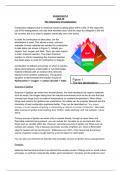
tetrahedron is used. This allows a clear, pictured
example of what materials are needed for combustion
to take place (as shown in Figure 1). Initially you
require: fuel, oxygen and heat. Then, you also require
a chain chemical reaction. The chain chemical
reaction is vital for assessing the chemical reaction
that takes place in order for combustion to happen.
Combustion is defined as burning, or when a reaction
takes place between a flammable or non-flammable
material interacts with an oxidiser (this removes
electrons from another substance). The general
equation to demonstrate this reaction would be:
Hydrocarbon + oxygen -> carbon dioxide + water. Figure 1
The fire tetrahedron
Sources of Ignition
Sources of Ignition can arise from several places, the fuels tending to be organic materials
such as wood, the oxygen being from the natural environment such as the air and the heat
coming from things such as external temperature (or ambient temperature). When these
things and reasons for ignitions are understood, fire safety can be properly followed and the
chemistry of said combustion explained better. They can be described as: “Any object,
process or event capable of igniting or transmitting a medium to prompt combustion”, this could
allow sources of ignition to be anything from ‘friction’ ‘static electricity’ and ‘hot surfaces’. (Anon.
2014).
Primary sources of ignition are when a fire is caused directly, through an open flame and
flammable materials being present, you can include the ‘hot plate’ as an example and other
things such as candles within this. However, secondary sources of ignition are things such as
curtains and carpets. This is because secondary sources of ignition are ‘where a flammable
object is heated until its burning point. ’ (UKEssays.com, 2021.) This means that the primary
source of ignition creates enough heat for a second object to catch alight.
You can also use chemistry to describe why secondary sources of ignition exist, using pyrolysis.
Pyrolysis
Materials that become involved in accidental fires usually consist of things such as: wood, cotton
and paper, or synthetic materials like rubber, paint and plastics. Pyrolysis and its products occur
, when an initial fire is started through the primary source of ignition - the radiant heat from the
primary fire and its flames causes materials (such as carpets) to start decomposing - these then
become pyrolysis products (such as char, and in extreme cases it leaves mostly carbon, this is
carbonisation). These decomposing products release vapours and gases into the air, which can
then combust and burn, without any direct contact from the primary source. In turn, this creates
more pyrolysis products as the flames grow larger and more intense.
Smouldering Combustion
Smouldering combustion occurs when porous fuels exist. It is an incredibly persistent type of
combustion due to its slow nature. Porous fuels like peat contribute toward smouldering
combustion. Mainly happening within peat and coal deposits, it contributes majorly towards
expanding greenhouse gas emissions and the destruction of ecosystems.
Flash Point - This is the lowest temperature that a liquid will form such a flammable vapour that
can be ignited.
Fire Point - This is the lowest temperature in which the vapour of a fuel will burn after ignition.
Autoignition - This is the lowest temperature in which material will spontaneously ignite under
normal conditions without a flame.
Glowing Combustion
Glowing combustion is described as a type of combustion that lacks a flame. It has the ability to
be sustained with low oxygen levels. Glowing combustion tends to occur on the surface of
materials, when there is solid fuel. However, when the oxygen is increased, it may form into
flaming combustion (when a flame is present). An example of this happening in real life would be
with cigarettes, when the ends of the cigarette glow when it is being puffed.
Heat Transfer
Heat transfer uses the 2nd law of thermodynamics, this states: ‘the state of entropy of the
entire universe, as an isolated system, will always increase over time.’ This means that heat
will always be either increasing or remaining constant. This law recognises that within
objects, higher temperature air will always flow into and fill areas with cooler air. This can
happen until a thermal equilibrium is reached - this is when objects and their temperatures
are constant/stay the same. Within this, conduction, convection and radiation can display
ways in which heat can be transferred.
● Conduction - Conduction takes place when the atoms/molecules within an object
exhibit swifter vibrations within the hotter part and transfer the energy into the cooler
parts of the molecule. This results in a heat transfer. It transfers energy through
‘direct contact’ (Comunale J. 2022). This can happen in real life through examples
such as: cooking on an oven top, the vibrating molecules within the oven transfer
heat into the food that is being cooked. Radiators also use conduction, steam heats
the metal inside the radiator which cools up the colder air around it. Conduction is
most effective on metals compared to gases as they are overall better conductors.
Unit 10
The Chemistry of Combustion
Combustion happens due to chemical reactions taking place within a fire, in this report the
use of fire extinguishers, the way heat transfers occur and the ways to extinguish a fire will
be covered, this is in order to explain chemically how a fire works.
In order for combustion to take place, the fire
tetrahedron is used. This allows a clear, pictured
example of what materials are needed for combustion
to take place (as shown in Figure 1). Initially you
require: fuel, oxygen and heat. Then, you also require
a chain chemical reaction. The chain chemical
reaction is vital for assessing the chemical reaction
that takes place in order for combustion to happen.
Combustion is defined as burning, or when a reaction
takes place between a flammable or non-flammable
material interacts with an oxidiser (this removes
electrons from another substance). The general
equation to demonstrate this reaction would be:
Hydrocarbon + oxygen -> carbon dioxide + water. Figure 1
The fire tetrahedron
Sources of Ignition
Sources of Ignition can arise from several places, the fuels tending to be organic materials
such as wood, the oxygen being from the natural environment such as the air and the heat
coming from things such as external temperature (or ambient temperature). When these
things and reasons for ignitions are understood, fire safety can be properly followed and the
chemistry of said combustion explained better. They can be described as: “Any object,
process or event capable of igniting or transmitting a medium to prompt combustion”, this could
allow sources of ignition to be anything from ‘friction’ ‘static electricity’ and ‘hot surfaces’. (Anon.
2014).
Primary sources of ignition are when a fire is caused directly, through an open flame and
flammable materials being present, you can include the ‘hot plate’ as an example and other
things such as candles within this. However, secondary sources of ignition are things such as
curtains and carpets. This is because secondary sources of ignition are ‘where a flammable
object is heated until its burning point. ’ (UKEssays.com, 2021.) This means that the primary
source of ignition creates enough heat for a second object to catch alight.
You can also use chemistry to describe why secondary sources of ignition exist, using pyrolysis.
Pyrolysis
Materials that become involved in accidental fires usually consist of things such as: wood, cotton
and paper, or synthetic materials like rubber, paint and plastics. Pyrolysis and its products occur
, when an initial fire is started through the primary source of ignition - the radiant heat from the
primary fire and its flames causes materials (such as carpets) to start decomposing - these then
become pyrolysis products (such as char, and in extreme cases it leaves mostly carbon, this is
carbonisation). These decomposing products release vapours and gases into the air, which can
then combust and burn, without any direct contact from the primary source. In turn, this creates
more pyrolysis products as the flames grow larger and more intense.
Smouldering Combustion
Smouldering combustion occurs when porous fuels exist. It is an incredibly persistent type of
combustion due to its slow nature. Porous fuels like peat contribute toward smouldering
combustion. Mainly happening within peat and coal deposits, it contributes majorly towards
expanding greenhouse gas emissions and the destruction of ecosystems.
Flash Point - This is the lowest temperature that a liquid will form such a flammable vapour that
can be ignited.
Fire Point - This is the lowest temperature in which the vapour of a fuel will burn after ignition.
Autoignition - This is the lowest temperature in which material will spontaneously ignite under
normal conditions without a flame.
Glowing Combustion
Glowing combustion is described as a type of combustion that lacks a flame. It has the ability to
be sustained with low oxygen levels. Glowing combustion tends to occur on the surface of
materials, when there is solid fuel. However, when the oxygen is increased, it may form into
flaming combustion (when a flame is present). An example of this happening in real life would be
with cigarettes, when the ends of the cigarette glow when it is being puffed.
Heat Transfer
Heat transfer uses the 2nd law of thermodynamics, this states: ‘the state of entropy of the
entire universe, as an isolated system, will always increase over time.’ This means that heat
will always be either increasing or remaining constant. This law recognises that within
objects, higher temperature air will always flow into and fill areas with cooler air. This can
happen until a thermal equilibrium is reached - this is when objects and their temperatures
are constant/stay the same. Within this, conduction, convection and radiation can display
ways in which heat can be transferred.
● Conduction - Conduction takes place when the atoms/molecules within an object
exhibit swifter vibrations within the hotter part and transfer the energy into the cooler
parts of the molecule. This results in a heat transfer. It transfers energy through
‘direct contact’ (Comunale J. 2022). This can happen in real life through examples
such as: cooking on an oven top, the vibrating molecules within the oven transfer
heat into the food that is being cooked. Radiators also use conduction, steam heats
the metal inside the radiator which cools up the colder air around it. Conduction is
most effective on metals compared to gases as they are overall better conductors.