

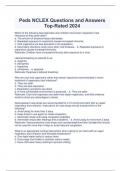
Peds NCLEX Questions and Answers Top-Rated 2024
Which of the following best describes why children have fewer respiratory tract infections as they grow older? a. The amount of lymphoid tissue decreases. b. Repeated exposure to organisms causes increased immunity. c. Viral organisms are less prevalent in the population. d. Secondary infections rarely occur after viral illnesses. - b. Repeated exposure to organisms causes increased immunity. Rationale: Children have increased immunity after exposure to a virus. Labored breathing is referred to as: a. dyspnea. b. tachypnea. c. hypopnea. d. orthopnea. - a. dyspnea. Rationale: Dyspnea is labored breathing. Why are cool-mist vaporizers rather than steam vaporizers recommended in home treatment of respiratory tract infections? a. They are safer. b. They are less expensive. c. Respiratory secretions are dried. d. A more comfortable environment is produced. - a. They are safer. Rationale: Cool-mist vaporizers are safer than steam vaporizers, and little evidence exists to show any advantages to steam. Decongestant nose drops are recommended for a 10-month-old infant with an upper respiratory tract infection. Instructions for nose drops should include which of the following? a. Avoid using for more than 3 days. b. Keep drops to use again for nasal congestion. c. Administer drops until nasal congestion subsides. d. Administer drops after feedings and at bedtime. - a. Avoid using for more than 3 days Rationale: Vasoconstrictive nose drops such as phenylephrine (Neo-Synephrine) should not be used for more than 3 days to avoid rebound congestion. What is an appropriate nursing intervention when caring for an infant with an upper respiratory tract infection and elevated temperature? a. Give tepid water baths to reduce fever. b. Encourage food intake to maintain caloric needs. c. Have child wear heavy clothing to prevent chilling. d. Give small amounts of favorite fluids frequently to prevent dehydration. - d. Give small amounts of favorite fluids frequently to prevent dehydration Rationale: Preventing dehydration by small frequent feedings is an important intervention in the febrile child. The parent of an infant with nasopharyngitis should be instructed to notify the health professional if the infant: a. becomes fussy. b. has a cough. c. has a fever over 99° F. d. shows signs of an earache. - d. Shows signs of an earache. Rationale: If an infant with nasopharyngitis shows signs of an earache, it may mean a secondary bacterial infection is present and should be referred to a practitioner for evaluation. It is generally recommended that a child with acute streptococcal pharyngitis can return to school: a. when sore throat is better. b. if no complications develop. c. after taking antibiotics for 24 hours. d. after taking antibiotics for 3 days. - c. After taking antibiotics for 24 hours. Rationale: After children have taken antibiotics for 24 hours, they are no longer contagious to other children. A child is diagnosed with influenza, probably type A disease. Management includes which of the following? a. Clear liquid diet for hydration b. Aspirin to control fever c. Amantadine hydrochloride to reduce symptoms d. Antibiotics to prevent bacterial infection - c. Amantadine hydrochloride to reduce symptoms Rationale: Amantadine may reduce symptoms related to influenza A if administered within 24 to 48 hours of onset. It is ineffective against type B or C. Chronic otitis media with effusion (OME) is differentiated from acute otitis media (AOM) because it is usually characterized by which of the following? a. Fever as high as 40° C (104° F) b. Severe pain in the ear c. Nausea and vomiting d. A feeling of fullness in the ear - d. A feeling of fullness in the ear Rationale: OME is characterized by feeling of fullness in ear or other nonspecific complaints. Which of the following statements is characteristic of AOM? a. The etiology is unknown. b. Permanent hearing loss often results. c. It can be treated by intramuscular (IM) antibiotics. d. It is treated with a broad range of antibiotics. - d. It is treated with a broad range of antibiotics Rationale: Historically AOM has been treated with a range of antibiotics. However, new research shows that antibiotics do not improve outcomes in children with uncomplicated AOM.
Información del documento
- Subido en
- 24 de noviembre de 2023
- Número de páginas
- 56
- Escrito en
- 2023/2024
- Tipo
- Examen
- Contiene
- Preguntas y respuestas

