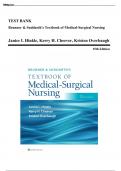
Test bank for brunner suddarth s textbook of medical surgical nursing 14th edition
Test bank for brunner suddarth s textbook of medical surgical nursing 14th editionChapter 03: Critical Thinking, Ethical Decision Making and the Nursing Process 1. A nurse has been offered a position on an obstetric unit and has learned that the unit offers therapeutic abortions, a procedure which contradicts the nurses personal beliefs. What is the nurses ethical obligation to these patients? A) The nurse should adhere to professional standards of practice and offer service to these patients. B) The nurse should make the choice to decline this position and pursue a different nursing role. C) The nurse should decline to care for the patients considering abortion. D) The nurse should express alternatives to women considering terminating their pregnancy. Ans: B Feedback: To avoid facing ethical dilemmas, nurses can follow certain strategies. For example, when applying for a job, a nurse should ask questions regarding the patient population. If a nurse is uncomfortable with a particular situation, then not accepting the position would be the best option. The nurse is only required by law (and practice standards) to provide care to the patients the clinic accepts; the nurse may not discriminate between patients and the nurse expressing his or her own opinion and providing another option is inappropriate. 2. A terminally ill patient you are caring for is complaining of pain. The physician has ordered a large dose of intravenous opioids by continuous infusion. You know that one of the adverse effects of this medicine is respiratory depression. When you assess your patients respiratory status, you find that the rate has decreased from 16 breaths per minute to 10 breaths per minute. What action should you take? A) Decrease the rate of IV infusion. B) Stimulate the patient in order to increase respiratory rate. C) Report the decreased respiratory rate to the physician. D) Allow the patient to rest comfortably. Ans: C Feedback: harryson BRUNNER AND SUDDARTHS TEXTBOOK OF MEDICAL SURGICAL NURSING 14TH EDITION HINKLE TEST BANK Test Bank - Brunner & Suddarth's Textbook of Medical-Surgical Nursing 14e (Hinkle 2017) 42 NURSINGTB.COM End-of life issues that often involve ethical dilemmas include pain control, do not resuscitate orders, lifeharryson BRUNNER AND SUDDARTHS TEXTBOOK OF MEDICAL SURGICAL NURSING 14TH EDITION HINKLE TEST BANK Test Bank - Brunner & Suddarth's Textbook of Medical-Surgical Nursing 14e (Hinkle 2017) 43 NURSINGTB.COM support measures, and administration of food and fluids. The risk of respiratory depression is not the intent of the action of pain control. Respiratory depression should not be used as an excuse to withhold pain medication for a terminally ill patient. The patients respiratory status should be carefully monitored and any changes should be reported to the physician. 3. An adult patient has requested a do not resuscitate (DNR) order in light of his recent diagnosis with late stage pancreatic cancer. The patients son and daughter-in-law are strongly opposed to the patients request. What is the primary responsibility of the nurse in this situation? A) Perform a slow code until a decision is made. B) Honor the request of the patient. C) Contact a social worker or mediator to intervene. D) Temporarily withhold nursing care until the physician talks to the family. Ans: B Feedback: The nurse must honor the patients wishes and continue to provide required nursing care. Discussing the matter with the physician may lead to further communication with the family, during which the family may reconsider their decision. It is not normally appropriate for the nurse to seek the assistance of a social worker or mediator. A slow code is considered unethical. 4. An elderly patient is admitted to your unit with a diagnosis of community-acquired pneumonia. During admission the patient states, I have a living will. What implication of this should the nurse recognize? A) This document is always honored, regardless of circumstances. B) This document specifies the patients wishes before hospitalization. C) This document that is binding for the duration of the patients life. D) This document has been drawn up by the patients family to determine DNR status. Ans: B Feedback: A living will is one type of advance directive. In most situations, living wills are limited to situations in which the patients medical condition is deemed terminal. The other answers are incorrect because living wills are not always honored, they are not binding for the duration of the patients life, and they are not drawn up by the patients family.
Escuela, estudio y materia
- Institución
- Brunner suddarth s textbook of medic
- Grado
- Brunner suddarth s textbook of medic
Información del documento
- Subido en
- 22 de noviembre de 2023
- Número de páginas
- 24
- Escrito en
- 2023/2024
- Tipo
- Examen
- Contiene
- Preguntas y respuestas
Temas
-
test bank for brunner suddarth s textbook of medic
-
chapter 03 critical thinking ethical decision ma