Principles of Microeconomics Lecture 11 – Equilibrium
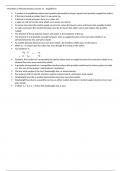
A market is in equilibrium when total quantity demanded by buyers equals total quantity supplied by sellers.
If the tax is levied on sellers then it is an excise tax.
If the tax is levied on buyers then it is a sales tax.
a sales tax rate $t has the same effect as an excise tax rate $t.
An excise tax raises the market supply curve by $t, raises the buyers’ price and lowers the quantity traded.
An sales tax lowers the market demand curve by $t, lowers the sellers’ price and reduces the quantity
traded.
The division of the $t between buyers and sellers is the incidence of the tax.
The fraction of a $t quantity tax paid by buyers rises as supply becomes more own-price elastic or as
demand becomes less own-price elastic.
As market demand becomes less own-price elastic, tax incidence shifts more to the buyers
When eD = 0, buyers pay the entire tax, even though it is levied on the sellers
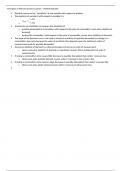
Tax incidence is
o
Similarly, the fraction of a $t quantity tax paid by sellers rises as supply becomes less own-price elastic or as
demand becomes more own-price elastic.
A quantity tax imposed on a competitive market reduces the quantity traded and so reduces gains-to-trade
(i.e. the sum of Consumers’ and Producers’ Surpluses).
The lost total surplus is the tax’s deadweight loss, or excess burden.
Tax reduces both CS and PS, transfers surplus to government, and lowers total surplus
Deadweight loss falls as market demand becomes less own-price elastic.
Deadweight loss due to a quantity tax rises as either market demand or market supply becomes more own-
price elastic.
If either eD = 0 or eS = 0 then the deadweight loss is zero.
A market is in equilibrium when total quantity demanded by buyers equals total quantity supplied by sellers.
If the tax is levied on sellers then it is an excise tax.
If the tax is levied on buyers then it is a sales tax.
a sales tax rate $t has the same effect as an excise tax rate $t.
An excise tax raises the market supply curve by $t, raises the buyers’ price and lowers the quantity traded.
An sales tax lowers the market demand curve by $t, lowers the sellers’ price and reduces the quantity
traded.
The division of the $t between buyers and sellers is the incidence of the tax.
The fraction of a $t quantity tax paid by buyers rises as supply becomes more own-price elastic or as
demand becomes less own-price elastic.
As market demand becomes less own-price elastic, tax incidence shifts more to the buyers
When eD = 0, buyers pay the entire tax, even though it is levied on the sellers
Tax incidence is
o
Similarly, the fraction of a $t quantity tax paid by sellers rises as supply becomes less own-price elastic or as
demand becomes more own-price elastic.
A quantity tax imposed on a competitive market reduces the quantity traded and so reduces gains-to-trade
(i.e. the sum of Consumers’ and Producers’ Surpluses).
The lost total surplus is the tax’s deadweight loss, or excess burden.
Tax reduces both CS and PS, transfers surplus to government, and lowers total surplus
Deadweight loss falls as market demand becomes less own-price elastic.
Deadweight loss due to a quantity tax rises as either market demand or market supply becomes more own-
price elastic.
If either eD = 0 or eS = 0 then the deadweight loss is zero.