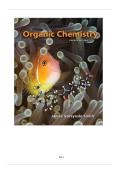
Test Bank of Organic Chemistry 4th Edition By Janice Smith All Chapters 1-31| Complete Solutions (LATEST VERSION) Assured A+.
Test Bank of Organic Chemistry 4th Edition By Janice Smith All Chapters 1-31| Complete Solutions (LATEST VERSION) Assured A+. Chapter 1: Structure and Bonding 1. What is the ground-state electronic configuration of a carbon atom? A) 1s2 , 2s2 , 2p5 B) 1s2 , 2s2 , 2p2 C) 1s2 , 2s2 , 2p6 D) 1s2 , 2s2 , 2p4 2. What is the ground-state electronic configuration of a fluorine atom? A) 1s2 , 2s2 , 2p2 B) 1s2 , 2s2 , 2p3 C) 1s2 , 2s2 , 2p4 D) 1s2 , 2s2 , 2p5 3. What is the ground-state electronic configuration of a magnesium cation (Mg2+)? A) 1s2 , 2s2 , 2p6 C) 1s2 , 2s2 , 2p6 , 3s2 B) 1s2 , 2s2 , 2p6 , 3s1 D) 1s2 , 2s2 , 2p6 , 3s2 , 3p2 4. What is the ground-state electronic configuration of a chlorine anion (Cl—)? A) 1s2 , 2s2 , 2p6 C) 1s2 , 2s2 , 2p6 , 3s2 , 3p5 B) 1s2 , 2s2 , 2p6 , 3s2 , 3p6 D) 1s2 , 2s2 , 2p6 , 3s2 , 3p4 5. Which of the following statements about valence electrons is true? A) They are the most tightly held electrons. B) They do not participate in chemical reactions. Page 1 Test Bank of Organic Chemistry 4th Edition By Janice Smith All Chapters 1-31| Complete Solutions (LATEST VERSION) Assured A+. Chapter 1: Structure and Bonding C) They are the outermost electrons. D) They reveal the period number of a second-row element. 6. Which of the following statements about bonding is true? A) Covalent bonds result from the transfer of electrons from one element to another. B) Ionic bonds result from the transfer of electrons from a metal to a non-metal. C) Ionic bonds result from the sharing of electrons between two non-metals. D) Covalent bonds result from the sharing of electrons between two metals. 7. Which of the following would you expect to have ionic bonds? A) CO B) FBr C) NF3 D) NaCl 8. Which of the following molecules has nonpolar covalent bonds? A) HCl B) N2 C) CHCl3 D) NO 9. Which of the following molecules contain both covalent and ionic bonds? A) I, II B) I, IV C) II, III D) II, IV 10. Arrange the following bonds in decreasing order of ionic character, putting the most ionic first. A) I II III IV C) IV III II I B) IV II I III D) IV II III I 11. Which of the following statements correctly describes the typical number of bonds for carbon, nitrogen, and oxygen in most neutral organic molecules? A) Carbon forms 4 covalent bonds, nitrogen forms 2 covalent bonds and oxygen forms 3 covalent bonds. B) Carbon forms 4 covalent bonds, nitrogen forms 3 covalent bonds and oxygen forms 2 covalent bonds. Page 2 Chapter 1: Structure and Bonding C) Carbon forms 4 covalent bonds, nitrogen forms 5 covalent bonds and oxygen forms 2 covalent bonds. D) Carbon forms 4 covalent bonds, nitrogen forms 5 covalent bonds and oxygen forms 4 covalent bonds. 12. Which is not an acceptable Lewis structure for the anion CH2NCO—? A) I B) II C) III D) IV 13. Which of the following Lewis structures is correct? A) I B) II C) III D) IV 14. Which of the following Lewis structures is correct? A) I, II B) I, III C) II, III D) III, IV 15. Which is the correct Lewis structure for acetic acid (CH3CO2H)? A) I B) II C) III D) IV Page 3 Chapter 1: Structure and Bonding 16. In which of the following ions does carbon have a formal charge? A) I B) II C) III D) None of the above 17. In which of the following ions does carbon have a formal charge? A) I B) II C) III D) None of the above 18. What is the formal charge of carbon in carbon monoxide (CO) when drawn with a triple bond? A) 0 B) -2 C) -1 D) +1 19. Which of the following statements about constitutional isomers is true? A) Constitutional isomers are different molecules having different molecular formula. B) Constitutional isomers are different molecules having same molecular formula. C) Constitutional isomers are same molecules having different molecular formula. D) Constitutional isomers are same molecules having the same molecular formula. 20. How many constitutional isomers are there for a molecule having the molecular formula C2H6O? A) 1 B) 2 C) 3 D) 4 21. How many constitutional isomers are there for a molecule having the molecular C3H8O? A) 1 B) 2 C) 3 D) 4 22. How many constitutional isomers are there for a molecule having the molecular formula C3H6? A) 1 B) 2 C) 3 D) 4 23. How many constitutional isomers are there for a molecule having the molecular formula C2H4Cl2? A) 1 B) 2 C) 3 D) 4 24. How many different isomers are there for a compound having the molecular formula C3H6O? A) 4 B) 5 C) 6 D) 7 Page 4 Chapter 1: Structure and Bonding 25. Which of the following molecules are constitutional isomers? A) I, II, IV B) II, III, IV C) I, III, IV D) I, II, III 26. Which of the following compounds has an atom with an unfilled valence shell of electrons? A) H2O B) BCl3 C) CH4 D) CO2 27. Which of the following statements about resonance structures is true? A) Resonance structures have the same placement of electrons but different arrangement of atoms. B) Resonance structures have the same placement of atoms but different arrangement of electrons. C) Resonance structures have the same placement of atoms and the same arrangement of electrons. D) Resonance structures have different placement of atoms and different arrangement of electrons. 28. Which of the following statements about resonance structures is not true? A) There is no movement of electrons from one form to another. B) Resonance structures are not isomers. C) Resonance structures differ only in the arrangement of electrons. D) Resonance structures are in equilibrium with each other. 29. Which of the following pair does not represent resonance structures? A) I B) II C) III D) IV Page 5 Chapter 1: Structure and Bonding 30. What 2 things will change between two resonance structures? A) The position of multiple bonds and non-bonded electrons. B) The position of multiple bonds and single bonds. C) The placement of atoms and single bonds. D) The placement of atoms and non-bonded electrons. 31. Which of the following is a resonance structure of the compound below? A) I B) II C) III D) IV 32. Which of the following resonance structures is the least important contributor to the resonance hybrid of the formate anion, HCOO—? A) I B) II C) III D) IV 33. Rank the following in order of decreasing importance as contributing structures to the resonance hybrid of formaldehyde, H2CO. A) I II III B) I III II C) II I III D) III II I Page 6 Chapter 1: Structure and Bonding 34. Follow the curved arrows to draw the second resonance structure for the ion below. A) I B) II C) III D) IV 35. Which is more important in each pair of contributing resonance structures? A) II, IV, V B) II, III, V C) II, III, VI D) I, IV, V 36. What is the approximate value of the H-C-H bond angle in methane, CH4? A) 90° B) 109.5° C) 120° D) 180° 37. What is the approximate C-C-C bond angle in propene, CH3CH=CH2? A) 90° B) 109.5° C) 120° D) 180°.
Escuela, estudio y materia
- Institución
- Organic Chemistry 4th Edition
- Grado
- Organic Chemistry 4th Edition
Información del documento
- Subido en
- 21 de noviembre de 2023
- Número de páginas
- 346
- Escrito en
- 2023/2024
- Tipo
- Examen
- Contiene
- Preguntas y respuestas
Temas
-
test bank of organic chemistry 4th edition
-
organic chemistry 4th edition by janice smith
-
organic chemistry 4th edition all chapters 1 31
-
organic chemistry 4th edition complete solutions