ATI RN Nursing Care of Children Proctored Exam 2019
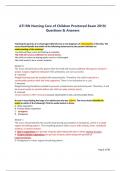
ATI RN Nursing Care of Children Proctored Exam 2019/ Questions & Answers Teaching the parents of a school-aged child who has a new diagnosis of osteomyelitis of the tibia. The nurse should identify that which of the following statements by the parents indicates an understanding of the teaching? my child will have a cast until healing is complete. My child will receive antibiotics forseveral weeks. My child can return to playing sports once he is discharged. My child needs to be in contact isolation. Answer: b The nurse should instruct the parent that the child will receive antibiotic therapy for at least 4 weeks. Surgery might be indicated if the antibiotics are not successful. A - incorrect Weight bearing must be avoided with osteomyelitis. Therefore, the child is placed in a comfortable position with the limb supported. There is no indication for a cast. C- incorrect Weight bearing should be avoided to prevent complications and minimize pain. Therefore, it will be several weeks to months before the child can play contact sports. D- incorrect Contact isolation is NOT necessary, because osteomyelitis is not a communicable illness. A nurse is auscultating the lungs of an adolescent who has asthma. The nurse should identify the sound as which of the following? Click the audio button to listen. A- Biots respiration B- Chaney Stokesrespiration C- tackypnea D - Bradypnea Answer- c The nurse should identify the sound heard during auscultation as tachypnea, which is a rapid, regular breathing pattern. This breathing pattern often occurs with anxiety, fever, metabolic acidosis, or severe anemia. A- Biot's respirations are periods of apnea alternating with two or three shallow breaths. B- Cheyne-Stokesrespirations are periods of apnea alternating with periods of hyperventilation. D- Bradypnea is a slow, regular breathing pattern. Page 2 of 31 A nurse in an emergency department is caring for a school-age child who is experiencing an anaphylactic reaction. Which of the following is the priority action by the nurse? A- Elevate the head of the child's bed B- insert a large-bore IV catheter for the child C- determine the allergen that caused the child's reaction D- administer IM epinephrine to the child Answer- d Page 3 of 31 When using the urgent vs nonurgent approach to client care, the nurse determines that the priority action is administering IM epinephrine to the child. During an anaphylactic reaction, histamine release causes bronchoconstriction and vasodilation. Thisis an emergency because ultimately it causes decreased blood return to the heart. A- Elevating the head of the child's bed is important to facilitate breathing and circulation. However, it is not the priority action the nurse should take. B- Inserting a large bore IV catheter isimportant to facilitate administration of IV fluids and medications. However, it is not the priority action the nurse should take. C- Determining the allergen that caused the child's reaction is important to prevent any additional episodes of anaphylaxis. However, it is not the priority action the nurse should take. The nurse is preparing to administer an immunization to a four-year-old child. Which of the following actions should the nurse plan to take? A- Place the child in a prone position for the immunization B- request that the child's caregiver leave the room during the immunization C- administer the immunization using a 24 gauge needle D- inject the immunization slowly after aspirating for 3 seconds
Escuela, estudio y materia
- Institución
- ATI RN Nursing Care of Children Proctore
- Grado
- ATI RN Nursing Care of Children Proctore
Información del documento
- Subido en
- 19 de noviembre de 2023
- Número de páginas
- 32
- Escrito en
- 2023/2024
- Tipo
- Examen
- Contiene
- Preguntas y respuestas
Temas
-
ati rn nursing care of children proctored ex
-
ati rn nursing care of children proctored exam 201

Documento también disponible en un lote