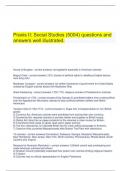
Praxis II: Social Studies (5004) questions and answers well illustrated.
Praxis II: Social Studies (5004) questions and answers well illustrated. House of Burgess - correct answers.1st legislative assembly in American colonies Magna Carta - correct answers.1215; charter of political rights to rebellious English barons from King John Mayflower Compact - correct answers.1st written framework of government for United States created by English colonist aboard the Mayflower Ship Great Awakening - correct answers.; religious revivals of Protestants in colonies Proclamation of 1763 - correct answers.King George III; prohibited settlers from crossing West over the Appalachian Mountains; attempt to stop conflicts between settlers and Native Americans Taxation Acts of - correct answers.1) Sugar Act: increased duties on non-British goods; 2) Currency Act: American colonies were prohibited from issuing their own currency; 3) Quartering Act: required colonies to provide shelter and supplies to British troops; 4) Stamp Act: direct tax on paper products for the colonies to raise money for Britain; 5) Townshend Acts: taxes on glass, lead, paint, paper and tea; 6) Tea Act: reduced tax on imported British tea for unfair selling advantage in America; 7) Coercive Acts: punished Massachusetts after Boston Tea Party with restrictions 13 colonies - correct answers.Connecticut, Delaware, Georgia, Maryland, Massachusetts, New Hampshire, New Jersey, New York, North Carolina, Pennsylvania, Rhode Island, South Caroline and Virginia Reasons for American Revolution - correct answers.1) British control was overbearing and made American colonies feel inferior 2) Anglican Church potentially expanded their power over colonies limiting religious freedom 3) Taxation 4) Colonies had no official representation in English Parliament 5) British attempts to block Westward expansion Events Leading up to American Revolution - correct answers.1) Sons of Liberty: Samuel Adams led protest group 2) Boston Massacre: 1770; soldiers fired on a crowd 3) Committees of Correspondence: set up through colonies to spread revolutionary ideas 4) The Boston Tea Party: 1773; Sons of Liberty dumped tea into the Boston Harbor from a British ship to protest tax 5) First Continental Congress: 1774; colonies list grievances and develop a plan to boycott 6) The Shot Heard Round the World: 1775; fight ensued between English soldiers and colonial militia (Minutemen) Turning Points of American Revolution - correct answers.1) Actions of Second Continental Congress: established Continental Army led by George Washington 2) "Common Sense": written by Thomas Paine in 1776; called for independence 3) Alliance with France: 1778; Benjamin Franklin negotiated an agreement with France to fight with the Americans 4) Treaty of Paris: 1782; signaled the end of the war; granted colonies independence and gave them territorial rights Declaration of Independence - correct answers.July 4th, 1776; the document that proclaimed independence of the colonies from Great Britain by the 2nd Continental Congress; written by Thomas Jefferson Articles of Confederation - correct answers.1777; the nation's first constitution designed to protect the states' rights over the national government US Constitution - correct answers.1789; created the 3 branches with checks and balances and a bicameral legislature for equal representation; Federalists v. Anti-Federalists Federalist Papers - correct answers.1787-88; Written by James Madison, John Jay and Alexander Hamilton Basic Principles of the Constitution - correct answers.1) Popular Sovereignty: people establish government and give power to it; government functions only with consent of the people 2) Limited Government: specifies limits on government authority 3) Separation of Powers: power is divided among 3 government branches 4) Checks and Balances: ensures each branch has the authority and ability to restrain the powers of the other 2 branches to prevent tyranny 5) Judicial Review: established by Marbury v. Madison; the judiciary may evaluate actions/powers of legislature and executive to ensure they are abiding by the Constitution; if unconstitutional the judicial branch can nullify 6) Federalism: division of power between the central government and local governments to limit the power of the Federal government and allows states to deal with local problems Delegated Powers in the Constitution - correct answers.Powers granted by the Constitution 1) Expressed/Enumerated: specific 2) Inherent: powers the National governments have historically possessed 3) Implied: not expressly stated; reasonably suggested 4) Reserved: powers that belong to the states 5) Exclusive: reserved to the national government 6) Concurrent: powers that are shared by national and state governments
Escuela, estudio y materia
- Institución
- Praxis II: Social Studies
- Grado
- Praxis II: Social Studies
Información del documento
- Subido en
- 17 de noviembre de 2023
- Número de páginas
- 11
- Escrito en
- 2023/2024
- Tipo
- Examen
- Contiene
- Preguntas y respuestas
Temas
-
praxis ii social studies 5004 questions

Documento también disponible en un lote