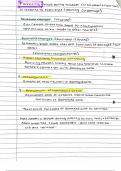
Lecture 1: Research perspectives, research objective
and questions
Gray, H1 – 3
Learning goals
- Students are able to identify current and complex public health challenges
- Students are able to explain different epistemological stances (e.g., objectivism,
constructivism), theoretical perspectives (e.g., positivism, interpretivism) and the relationship
between them
- Students can define and give examples of epistemic injustice in health sciences
- Students can reflect on their own positionality
- Students are able to formulate an objective and research questions
Epistemology and theoretical perspectives and the relationship
between them
Epistemology is important because:
- A knowledge of research philosophy will help the researcher to recognize which design will
work.
- It can help clarify issues of the research design.
Three different types of theory of knowledge:
1. Objectivism: Research is about discovering an objective truth. There’s objective reality out
there. Don’t include own feelings.
a. Connects to theoretical perspective of Positivism: There is only one truth and reality
can be measured.
b. Post-positivism: We can only approximate the truth.
2. Constructivism: There is no external world. Meaning is created, not discovered, by the
subject’s interactions with the world. Subjects construct their own meaning in different ways,
even in relation to the same phenomenon. Knowledge is constructed in a certain context.
a. Connects to theoretical perspective of Interpretivism: Multiple, contradictory but
equally valid accounts of the world can exist.
3. Subjectivism: Knowledge isn’t created by interaction, but it is imposed by the subject on the
object. Subjects do construct meaning, but do so from cultural and religious beliefs.
4. Critical inquiry: Questions currently held values and assumptions and challenges
conventional social structures. Is not content to interpret the world, but seeks to change it.
,The theoretical perspectives are too broad to generate research questions. Instead, conceptual
frameworks are used to generate research questions.
Epistemic injustice
Epistemic injustice occurs if knowledge held by people who belong to marginalized groups is afforded
less credibility. Health researchers e.g. still choose to interview a disabled person’s caretaker instead
of the person itself because they are considered less competent. Even though the person itself is best
to describe his/her own needs.
Two types of injustice:
1. Testimonial injustice: The hearer takes the speaker’s words less seriously because of
ingrained prejudice. Because of a specific characteristic you find them less credible.
2. Hermeneutical injustice: People do not have the words to describe their experience or have
enough shared experience, making them seem dishonest.
Objective and research questions
A research topic can arise from own previous research or experiences from fieldwork.
Structure of an introduction:
- Broad area of research
- Wat is known/done about it
- What is not known/done about it and why is this a problem
- Therefore, the objective of this study is …
- Objective is:
o Informative (knowledge is going to gained)
o Useful (study can be used to take action)
o Realistic (likelihood of contributing to solving the problem)
o Feasible (time and resources)
o Clear (specify contribution)
Internal objective: objective of the study itself.
External objective: contribution to the bigger picture.
The aim is to [know/understand/gain insights] (internal) in order to [do something about the
problem] (external)
The research objective is to [do something about the problem] (external) by [gaining
knowledge] (internal)
Research questions shouldn’t become as a surprise. You have to introduce the topic by literature
study.
Lecture 2: Conceptual frameworks and
operationalizing your research
Learning goals
, - Students are able to explain inductive and deductive reasoning
- Students are able to explain what a theory / conceptual framework is
- Students are able to explain why and how we use theory / conceptual frameworks in
research
- Students are familiar with the main considerations when selecting a theory / conceptual
framework for a given study
Role of theory / conceptual frameworks
In Health Sciences (e.g. biomedical sciences) theories are mainly used in the methods (‘we’re using
tool X, which is based on theory Y’), whereas in social sciences it’s included in a distinct part.
In quantitative research, the concepts are operationalized in indicators (or variables) that provide
structure to the measurement tools (e.g. the sub-scales from questionnaires in surveys). In qualitative
research the concepts are more loosely used to provide guidance to data collection tools (= inductive
approach) and provide interpretive frames for analysis (= deductive approach).
Inductive vs. deductive reasoning
Deductive reasoning: Theory -> Hypothesis -> Data collection -> Confirmation, rejection, modification
The theory that is used as a basis for the study is clarified in the theoretical framework. If for
example the study is based on a model of stigma, multiple types of stigmas that exist are explained in
the conceptual framework. The collected data is compared to the theory that was elaborated in the
conceptual frameworks to see if the data fits one of the stigma’s. Then you can either confirm or
reject your hypothesis. For example, the hypothesis could be that stigma exists among people with
leprosy. Based on interviews you can confirm this hypothesis. If new stigmas arise, you can add it to
the model (abductive reasoning).
Inductive reasoning: Data collection -> Analyses: patterns e.g. -> Hypothesis -> Theory
Data collection leads to a new theory, however it’s difficult to have a completely open view
on data as many people already have a certain theory in their head. For data collection, an existing
theory or sensitizing topics can be used to make the topic list. For analysis, no framework is used.
Reality: Deductive approach -> Inductive approach -> Deductive approach
For some data in interviews you try to think inductively, however it may be possible that a
theory already exist for it.
Why and how to use theories / conceptual frameworks
, Theory: A set of interrelated constructs (concepts), definitions and propositions that present a
systematic view of phenomena by specifying relations among variables, with the purpose of
explaining and predicting phenomena. It’s a simplification of a more complex reality.
Constructs/concepts are:
- Observable (for example, well-being, risks, health)
- Distinguishable
- Variable
Frameworks are:
- The description of concepts
- The relation between concepts in order to understand a real-world problem.
Conceptual frameworks can be visualized in a model or described. It can help to:
- Formulate specific research questions. The objective contains a core concept which may fit a
model, which then can be used to generate specific research questions.
- Select the right tools that guide data collection -> For example, an interview guide can be
based on an existing model.
- Analyze results (deductive approach).
- Make research understandable to others.
Some disadvantages are:
- Time-consuming to develop.
- Overly simplistic (limits their usefulness in complex situations).
- Developed for specific situations (not useful in other contexts).
- Tough to incorporate new ideas.
When deciding on a conceptual framework you have to justify your choice. Also:
- Provide some historical context.
- Introduce fields and areas in which it has been applied.
- Describe the model in detail.
- Position it in your own study and present critiques.
Selecting a theory / conceptual framework for a study
1. A framework that exactly fits your research topic -> Search for the concepts in your aim in
literature. There may exist a model for controlling a certain infectious disease, but not the
disease you want to research. Then, you can use that model for your research.
2. Multiple theories from the literature need to be combined.
3. Several relevant concepts can be derived from literature (sensitizing concepts) -> A
framework is not imposed on the situation, but you research the concepts in your aim in
order to give you direction in your own research. E.g. in case of research in coping strategies
after divorce, you look into which coping strategies are already described in literature. They
help you understand a certain phenomenon. The concept is deconstructed, which can help to
steer the interview towards certain directions.
4. Framework emerges from the data (Grounded Theory) -> A researcher derives a general,
abstract theory of a process, action or interaction grounded in the views of participants. A
model emerges from the data.
In order to select the right option, you can:
1. ask yourself theoretical questions or (what does this mean in my research question?)
and questions
Gray, H1 – 3
Learning goals
- Students are able to identify current and complex public health challenges
- Students are able to explain different epistemological stances (e.g., objectivism,
constructivism), theoretical perspectives (e.g., positivism, interpretivism) and the relationship
between them
- Students can define and give examples of epistemic injustice in health sciences
- Students can reflect on their own positionality
- Students are able to formulate an objective and research questions
Epistemology and theoretical perspectives and the relationship
between them
Epistemology is important because:
- A knowledge of research philosophy will help the researcher to recognize which design will
work.
- It can help clarify issues of the research design.
Three different types of theory of knowledge:
1. Objectivism: Research is about discovering an objective truth. There’s objective reality out
there. Don’t include own feelings.
a. Connects to theoretical perspective of Positivism: There is only one truth and reality
can be measured.
b. Post-positivism: We can only approximate the truth.
2. Constructivism: There is no external world. Meaning is created, not discovered, by the
subject’s interactions with the world. Subjects construct their own meaning in different ways,
even in relation to the same phenomenon. Knowledge is constructed in a certain context.
a. Connects to theoretical perspective of Interpretivism: Multiple, contradictory but
equally valid accounts of the world can exist.
3. Subjectivism: Knowledge isn’t created by interaction, but it is imposed by the subject on the
object. Subjects do construct meaning, but do so from cultural and religious beliefs.
4. Critical inquiry: Questions currently held values and assumptions and challenges
conventional social structures. Is not content to interpret the world, but seeks to change it.
,The theoretical perspectives are too broad to generate research questions. Instead, conceptual
frameworks are used to generate research questions.
Epistemic injustice
Epistemic injustice occurs if knowledge held by people who belong to marginalized groups is afforded
less credibility. Health researchers e.g. still choose to interview a disabled person’s caretaker instead
of the person itself because they are considered less competent. Even though the person itself is best
to describe his/her own needs.
Two types of injustice:
1. Testimonial injustice: The hearer takes the speaker’s words less seriously because of
ingrained prejudice. Because of a specific characteristic you find them less credible.
2. Hermeneutical injustice: People do not have the words to describe their experience or have
enough shared experience, making them seem dishonest.
Objective and research questions
A research topic can arise from own previous research or experiences from fieldwork.
Structure of an introduction:
- Broad area of research
- Wat is known/done about it
- What is not known/done about it and why is this a problem
- Therefore, the objective of this study is …
- Objective is:
o Informative (knowledge is going to gained)
o Useful (study can be used to take action)
o Realistic (likelihood of contributing to solving the problem)
o Feasible (time and resources)
o Clear (specify contribution)
Internal objective: objective of the study itself.
External objective: contribution to the bigger picture.
The aim is to [know/understand/gain insights] (internal) in order to [do something about the
problem] (external)
The research objective is to [do something about the problem] (external) by [gaining
knowledge] (internal)
Research questions shouldn’t become as a surprise. You have to introduce the topic by literature
study.
Lecture 2: Conceptual frameworks and
operationalizing your research
Learning goals
, - Students are able to explain inductive and deductive reasoning
- Students are able to explain what a theory / conceptual framework is
- Students are able to explain why and how we use theory / conceptual frameworks in
research
- Students are familiar with the main considerations when selecting a theory / conceptual
framework for a given study
Role of theory / conceptual frameworks
In Health Sciences (e.g. biomedical sciences) theories are mainly used in the methods (‘we’re using
tool X, which is based on theory Y’), whereas in social sciences it’s included in a distinct part.
In quantitative research, the concepts are operationalized in indicators (or variables) that provide
structure to the measurement tools (e.g. the sub-scales from questionnaires in surveys). In qualitative
research the concepts are more loosely used to provide guidance to data collection tools (= inductive
approach) and provide interpretive frames for analysis (= deductive approach).
Inductive vs. deductive reasoning
Deductive reasoning: Theory -> Hypothesis -> Data collection -> Confirmation, rejection, modification
The theory that is used as a basis for the study is clarified in the theoretical framework. If for
example the study is based on a model of stigma, multiple types of stigmas that exist are explained in
the conceptual framework. The collected data is compared to the theory that was elaborated in the
conceptual frameworks to see if the data fits one of the stigma’s. Then you can either confirm or
reject your hypothesis. For example, the hypothesis could be that stigma exists among people with
leprosy. Based on interviews you can confirm this hypothesis. If new stigmas arise, you can add it to
the model (abductive reasoning).
Inductive reasoning: Data collection -> Analyses: patterns e.g. -> Hypothesis -> Theory
Data collection leads to a new theory, however it’s difficult to have a completely open view
on data as many people already have a certain theory in their head. For data collection, an existing
theory or sensitizing topics can be used to make the topic list. For analysis, no framework is used.
Reality: Deductive approach -> Inductive approach -> Deductive approach
For some data in interviews you try to think inductively, however it may be possible that a
theory already exist for it.
Why and how to use theories / conceptual frameworks
, Theory: A set of interrelated constructs (concepts), definitions and propositions that present a
systematic view of phenomena by specifying relations among variables, with the purpose of
explaining and predicting phenomena. It’s a simplification of a more complex reality.
Constructs/concepts are:
- Observable (for example, well-being, risks, health)
- Distinguishable
- Variable
Frameworks are:
- The description of concepts
- The relation between concepts in order to understand a real-world problem.
Conceptual frameworks can be visualized in a model or described. It can help to:
- Formulate specific research questions. The objective contains a core concept which may fit a
model, which then can be used to generate specific research questions.
- Select the right tools that guide data collection -> For example, an interview guide can be
based on an existing model.
- Analyze results (deductive approach).
- Make research understandable to others.
Some disadvantages are:
- Time-consuming to develop.
- Overly simplistic (limits their usefulness in complex situations).
- Developed for specific situations (not useful in other contexts).
- Tough to incorporate new ideas.
When deciding on a conceptual framework you have to justify your choice. Also:
- Provide some historical context.
- Introduce fields and areas in which it has been applied.
- Describe the model in detail.
- Position it in your own study and present critiques.
Selecting a theory / conceptual framework for a study
1. A framework that exactly fits your research topic -> Search for the concepts in your aim in
literature. There may exist a model for controlling a certain infectious disease, but not the
disease you want to research. Then, you can use that model for your research.
2. Multiple theories from the literature need to be combined.
3. Several relevant concepts can be derived from literature (sensitizing concepts) -> A
framework is not imposed on the situation, but you research the concepts in your aim in
order to give you direction in your own research. E.g. in case of research in coping strategies
after divorce, you look into which coping strategies are already described in literature. They
help you understand a certain phenomenon. The concept is deconstructed, which can help to
steer the interview towards certain directions.
4. Framework emerges from the data (Grounded Theory) -> A researcher derives a general,
abstract theory of a process, action or interaction grounded in the views of participants. A
model emerges from the data.
In order to select the right option, you can:
1. ask yourself theoretical questions or (what does this mean in my research question?)