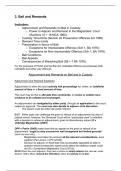
3. Bail and Remands
Includes:
- Adjournment and Remands on Bail in Custody;
o Power to Adjourn and Remand in the Magistrates’ Court
(Sections 10 + 18 MCA 1980);
- Custody Time-limits (Section 22 Prosecution Offences Act 1985)
- Remand Time-Limits
- Presumption in favour of Bail;
o Exceptions for Imprisonable Offences (Sch 1, BA 1976);
o Exceptions for Non-imprisonable Offences (Sch 1, BA 1976).
- Bail Conditions;
- Bail Appeals;
- Consequences of Breaching Bail (S6 + 7 BA 1976).
For the purposes of PACE and the Bail Act, Indictable Offence encompasses both
indictable and either way offences.
Adjournment and Remands on Bail and in Custody
Adjournment and Remand Explained
Adjournment is when the court actively halt proceedings for, either, an indefinite
amount of time or a fixed amount of time.
The court may do this to alleviate time constraints; to review or enable more
evidence to be collated and exchanged.
An adjournment can instigated by either party, through an application to the court;
subject to approval. The court can also decide to adjourn at its discretion.
- The reason must be within the public interest.
D.27 Either party can challenge the grant or refusal of an adjournment by way of
judicial review, however, the Divisional Court will be “particularly slow” to interfere
with a decision to refuse an adjournment, given its discretionary nature (R v
Uxbridge Magistrates (2007))
DPP v Petrie (2005) made clear that an appeal on the grant or refusal of an
adjournment “ought to only succeed on well recognised but limited grounds”
(such as error etc.)
- Magistrates must take into account all the relevant considerations, even
weather (Pari-Jones v CPS (2018)).
- Decision to adjourn on fixed date was successfully appealed as date in
question meant prosecution expert could attend but defence expert could
not (R v Sunderland Magistrates Court (2019)).
D5.30 When the court adjourns, they have a choice to simply adjourn the case or, under
Section 128(1) MCA, remand the defendant, either in custody or on bail.
, Simple adjournment is when the defendant remains totally at liberty for the period
of the adjournment;
- Only Magistrates’ Courts do this;
Remanding the accused in custody involves taking them into police custody for
the duration of the adjournment;
- If the court choose to do this, the adjournment will have to be for a fixed
period.
Remanding the defendant on bail means the defendant will be free to leave but
under conditions;
These powers are regulated in the Magistrates Court by the MCA 1980, Ss10(1) and 18(4)
Statutory Provisions on Power to Adjourn and Remand in the Magistrates Court
S10 MCA 1980- Applies to appearances for summary offences up until conviction, and to appearances for either
way offences from after allocation has been determined.
(1) A magistrates’ court may at any time adjourn a trial of fact.
(2) The court may either fix the time and place at which the trial is to be resumed, or, unless it
remands the accused, leave the time and place to be determined later by the court; but the trial
shall not be resumed at that time and place unless the court is satisfied that the parties have had
adequate notice.
…
(4) On adjourning a trial of fact, the court may remand the accused and, where the accused has
attained the age of 18 years, shall do so if the offence is triable either way and:
(a) on the occasion on which the accused first appeared, or was brought before the court to
answer to the information, he was in custody or, having been released on bail,
surrendered to the custody of the court; or
(b) the accused has been remanded at any time in the course of proceedings on the
information;
and, where the court remands the accused, the time fixed for the resumption of the trial shall be
that at which he is required to appear or be brought before the court in pursuance of the remand or
would be required to be brought before the court but for section 128(3A) below.
Essentially, s10 MCA 1980 affords the Magistrates Court the power to adjourn a trial at any
point and remand the accused if they do so. The accused must be remanded if: the
offence is one of either way and the accused has appeared under police custody at any
stage in the proceedings prior.
So if the defendant first appeared in response to summons or requisition and has not been
remanded at an earlier hearing in proceedings he will not need to be remanded, unless it is
in the interest of justice to do so.
S18 MCA 1980- Governs adjournments until allocation has been determined.
- Sections 19 to 23 below shall have effect where a person who has attained the age of 18 years
appears or is brought before a magistrates’ court on an information charging him with an offence
triable either way and:
(1) he indicates he would plead not guilty, or
(2) his representative indicates he would plead not guilty.
(4) A magistrates’ court may adjourn the proceedings at any time, and on doing so on any occasion when
, Both section 10(4) and 18(4) are essentially saying the same thing… that, when
adjourning either way proceedings, the court must remand the accused unless they
appeared in answer to summons/ requisition and have not been remanded in
an earlier hearing, in which case it must be in the interest of justice.
Remands in Custody in the Absence of the Accused
D5.33 To avoid the accused of being dragged before the court in custody, when it is
obvious that no progress will be possible at the hearing, a remand in custody may
take place in the absence of the accused, under s128(3A to 3E). Only if the
accused:
(a) Has consented at an early hearing to not be present in future remands;
(b) Has a legal representative acting in the case (no need to be present);
(c) Has not been remanded in absence of more than two consecutive
occasions; and
(d) Has not withdrawn consent.
Time Limits
Custody Time-Limits (CTL)
Custody time limits are the statutory limitations put on the maximum amount of
time a defendant can spend on remand, whilst awaiting trial. To prevent unduly
long periods on liberty restrictions.
Includes:
- Adjournment and Remands on Bail in Custody;
o Power to Adjourn and Remand in the Magistrates’ Court
(Sections 10 + 18 MCA 1980);
- Custody Time-limits (Section 22 Prosecution Offences Act 1985)
- Remand Time-Limits
- Presumption in favour of Bail;
o Exceptions for Imprisonable Offences (Sch 1, BA 1976);
o Exceptions for Non-imprisonable Offences (Sch 1, BA 1976).
- Bail Conditions;
- Bail Appeals;
- Consequences of Breaching Bail (S6 + 7 BA 1976).
For the purposes of PACE and the Bail Act, Indictable Offence encompasses both
indictable and either way offences.
Adjournment and Remands on Bail and in Custody
Adjournment and Remand Explained
Adjournment is when the court actively halt proceedings for, either, an indefinite
amount of time or a fixed amount of time.
The court may do this to alleviate time constraints; to review or enable more
evidence to be collated and exchanged.
An adjournment can instigated by either party, through an application to the court;
subject to approval. The court can also decide to adjourn at its discretion.
- The reason must be within the public interest.
D.27 Either party can challenge the grant or refusal of an adjournment by way of
judicial review, however, the Divisional Court will be “particularly slow” to interfere
with a decision to refuse an adjournment, given its discretionary nature (R v
Uxbridge Magistrates (2007))
DPP v Petrie (2005) made clear that an appeal on the grant or refusal of an
adjournment “ought to only succeed on well recognised but limited grounds”
(such as error etc.)
- Magistrates must take into account all the relevant considerations, even
weather (Pari-Jones v CPS (2018)).
- Decision to adjourn on fixed date was successfully appealed as date in
question meant prosecution expert could attend but defence expert could
not (R v Sunderland Magistrates Court (2019)).
D5.30 When the court adjourns, they have a choice to simply adjourn the case or, under
Section 128(1) MCA, remand the defendant, either in custody or on bail.
, Simple adjournment is when the defendant remains totally at liberty for the period
of the adjournment;
- Only Magistrates’ Courts do this;
Remanding the accused in custody involves taking them into police custody for
the duration of the adjournment;
- If the court choose to do this, the adjournment will have to be for a fixed
period.
Remanding the defendant on bail means the defendant will be free to leave but
under conditions;
These powers are regulated in the Magistrates Court by the MCA 1980, Ss10(1) and 18(4)
Statutory Provisions on Power to Adjourn and Remand in the Magistrates Court
S10 MCA 1980- Applies to appearances for summary offences up until conviction, and to appearances for either
way offences from after allocation has been determined.
(1) A magistrates’ court may at any time adjourn a trial of fact.
(2) The court may either fix the time and place at which the trial is to be resumed, or, unless it
remands the accused, leave the time and place to be determined later by the court; but the trial
shall not be resumed at that time and place unless the court is satisfied that the parties have had
adequate notice.
…
(4) On adjourning a trial of fact, the court may remand the accused and, where the accused has
attained the age of 18 years, shall do so if the offence is triable either way and:
(a) on the occasion on which the accused first appeared, or was brought before the court to
answer to the information, he was in custody or, having been released on bail,
surrendered to the custody of the court; or
(b) the accused has been remanded at any time in the course of proceedings on the
information;
and, where the court remands the accused, the time fixed for the resumption of the trial shall be
that at which he is required to appear or be brought before the court in pursuance of the remand or
would be required to be brought before the court but for section 128(3A) below.
Essentially, s10 MCA 1980 affords the Magistrates Court the power to adjourn a trial at any
point and remand the accused if they do so. The accused must be remanded if: the
offence is one of either way and the accused has appeared under police custody at any
stage in the proceedings prior.
So if the defendant first appeared in response to summons or requisition and has not been
remanded at an earlier hearing in proceedings he will not need to be remanded, unless it is
in the interest of justice to do so.
S18 MCA 1980- Governs adjournments until allocation has been determined.
- Sections 19 to 23 below shall have effect where a person who has attained the age of 18 years
appears or is brought before a magistrates’ court on an information charging him with an offence
triable either way and:
(1) he indicates he would plead not guilty, or
(2) his representative indicates he would plead not guilty.
(4) A magistrates’ court may adjourn the proceedings at any time, and on doing so on any occasion when
, Both section 10(4) and 18(4) are essentially saying the same thing… that, when
adjourning either way proceedings, the court must remand the accused unless they
appeared in answer to summons/ requisition and have not been remanded in
an earlier hearing, in which case it must be in the interest of justice.
Remands in Custody in the Absence of the Accused
D5.33 To avoid the accused of being dragged before the court in custody, when it is
obvious that no progress will be possible at the hearing, a remand in custody may
take place in the absence of the accused, under s128(3A to 3E). Only if the
accused:
(a) Has consented at an early hearing to not be present in future remands;
(b) Has a legal representative acting in the case (no need to be present);
(c) Has not been remanded in absence of more than two consecutive
occasions; and
(d) Has not withdrawn consent.
Time Limits
Custody Time-Limits (CTL)
Custody time limits are the statutory limitations put on the maximum amount of
time a defendant can spend on remand, whilst awaiting trial. To prevent unduly
long periods on liberty restrictions.