CLEP Biology Study Guide
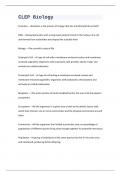
Evolution -->Evolution is the process of change that has transformed life on Earth DNA -->Deoxyribonucleic acid: a long linear polymer found in the nucleus of a cell and formed from nucleotides and shaped like a double helix Biology -->The scientific study of life Eukaryotic Cell -->A type of cell with a membrane-enclosed nucleus and membrane- enclosed organelles. Organisms with eukaryotic cells (protists, plants, fungi, and animals) are called eukaryotes. Prokaryotic Cell -->A type of cell lacking a membrane-enclosed nucleus and membrane-enclosed organelles. Organisms with prokaryotic cells (bacteria and archaea) are called prokaryotes. Biosphere -->The entire portion of Earth inhabited by life; the sum of all the planet's ecosystems. Ecosystems -->All the organisms in a given area as well as the abiotic factors with which they interact; one or more communities and the physical environment around them Community -->All the organisms that inhabit a particular area; an assemblage of populations of different species living close enough together for potential interaction. Population -->A group of individuals of the same species that live in the same area and interbreed, producing fertile offspring. Organism -->a creature such as a plant, animal or a single-celled life form, or something that has interdependent parts and that is being compared to a living creature Organs -->A specialized center of body function composed of several different types of tissues. Organ Systems -->A group of organs that work together in performing vital body functions. Tissues -->An integrated group of cells with a common structure, function, or both. Organelles -->Any of several membrane-enclosed structures with specialized functions, suspended in the cytosol of eukaryotic cells. Cell -->The part of a neuron that houses the nucleus and most other organelles. Molecule -->Two or more atoms held together by covalent bonds. Negative Feedback -->A form of regulation in which accumulation of an end product of a process slows the process; in physiology, a primary mechanism of homeostasis, whereby a change in a variable triggers a response that counteracts the initial change. Positive Feedback -->A form of regulation in which an end product of a process speeds up that process; in physiology, a control mechanism in which a change in a variable triggers a response that reinforces or amplifies the change. Adaptation -->Inherited characteristic of an organism that enhances its survival and reproduction in a specific environment. What are the 7 Characteristics of Life? -->1. Order 2. Regulation 3. Energy Processing 4. Evolutionary Adaptation 5. Response to the Environment 6. Reproduction 7. Growth and Development Metabolism -->The totality of an organism's chemical reactions, consisting of catabolic and anabolic pathways, which manage the material and energy resources of the organism. What are the three domains by which all living organisms are classified? -->Domain Bacteria Domain Archaea Domain Eukarya What are the 4 kingdoms in the Domain Eukarya? -->Plantae Animalia Fungi Protista What are Bacteria? -->All unicellular prokaryotic (no nucleus) organisms with peptidoglycan in their cell walls What is the Theory of Natural Selection? -->A process in which individuals that have certain inherited traits tend to survive and reproduce at higher rates than other individuals because of those traits. Why is evolution considered the core theme of biology? -->Evolution accounts for the unity and diversity of life and it explains the most fundamental aspects of all life on earth. It accounts for the common features shared by all forms of life due to the descent from a common ancestor.
Escuela, estudio y materia
- Institución
- CLEP Biology
- Grado
- CLEP Biology
Información del documento
- Subido en
- 6 de noviembre de 2023
- Número de páginas
- 65
- Escrito en
- 2023/2024
- Tipo
- Examen
- Contiene
- Preguntas y respuestas
Temas
-
clep biology
-
biology

Documento también disponible en un lote