Introductory Psychology CLEP Chapter 4: Sensation and Perception
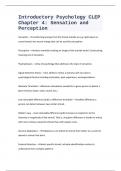
Sensation --Transforming energy from the stimuli outside us (e.g. light waves or sound waves) into neural energy that can be used for perception. Perception --Involves mentally creating an image of the outside world. Constructing meaning out of sensation. Psychophysics --Area of psychology that addresses the topic of sensation. Signal detection theory --Our ability to notice a stimulus will vary due to psychological factors including motivation, past experience, and expectations. Absolute Threshold --Minimum stimulation needed for a given person to detect a given stimulus (odor, taste, sound, etc.) Just noticeable difference (jnd) or difference threshold --Smallest difference a person can detect between two similar stimuli. Weber's Law --Just noticeable difference (jnd) increases in proportion to the intensity or magnitude of the stimuli. That is, any given difference is harder to notice with more intense, powerful stimuli than with weaker ones. Sensory Adaptation --Predisposes us to attend to stimuli that matter to us and not attend to stimuli that don't. Feature Detectors --Detect specific stimuli, activate identification centers to understand more complex patterns Selective Attention --Too many stimuli to attend to so the body is only aware of certain stimuli. Reality is chosen, organized, and interpreted, not simply detected. Gestalt Psychologists --Discovered that the brain pieces together meaningful experiences out of fragments of sensation, and the mind fills in gaps in our sensations. Depth Perception --Allows us to estimate distances between ourselves and objects we see (our retinas can only see 2D our brains do the rest). Uses binocular cues and/or monocular cues. Binocular Cues --Requires both eyes, and includes retinal disparity & convergence. Retinal Disparity --Uses differences in images between right and left eye to gauge distance. Convergence --Extent to which eyes must turn toward the nose to gauge closeness of an object. Monocular Cues --Uses one eye only for depth perception (includes linear perspective, motion parallax, and texture gradients). Linear Perspective --Parallel lines appear to converge as they get farther away. Closer together = farther away (like railroad tracks in the distance). Motion Parallax (or relative motion) --Apparent movement of stable objects as we move. Fixation points are what you are looking at (these objects move quickly when close to you and slowly when far away). Interposition --When an object partially blocks out another object and therefore looks closer than the object it is blocking out.
Escuela, estudio y materia
- Institución
- Psychology CLEP
- Grado
- Psychology CLEP
Información del documento
- Subido en
- 5 de noviembre de 2023
- Número de páginas
- 3
- Escrito en
- 2023/2024
- Tipo
- Examen
- Contiene
- Preguntas y respuestas
Temas
-
psychology clep
-
clep
-
sensation and perception
-
perception

Documento también disponible en un lote