

HCs parasitology
HC 1: introduction (31/10/22)
-Parasite -> An eukaryotic organism that must live in or on other
organisms (hosts) to complete its natural life cycle.
-Medical parasitology -> Eukaryotic organisms that infect human
hosts.
-Symbiosis -> ‘Organisms living together’ -> Close association
between two organisms
• (micro)organism and host
• Different forms:
o Commensalism -> (micro)organism benefits, and the
host is neither harmed nor helped
▪ Benefit is uni-directional
o Mutualism -> Both (micro)organism and host benefit
▪ Benefit is bi-directional
o Parasitism -> (micro)organism benefits, but the host
is harmed
▪ Benefit is uni-directional
-Endo VS ecto parasites:
• Endoparasites -> Live IN the host -> Infection
o Example: Plasmodium falciparum
o Protozoa -> Unicellular
o Metazoa -> Multicellular
• Ectoparasite -> Live ON the host -> Infestation
o Example: Pediculosis humanus capitis (head louse)
o Insecta -> Lice and fleas
o Arachnida -> Mites and ticks
-Facultative VS obligate:
• Facultative -> The parasite may exist in a free-living state
• Obligate -> The parasite cannot survive without its host
-Different types of hosts:
• Definitive host -> In which sexual replication takes place.
• Intermediate host -> Only asexual replication takes place (so no sexual replication).
• Accidental host -> Parasite is seldom found
in this host (host was infected by ‘accident’).
-Classification of parasites:
• Protozoa -> Unicellular eukaryotes
o Rhizopodes
o Cilliates
, o Flagellates
o Sporozoans
- Organelles of locomotion
- Reproduction -> Binary fission or
schizogony (multiple fission)
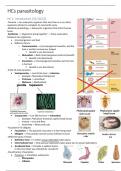
o Examples: (picture)
• Metazoa -> Multicellular eukaryotes
(helminths)
o Trematodes (fluke)
o Cestodes (tapeworm)
o Nematodes (roundworm)
- Their morphology/sex -> male or female or hermaphroditic and have a alimentary tract
(darmstelsel).
- Examples: (picture)
-Differences between protozoa and helminths:
• Protozoa:
o Size: 1-100 m
o Unicellular
o Intra- and extracellular
o Reproduction in host -> asexual and/or sexual
o Increase in parasite load (-)
• Helminths:
o size: mm - meters
o Multicellular
o Hermaphroditic or / worm
o Reproduction -> eggs of larvae
o Stable population
-Life cycles:
• Direct -> Parasite needs one HOST to
complete its life cycle.
o Example: Enterobius vermicularis
• Indirect -> Parasite needs TWO (or more)
HOSTS to complete its life cycle.
o Example: Taenia solium/saginata
,HC 2: Ectoparasites – nuisance and their role in disease transmission (03/11/22)
-One health -> Unites the different disciplines (human, animal and environmental health).
-Hair follicle mites -> demodex
• 1/3 of men have them (there are benign)
-Today’s topics:
• Overview of ectoparasites
• Nuisance
• Transmission of pathogens by vectors:
o Epidemiological concepts
o Example of malaria and alternatives for
malaria control
Overview of ectoparasites
-Parasites come from the kingdom Animalia.
• Pathogens come from Bacteria, Fungi, as well as
viruses.
, -(Negative) roles of arthropods in human health:
• Ectoparasitosis -> E. g. scabies mite
• Endoparasitosis -> E. g. fly larvae that cause myasis (invading tissue).
• Poisoning -> Wasp, bee stings, spider bites
• Allergic reactions -> House dust mite
• Nuisance (ergenis) -> Midges and black flies in summer
• Delusory parasitosis
• As a vector of a disease agent, such as viruses, bacteria and parasites -> E. g. malaria mosquitos,
black flies, ticks, tsetse flies, blood-sucking bugs, fleas, sand flies and body lice
o Most serious impact on human health.
-Global trends in vector-borne diseases (picture).
-Plague -> results of a flee bite, or direct transmission
• Ancient diseases are still around thus! (2017, in Madagascar)
-West Nile virus -> First case found in a bird, we also found them later in mosquitos.
• Problem now (in The Netherlands).
-Ectoparasites -> Organisms living at the expense of other species of organisms (hosts), particularly on the
external body surfaces
• Damage can be caused as a result of bloodfeeding, burrowing, crawling or scraping the skin surface.
Ectoparasites: their role in nuisance
-Examples of ectoparasites (and their role in nuisance):
• Pediculus humanus (hoofdluis) -> Obligate human parasite (adapted to
humans).
o Risk factor -> taking selfies
o Needs to be transmitted via hair-to-hair, when it falls on the ground, it
is a dead end for the lice.
• Blood-sucking crab louse (Phtirus pubis) (schaamluis) -> STD (sexual
transmitted disease)
o Actually becoming endangered
• Blood-feeding Bed bugs -> Direct damage
o Cause itchy bites
o Can be present in even hygienic sleep areas.
o Becoming more resisted to anti-insect stuff.
o Heating works!
HC 1: introduction (31/10/22)
-Parasite -> An eukaryotic organism that must live in or on other
organisms (hosts) to complete its natural life cycle.
-Medical parasitology -> Eukaryotic organisms that infect human
hosts.
-Symbiosis -> ‘Organisms living together’ -> Close association
between two organisms
• (micro)organism and host
• Different forms:
o Commensalism -> (micro)organism benefits, and the
host is neither harmed nor helped
▪ Benefit is uni-directional
o Mutualism -> Both (micro)organism and host benefit
▪ Benefit is bi-directional
o Parasitism -> (micro)organism benefits, but the host
is harmed
▪ Benefit is uni-directional
-Endo VS ecto parasites:
• Endoparasites -> Live IN the host -> Infection
o Example: Plasmodium falciparum
o Protozoa -> Unicellular
o Metazoa -> Multicellular
• Ectoparasite -> Live ON the host -> Infestation
o Example: Pediculosis humanus capitis (head louse)
o Insecta -> Lice and fleas
o Arachnida -> Mites and ticks
-Facultative VS obligate:
• Facultative -> The parasite may exist in a free-living state
• Obligate -> The parasite cannot survive without its host
-Different types of hosts:
• Definitive host -> In which sexual replication takes place.
• Intermediate host -> Only asexual replication takes place (so no sexual replication).
• Accidental host -> Parasite is seldom found
in this host (host was infected by ‘accident’).
-Classification of parasites:
• Protozoa -> Unicellular eukaryotes
o Rhizopodes
o Cilliates
, o Flagellates
o Sporozoans
- Organelles of locomotion
- Reproduction -> Binary fission or
schizogony (multiple fission)
o Examples: (picture)
• Metazoa -> Multicellular eukaryotes
(helminths)
o Trematodes (fluke)
o Cestodes (tapeworm)
o Nematodes (roundworm)
- Their morphology/sex -> male or female or hermaphroditic and have a alimentary tract
(darmstelsel).
- Examples: (picture)
-Differences between protozoa and helminths:
• Protozoa:
o Size: 1-100 m
o Unicellular
o Intra- and extracellular
o Reproduction in host -> asexual and/or sexual
o Increase in parasite load (-)
• Helminths:
o size: mm - meters
o Multicellular
o Hermaphroditic or / worm
o Reproduction -> eggs of larvae
o Stable population
-Life cycles:
• Direct -> Parasite needs one HOST to
complete its life cycle.
o Example: Enterobius vermicularis
• Indirect -> Parasite needs TWO (or more)
HOSTS to complete its life cycle.
o Example: Taenia solium/saginata
,HC 2: Ectoparasites – nuisance and their role in disease transmission (03/11/22)
-One health -> Unites the different disciplines (human, animal and environmental health).
-Hair follicle mites -> demodex
• 1/3 of men have them (there are benign)
-Today’s topics:
• Overview of ectoparasites
• Nuisance
• Transmission of pathogens by vectors:
o Epidemiological concepts
o Example of malaria and alternatives for
malaria control
Overview of ectoparasites
-Parasites come from the kingdom Animalia.
• Pathogens come from Bacteria, Fungi, as well as
viruses.
, -(Negative) roles of arthropods in human health:
• Ectoparasitosis -> E. g. scabies mite
• Endoparasitosis -> E. g. fly larvae that cause myasis (invading tissue).
• Poisoning -> Wasp, bee stings, spider bites
• Allergic reactions -> House dust mite
• Nuisance (ergenis) -> Midges and black flies in summer
• Delusory parasitosis
• As a vector of a disease agent, such as viruses, bacteria and parasites -> E. g. malaria mosquitos,
black flies, ticks, tsetse flies, blood-sucking bugs, fleas, sand flies and body lice
o Most serious impact on human health.
-Global trends in vector-borne diseases (picture).
-Plague -> results of a flee bite, or direct transmission
• Ancient diseases are still around thus! (2017, in Madagascar)
-West Nile virus -> First case found in a bird, we also found them later in mosquitos.
• Problem now (in The Netherlands).
-Ectoparasites -> Organisms living at the expense of other species of organisms (hosts), particularly on the
external body surfaces
• Damage can be caused as a result of bloodfeeding, burrowing, crawling or scraping the skin surface.
Ectoparasites: their role in nuisance
-Examples of ectoparasites (and their role in nuisance):
• Pediculus humanus (hoofdluis) -> Obligate human parasite (adapted to
humans).
o Risk factor -> taking selfies
o Needs to be transmitted via hair-to-hair, when it falls on the ground, it
is a dead end for the lice.
• Blood-sucking crab louse (Phtirus pubis) (schaamluis) -> STD (sexual
transmitted disease)
o Actually becoming endangered
• Blood-feeding Bed bugs -> Direct damage
o Cause itchy bites
o Can be present in even hygienic sleep areas.
o Becoming more resisted to anti-insect stuff.
o Heating works!

