Table of contents
Lecture 1 .............................................................................................................................................. 2
1.1 Coleman diagram ...................................................................................................................... 4
Lecture 2 .............................................................................................................................................. 5
2.1 Game-theoretic concepts ......................................................................................................... 9
2.2 Two-by-two games.................................................................................................................. 11
Lecture 3 ............................................................................................................................................ 13
3.1 Repeated Prisoners Dilemma ................................................................................................. 19
3.2 Public goods game (with punishment)................................................................................... 23
Lecture 4 ............................................................................................................................................ 25
4.1 Non-standard preferences ...................................................................................................... 31
Lecture 5 ............................................................................................................................................ 34
5.2 The problem of segregation ................................................................................................... 41
5.3 Introduction to agent-based modelling and simulation ........................................................ 43
Lecture 6 ............................................................................................................................................ 45
6.2 The problem of mass collective action................................................................................... 49
6.3 Cumulative distribution functions .......................................................................................... 51
6.4 Granovetter’s Threshold model .............................................................................................. 52
Lecture 7 ........................................................................................................................................... 56
7.1 The demand of social norms .................................................................................................. 61
,Lecture 1
Sociology: research on social phenomena and their social conditions (causes). We look deeper into
the why.
Some types of problems
• Descriptive problems. How does the system look like? Trends over time. Difference between,
countries, cities/rural areas.
• Explanatory problems. What are the effects? What are the mechanisms?
• Problems of institutional design. How to reduce or mitigate?
• Normative problems. What kind of problems are acceptable? What do we think of the
outcomes?
Types of explanations
• Covering law explanations. The phenomenon is explained by a causal law (like law of gravity).
• Statistical explanations. The phenomenon is explained by a statistical relationship.
• Mechanism explanations. The phenomenon is explained by means of an action-based
explanation incorporating social restrictions/opportunities and the aggregation process.
Hedström. There seem to be no real “laws” in social science at the social level. Causal mechanisms
remains unclear.
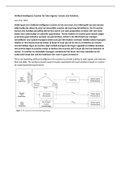
Coleman’s diagram. Connect macro-level
conditions to macro-level outcomes through
the underlying micro-level processes.
We are interested in macro change, but the
way we explain it is through the micro-level.
The arrows are not necessarily causal
relationships, it is a thinking framework.
Essence of Coleman’s diagram. Causes of social conditions lead to change in individual situations
(bridge assumptions). This individual change of situation change individual behaviour (behavioural
theory). Collectively, this leads to a new social outcome at the macro-level (transformation rules).
In abstract theory formation: macro can refer to any group that brings together lower-level units.
• Mico = individual; macro = two, three or more
• Micro = organisations; macro = industry
In more applied contexts these labels often have a more substantive interpretation.
• Macro = countries, societies.
• Meso = organisations, groups.
• Micro = individuals.
2
,Common sense. The routine knowledge we have of our everyday world and activities.
Lazarsfeld’ research. Says what you first hear/learn as common sense, you start taking as true. If you
have the correlation, it’s easy to make a common sense argument.
Watts’ statement. He means with sociology isn’t rocket science, that sociology is much harder than
physics. In physics it is all very clear, you can predict what is coming up. To get order in sociology is
hard. We are very good in rocket science
Five important aspects of theory building
(1) Be precise. Make things less ambiguous, like definitions, but also language in general. Make it
precise, formalization helps to be precise.
(2) Avoid black boxes. Many arguments are related, but how exactly it works is unknown.
Thinking about plausible mechanisms often open black
boxes.
Try to open up what you want to open up, but at a
certain point it is the end of the discipline.
(3) Include micro level. Way to open the black box: to find mechanisms how things work. Make
sure to start thinking about what individuals do (from a to b, and understanding b).
(4) Model the micro-macro link. The transformation rule is often ignored. This is about the
relationship between individual effects and collective effects: how behaviour of individuals
influences each other's behaviour.
How does the individual choice affect the minds of other people?
(5) Search for the appropriate micro-model. Behavioural theory: as simple as possible, as
complex as necessary. Rationality assumptions at micro-level, abstract a little bit.
Merton. Self-fulfilling prophecies are in the beginning false definitions of the situation evoking a new
behaviour which makes the originally false conception come true.
Example Coleman-boat
3
, 1.1 Coleman diagram
Sociological questions are questions about relations between macro-conditions to macro-outcomes.
Coleman’s diagram is important by common-sense claims.
Explanations should go beyond common sense claims directly on the macro relation; they should
make understandable how macro-conditions affect individual behaviour and how behavioural
reactions of many lead back to the macro-outcome.
Good theory’s make the relation between
macro-conditions and macro-outcomes clear.
This is easy to do to connect this with micro-
level and individual level.
Starting point is macro-point relation point.
How are the social conditions relate to
collective effects?
First step is: how does social conditions affect
the individual goals and expectations, this is
what we called the bridge assumptions.
Second step: make a theory on the individual level, behavioural theory, what will be the individual
effects? What will be the behaviour, how will they react to their goal. All depend on their goals and
expectations.
Third step: what does this apply for the collective effects? How does this decent on the other social
conditions? Now we need assumptions for the transformation rules: how the individual behaviour
add up to the collective outcomes.
A thinking framework for sociological problems
- To ensure that arguments on bridge assumptions, transformation rules, and the individual
level theory are made explicit.
- Much more than a causal scheme: arguments on bridge assumptions and transformation
rules can imply feedback loops and other more complex causal relations, because, e.g.,
individual behaviour of one person can change macro-conditions for another person.
- To explicate some of these more complex mechanisms sometimes “Coleman-fleets” are used
to make that explicit.
- You can fix this to make more social outcomes, so the first condition: there is a fire alarm, and
macro outcome can be: people gets nervous, if you include that macro-outcome. Feedback
loops.
4
Lecture 1 .............................................................................................................................................. 2
1.1 Coleman diagram ...................................................................................................................... 4
Lecture 2 .............................................................................................................................................. 5
2.1 Game-theoretic concepts ......................................................................................................... 9
2.2 Two-by-two games.................................................................................................................. 11
Lecture 3 ............................................................................................................................................ 13
3.1 Repeated Prisoners Dilemma ................................................................................................. 19
3.2 Public goods game (with punishment)................................................................................... 23
Lecture 4 ............................................................................................................................................ 25
4.1 Non-standard preferences ...................................................................................................... 31
Lecture 5 ............................................................................................................................................ 34
5.2 The problem of segregation ................................................................................................... 41
5.3 Introduction to agent-based modelling and simulation ........................................................ 43
Lecture 6 ............................................................................................................................................ 45
6.2 The problem of mass collective action................................................................................... 49
6.3 Cumulative distribution functions .......................................................................................... 51
6.4 Granovetter’s Threshold model .............................................................................................. 52
Lecture 7 ........................................................................................................................................... 56
7.1 The demand of social norms .................................................................................................. 61
,Lecture 1
Sociology: research on social phenomena and their social conditions (causes). We look deeper into
the why.
Some types of problems
• Descriptive problems. How does the system look like? Trends over time. Difference between,
countries, cities/rural areas.
• Explanatory problems. What are the effects? What are the mechanisms?
• Problems of institutional design. How to reduce or mitigate?
• Normative problems. What kind of problems are acceptable? What do we think of the
outcomes?
Types of explanations
• Covering law explanations. The phenomenon is explained by a causal law (like law of gravity).
• Statistical explanations. The phenomenon is explained by a statistical relationship.
• Mechanism explanations. The phenomenon is explained by means of an action-based
explanation incorporating social restrictions/opportunities and the aggregation process.
Hedström. There seem to be no real “laws” in social science at the social level. Causal mechanisms
remains unclear.
Coleman’s diagram. Connect macro-level
conditions to macro-level outcomes through
the underlying micro-level processes.
We are interested in macro change, but the
way we explain it is through the micro-level.
The arrows are not necessarily causal
relationships, it is a thinking framework.
Essence of Coleman’s diagram. Causes of social conditions lead to change in individual situations
(bridge assumptions). This individual change of situation change individual behaviour (behavioural
theory). Collectively, this leads to a new social outcome at the macro-level (transformation rules).
In abstract theory formation: macro can refer to any group that brings together lower-level units.
• Mico = individual; macro = two, three or more
• Micro = organisations; macro = industry
In more applied contexts these labels often have a more substantive interpretation.
• Macro = countries, societies.
• Meso = organisations, groups.
• Micro = individuals.
2
,Common sense. The routine knowledge we have of our everyday world and activities.
Lazarsfeld’ research. Says what you first hear/learn as common sense, you start taking as true. If you
have the correlation, it’s easy to make a common sense argument.
Watts’ statement. He means with sociology isn’t rocket science, that sociology is much harder than
physics. In physics it is all very clear, you can predict what is coming up. To get order in sociology is
hard. We are very good in rocket science
Five important aspects of theory building
(1) Be precise. Make things less ambiguous, like definitions, but also language in general. Make it
precise, formalization helps to be precise.
(2) Avoid black boxes. Many arguments are related, but how exactly it works is unknown.
Thinking about plausible mechanisms often open black
boxes.
Try to open up what you want to open up, but at a
certain point it is the end of the discipline.
(3) Include micro level. Way to open the black box: to find mechanisms how things work. Make
sure to start thinking about what individuals do (from a to b, and understanding b).
(4) Model the micro-macro link. The transformation rule is often ignored. This is about the
relationship between individual effects and collective effects: how behaviour of individuals
influences each other's behaviour.
How does the individual choice affect the minds of other people?
(5) Search for the appropriate micro-model. Behavioural theory: as simple as possible, as
complex as necessary. Rationality assumptions at micro-level, abstract a little bit.
Merton. Self-fulfilling prophecies are in the beginning false definitions of the situation evoking a new
behaviour which makes the originally false conception come true.
Example Coleman-boat
3
, 1.1 Coleman diagram
Sociological questions are questions about relations between macro-conditions to macro-outcomes.
Coleman’s diagram is important by common-sense claims.
Explanations should go beyond common sense claims directly on the macro relation; they should
make understandable how macro-conditions affect individual behaviour and how behavioural
reactions of many lead back to the macro-outcome.
Good theory’s make the relation between
macro-conditions and macro-outcomes clear.
This is easy to do to connect this with micro-
level and individual level.
Starting point is macro-point relation point.
How are the social conditions relate to
collective effects?
First step is: how does social conditions affect
the individual goals and expectations, this is
what we called the bridge assumptions.
Second step: make a theory on the individual level, behavioural theory, what will be the individual
effects? What will be the behaviour, how will they react to their goal. All depend on their goals and
expectations.
Third step: what does this apply for the collective effects? How does this decent on the other social
conditions? Now we need assumptions for the transformation rules: how the individual behaviour
add up to the collective outcomes.
A thinking framework for sociological problems
- To ensure that arguments on bridge assumptions, transformation rules, and the individual
level theory are made explicit.
- Much more than a causal scheme: arguments on bridge assumptions and transformation
rules can imply feedback loops and other more complex causal relations, because, e.g.,
individual behaviour of one person can change macro-conditions for another person.
- To explicate some of these more complex mechanisms sometimes “Coleman-fleets” are used
to make that explicit.
- You can fix this to make more social outcomes, so the first condition: there is a fire alarm, and
macro outcome can be: people gets nervous, if you include that macro-outcome. Feedback
loops.
4