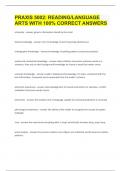
PRAXIS 5002 :READING/ LANGUAGE ARTS WITH 100% CORRECT ANSWERS
schemata generic information stored by the mind lexical knowledge one's knowledge of word meanings (dictionary) orthographic knowledge knowledge of spelling patterns and pronunciations syntax and contextual knowledge when children encounter unknown words in a sentence, they rely on their background knowledge to choose a word that makes sense. semantic knowledge reader's background knowledge of a topic, combined with the text information. Compared and incorporated into the reader's schema. phonemic awareness acknowledgement of sounds and words, for example, a child's realization that some words rhyme. phonemes the smallest unit of language capable of conveying distinction in meaning phonological awareness the ability of the reader to recognize the sounds of spoken language rime the vowel and everything after it /eep/ word family includes sleep, jeep, keep. word analysis the process readers use to figure out unfamiliar words based on written patterns. word recognition the process of automatically determining pronunciation and some degree of the meaning of an unknown word. decoding changing communication signals into messages. encoding changing messages into symbols phonics method of teaching reading and spelling based on phonetic interpretation of ordinary spelling high frequency words the words used most often in the English language sight words words that the reader learns to read spontaneously, either because of frequency or lack of conformity to orthographic rules. keyword method uses words and illustrations that highlight salient features of meaning. Many words cannot be learned this way. pre-phonemic spelling children know that letters stand for a message, but they don't know the relationship between spelling and pronunciation early phonemic spelling children are beginning to understand spelling. They usually write the first letter correctly, with the rest o the word compromising consonants or long vowels. letter-name spelling children spell some words consistently and correctly. They are developing sight vocabulary and a stable understanding of letters as representations of sounds. Long vowels are usually used accurately, but silent vowels are omitted. They spell unknown words by attempting to match the name of the letter to the sound. transitional spelling children typically enter this phase in late elementary school. They master short vowel sounds and know some spelling rules. They are developing a sense of correct and incorrect spellings. derivation spelling this stage is usually reached between high school and adulthood. This is the stage when spelling rules are being mastered. open syllable pattern ends with a single vowel, typically a long vowel (so, she, spy) closed syllable pattern vowel followed by a consonant. This is most common. (bad, big, is) vowel team syllable pattern two or more letters create one vowel sound. (meat, south, plain) R-controlled syllable pattern vowel is followed by an /r/. (four, far, bur-ger) vowel-silent e syllable pattern also referred to as vowel-consonant e. The first vowel becomes long and the e is silent. (fame, ape, pride) consonant+le syllable pattern consonant followed by /le/. (sam-ple, puz-zle, ta-ble) automticity automatic reading involves the development of strong orthographic representations, which allows fast and a curate identification of whole words made up of specific letter patterns. prosody concerns versification of text and involves such matters as which syllable of a word is accented. In terms of fluency, it is that spec which translates reading into the same experience as listening in the readers mind. regular (for reading and spelling) word types e.g. cat, print regular (for reading but not for spelling) word types e.g. float, brain--could be spelled flote or brane rule based word types e.g. canning--doubling rule; faking--drop e rule irregular word types e.g. beauty comprehension occurs when: students are able to make predictions, select main ideas, and establish significant and supporting details of the story. comprehension instruction should include: 1. large amounts of time for actual text reading er-directed instruction in comprehension strategies. 3. opportunities for peer and collaborative learning. 4. occasions for students to talk to a teacher and one another about their responses to reading. Bloom's Taxonmy (ascending order of sophistication) 1. knowledge 2. comprehension 3. application 4. analysis 5. synthesis 6. evaluation fiction works that are made up by the author, or are not true non-fiction written accounts of real people, places, objects, or events. conventions of fiction stories plot, characters, settings, and themes conventions of non-fiction stories plot, characters, settings, themes, interpretations, opinions, theories, research, and other elements. informational texts nonfiction. These types of books explain concepts and phenomena. Might explain the history of a state or the idea of photosynthesis. These types of text are usually based on research. Newspaper articles nonfiction. These short texts rely completely on factual information and are presented in a very straightforward, sometimes choppy manner. The purpose of these texts is to present information to readers in a quick and efficient manner. Essays nonfiction. Typically takes an opinion. and describes how the opinion was arrived at or why the opinion is a good one. biographies nonfiction. Describes the lives of individuals. Usually based on extensive research. memoirs nonfiction. Like an autobiography, but typically focuses on a specific idea, concept, issue, or event in life. letters nonfiction. When these are used in the classroom students are looking at the writer's style or the writers true opinions/feelings about certain events. journals nonfiction. Present personal ideas. When available they give students the opportunity to see peoples' thought process about various events or issues. traditional literature Opens up a world where right wins out over wrong, hard work and perseverance are rewarded, and helpless victims find vindication. These are worthwhile values that children identify with. Within these texts children are introduced to fanciful beings, humans with exaggerated powers, talking animals, and heroes that will inspire them. Folktales/Fairy Tales Adventures of animals or humans and the supernatural typically characterize these stories. The hero is usually on a quest aided by other-worldly helpers. More often than not, the story focuses on good and evil and reward an punishment. Ex. The 3 bears, Snow White, Sleeping Beauty picture books Designed primarily for preschool children. Tells a story with illustrations as well as with text. Typically a child's first introduction to books and print.
Escuela, estudio y materia
- Institución
- PRAXIS 5002
- Grado
- PRAXIS 5002
Información del documento
- Subido en
- 29 de octubre de 2023
- Número de páginas
- 18
- Escrito en
- 2023/2024
- Tipo
- Examen
- Contiene
- Preguntas y respuestas
Temas
-
praxis 5002 reading language arts

Documento también disponible en un lote