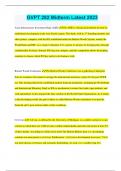
GVPT 282 Midterm Latest 2023
GVPT 282 Midterm Latest 2023 Asian Infrastructure Investment Bank (AIIB) The AIIB is a financial institution focused on multilateral development in the Asia-Pacific region. This bank, with its 17-founding member and other joiners, competes with the IFIs established under the Bretton Woods System, mainly the World Bank and IMF. As a result, it threatens U.S.'s power to advance its foreign policy through conditionality for loans. Instead, IFIs may not compete, and this competition allows developing countries to choose which IFI they prefer to do business with. Bretton Woods Conference The Bretton Woods Conference was a gathering of delegates from 44 countries who aimed to arrange the international monetary system for the post-WWII era. This meeting effectively established modern financial institutions, including the World Bank and International Monetary Fund, as IFIs as mechanism to ensure free trade, open markets, and curb nationalism. It also inspired the later creation of the World Trade Organization. As it relates to the developing world, the goal of these so-called Bretton Woods institutions is to provide financial aid to poor nations under certain conditions. Civil war Civil war, as defined by the University of Michigan, is a conflict exclusive to one country in which there are 1,000 or more combat-related deaths and each side incurs at least 5% of these deaths. According to Collier in his book The Bottom Billion, poor (i.e. developing) countries are more prone to civil war. Furthermore, "civil war is development in reverse." Civil war fuels disease, terrorism, and economic backsliding. As such, it is a conflict trap. For example, the Democratic Republic of Congo, which is still embroiled in civil war-like conflicts, is also fighting the spread of Ebola. Based on Collier's research, civil war leaves a country 15% worse than it was before. Colonialism Colonialism is the practice of subjugation by physical and psychological force of one culture by another. Colonialization resulted in the destruction of indigenous populations' cultures, traditions, and survival. Colonizers typically moved to the new territory and brought western-style economic and social conditions that did not fit in the colonies' original way of life. Cash cropping in Africa is one example of how colonialism not only inhibited development but also led to an "underdevelopment," especially in the post-colonial world. Cash cropping disrupted local crop production, thereby causing famines and social unrest. Prior to colonialism, people harvested only what was necessary, but with colonialism, overharvesting destroyed ecosystems. Comparative Advantage Comparative advantage describes the economic theory of trade specialization. In the context of a global free market system, countries will produce and export the products that they are able to produce the most quickly and effectively. This concept aligns with liberalism (i.e. Adam Smith and invisible hand), and it inspired the ideas of the Washington Consensus that attempted to manage the Latin American debt crisis in the 1980s. Conditionality Conditionality was an outcome of the Washington Consensus and it is the practice of loaning money based on policy commitments. This means that in exchange for a loan, a country must promise to complete a policy reform. This was used on Latin American countries during their debt crisis in the 1980s. Policies included curbing corruption and violence. Conflict trap This term was coined by Paul Collier and it refers to the causes that keep poor countries poor. Collier, in Chapter 2 of his book The Bottom Billion, names civil war as a conflict trap because it is "development in reverse." Low income, slow growth, and dependence on primary commodity exports creates situations of hopelessness and despair, which leads young men to join rebel/militia groups. The Democratic Republic of Congo is currently stuck in a conflict trap as it is rich in natural resources but has suffered years of civil war and internal conflict. Dependency Theory The Dependency theory, or the World Systems theory, rose in response to the Modernization theory. The Dependency theory argues that nations are divided into "core" and "periphery" states whereby the "periphery" states export primary commodity goods to the "core" states. This theory blames capitalism and imperialism as central factors to the underdevelopment of previously colonized countries. For example, countries in Africa and Latin America are underdeveloped to this day because they were busy exporting their natural resources to "core" states so that the "core" states could industrialize while the "periphery" states remained poor. Prior to colonialism, people harvested only what was necessary, but with colonialism, overharvesting destroyed ecosystems. Development ladder The development ladder is a theory that countries must pass through certain stages of advancement in order to reduce poverty, strengthen economically, and become fully developed. This theory is based on the ideas of the Modernization theory and Walt Rostow. Rostow highlighted five broad stages through which developing countries must pass to become modern societies. Elite colonialism Elite colonialism, also known as extraction colonialism, was the practice of mining natural resources and sending it back to the metropole. Examples of countries that served as extraction colonies include Brazil, the Côte d'Ivoire, DRC, and Ghana. These countries were more likely to end up poor than settlement colonies because they have no representation in the metropole government and also are slaves. Emerging donors Emerging donors describes the countries such as China, India, and Saudi Arabia, that are giving foreign assistance to developing countries. By providing aid without conditions, these emerging donors are introducing competition into the system because aid without conditions is more attractive to receiving nations. As such, western nations are less able to implement their foreign policy goals through foreign aid donations. Ethnic fractionalization Ethnic fractionalization is a measure of the probability that two randomly selected individuals will belong to different ethnolinguistic groups (heterogeneity). Countries with ethnic fractionalization can suffer from internal conflict leading to violence. Ethiopia is a country with ethnic fractionalization that lead to conflict between various rebel groups during the country's civil war in the 1970s through the 1990s. Ethnic Polarization Ethnic polarization incorporates measures of social tensions between two groups (can be common in less heterogeneous groups, particularly when there are two main groups). It negatively impacts economic development through its impact on civil wars and is better suited to capture the potential for conflict. Rwanda is an example of ethnic polarization in which there was a civil war between the two main ethnic groups in the country: the Hutu and the Tutsi. Export Oriented Industrialization (EOI) Export oriented industrialization refers to an economic development model. This method calls for government protected exports and also limited government intervention. In contrast to Latin America, EOI led to the growth of East and Southeast Asian economies such as South Korea because they phased out protectionist policies. General Agreement on Tariffs and Trade (GATT) The GATT, which became the WTO in 1955, was an organization dedicated to trade liberalization, non-discrimination (MFN principle), national treatment of foreign enterprise, and preferential access in developed markets to products from the South. Gini Coefficient The Gini coefficient, on a scale of 0 to 1, measures income inequality within a community, society, or country. The Gini coefficient is commonly used in tandem with GDP and HDI indexes as a measurement of development. However, it does not account for population size. Therefore, a small country but homogenously poor country may exhibit a score closer to 0, but a large, wealthy country with economic diversity will show a score closer to 1. Human Development Index (HDI) The Human Development Index (HDI), which measures life expectancy, years of schooling, and standard of living (income), is an indicator of development used by the United Nations Development Program. This indicator shows more than just economic development since life expectancy indicates health, years of schooling indicates education accessibility, and income level indicates quality of life. Human Security Paradigm The Human Security Paradigm is a model that shows the different aspects of security. Rather than relying solely on military assistance to solve security issues, this paradigm urges us to recognize the needs of humans on an individual level: food, health, environment. As such, this paradigm deepens the levels of security (national, regional, state, global) and broadens the type of aid (economic, environment, military, health). The human security paradigm has brought a renewed protection of human rights. Import Substitution Industrialization (ISI) Import substitution industrialization refers to an economic development model for Statism. This method calls for the replacement of imported consumer goods with domestically manufactured goods. ISI led to the economic collapse of Latin America in the 1980s. ISI was initially successful, but they pursued protectionism policies too far and it led to too much dependence on governmental support. As a result, many Latin American countries are still in disarray to this day because of the massive debts accrued as a result of ISI. Imperialism Imperialism is the practice of one country having political/economic control over another. This differs from colonialism in that the control is not direct. For example, the United States has imperialistic control over the politics and economies of other countries by our military force. Instrumental Freedoms Based on Sens Five Types of Freedoms, seen as both the means and the ends to development (*PESTS*): 1. *P*olitical (i.e. political freedoms) 2. *S*ocial (i.e. social opportunities) 3. *E*conomic (i.e. economic facilities) 4. *T*ransparent (i.e. transparency guidelines) 5. Protective *S*ecurity International Monetary Fund (IMF) The International Monetary Fund is an IFI, established during the Bretton Woods conference. It is an international organization consisting of 189 countries working to foster global monetary cooperation, secure financial stability, facilitate international trade, and reduce global poverty. It was originally created to oversee the fixed exchange rate arrangement between countries. In 1971, after we moved to floating exchanged rates, the role of the IMF shifted to examining IMF loan agreements to determine if a shortage of capital was due to economic fluctuations or economic policy. The IMF now monitors macroeconomic policy. The IMF took part in Jubilee 2000, in which it was widely decided that debt doomed states to permanent underdevelopment, therefore, 36 countries were given full debt relief by the IMF and other financial organizations. Metropole Metropole is the term used to define the colonizer (i.e. "home country") in relation to its colonized countries. For example, in the colonial empire of Great Britain, the England was commonly referred to as the metropole in relation to its colonies (e.g. India, South Africa, Australia, Kenya, and Hong Kong). Colonialization resulted in the destruction of indigenous population and cultures. This term is also important in the context of development, because after the metropole relinquished control during decolonization, many countries were left with unfamiliar western-style economic and social conditions that locals did not know how to handle. Modernization Theory The Modernization theory argues that some countries experience underdevelopment due to their internal institutions and traditional ways of life. This theory is consistent with the "development ladder" theory and the belief that developing nations must overcome their ways and acquire modern cultural values. Characteristics of a modern society include predominance of achievement, nuclear family, production for exchange, and differentiated political structures. Contrastingly, traditional societies have hierarchal structures of authority, primary economic activities, nepotism, and little social mobility. Neoliberalism Neoliberalism describes the 20th century reemergence of 19th century classical liberalist ideas. Neoliberalism favors laissez-faire economics and limited government interference in the economy. Neoliberalism emerged as a reaction against the post-war period Keynesian economics and social welfare programs. Pattern Variables Method of describing and classifying institutions and different societies. They are constructed as polar opposites to classify societies as a whole and examine them on the basis of these pattern variables. For example, traditional societies are classified with collectivity orientation, meaning that the predominance of roles are oriented towards the collective/to progress the community. Meanwhile, modern societies are classified with self-orientation because the predominance of roles has private self-interest as the prime motivation. (i.e. traditional societies → ascription and modern societies → achievement) Point Four Program (1949) President Truman's Point Four program attempted to provide technical assistance to developing countries and thwart the spread of communism (i.e. spread democracy). This meant that instead of providing financial aid to underdeveloped countries, the United States would help poor countries develop their own prosperity/welfare systems by giving them fundamental resources (i.e. clothing, technology, farming techniques). As a result, international aid become foreign policy. The Point Four program focused on agriculture, public health, and education sectors. Prebish-Singer Hypothesis Related to the Dependency theory, which identifies developed states as the industrial core and underdeveloped states as the agricultural periphery, the Prebisch-Singer hypothesis argues that the price of primary commodity exports in the long run falls relative to imports, causing imports to become more expensive. As a result, primary commodity exporters (i.e. developing countries) fall behind while the industrial core prospers. TThis idea is supported by Collier, who identifies dependency on primary commodity exports as a conflict trap for poor countries. Responsibility to Protect Doctrine (R2P) The R2P Doctrine was unanimously adopted by the United Nations in 2005. It assumes that every sovereign nation has the obligation to protect populations form genocide, war crimes, ethnic cleansing, and crimes against humanity. This doctrine was in response to the Rwandan genocide of 1994 and the Srebrenica massacre in 1995. With this doctrine, countries have not only a justification but also a compulsion to intervene in humanitarian conflicts, many of which occur in developing countries. However, it is considered a measure of last resort, and all members of the UN Security Council must agree to implement it. settlement colonies Settlement colonialism describes the practice of colonizers conquering land that they previously did not own and establishing new settlements so that people form Europe could come and live. A few examples include the U.S., Canada, and Australia. This method of colonialism often involved the destruction of indigenous cultures and populations. Statism Government ownership of strategically important industries. The government invests in industries that did not attract private capital (active intervention) and help build those industries up. It gained significant usage in American political discourse in the 1930s and 1940s, following the Great Depression. In Latin America, statism (ISI) was initially successful, but let to economic inefficiencies and income inequality because the government was too heavily involved in the economy. Structural Adjustment Program Policies that countries must follow if they want a loan from the world bank. A country in need of an SAP might have accumulated debt and an overvalued currency. The goals of these programs include creating a basis for non-inflationary growth, stimulate the growth potential of the private sector, and improve public-sector efficiency. Typical reforms might look like the removal of high tariffs, cutting government payroll, and ending government monopolies. Third World After WWII and during the Cold War, the term "third world" emerged to describe the countries who were part of neither the capitalist western world (i.e. the West and Japan) nor the Soviet world. Third world countries consisted of mostly former European colonies. As such, many of them were also poor because their culture and traditions had been uprooted by colonialism. Soon, "third world" became synonymous with "developing countries," as the United States pushed its capitalist vision through Truman's Point Four program. "Development" mean that third world countries should emulate first world civilization and living standards. Washington Consensus (1989) The Washington Consensus was a transnational policy paradigm that attempted to fix the Latin American debt crisis during the 1980s. Countries such as Brazil, Argentina, and Mexico had borrowed too much and could not meet their debt obligations. As a result, Latin American people suffered as their purchasing power decreased and they experienced low unemployment. Through the Washington Consensus, western-educated economists decided to give out new loans based on "conditionality," which meant that Latin American countries had to make policy changes in order to receive loans. Also, since the Latin American debt crisis occurred due to Statism, the Washington Consensus advocated for neoliberal economic policies (open markets, little government interference). World Bank Generates capital funds from member states and from borrowing in international financial markets. The banks then loan these funds, with interest, to states for economic development programs. The bank began in the 1950s with a focus on large infrastructure projects but has turned to focusing more on sustainable development with an emphasis on the environment since the 1990s. World Trade Organization The World Trade Organization, preceded by the GATT, is an international organization based in Geneva that monitors and enforces rules governing global trade. It is the only global organization that deals with rules of trade between nations. WTO members agree that if they believe a member is violating rules, they will use the multilateral system of settling disputes.
Escuela, estudio y materia
- Institución
- GVPT 282
- Grado
- GVPT 282
Información del documento
- Subido en
- 28 de octubre de 2023
- Número de páginas
- 13
- Escrito en
- 2023/2024
- Tipo
- Examen
- Contiene
- Preguntas y respuestas
Temas
-
gvpt 282 midterm latest 2023

Documento también disponible en un lote