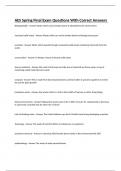
AES Spring Final Exam Questions With Correct Answers
Biodegradable - Answer Waste which can be broken down & absorbed by the environment municipal solid waste - Answer Waste which can not be broken down by biological processes Leachate - Answer Water which passed through compacted solid waste containing chemicals from the waste conservation - Answer To Reduce, Reuse & Recycle solid waste Source reduction - Answer We need to find ways to make use of materials we throw away. A way of reclaiming useful materials from waste compost - Answer This is made from decomposed plant & animal matter & spread on gardens to enrich the soil for plant growth hazardous waste - Answer Any waste which is a risk to the health of humans or other living things Natural movements - Answer Radioactive waste must sit for 1,000's of years for radioactivity to decrease to safe levels. Scientist look for sites free of what? Lack of drinking water - Answer The United Nations says the #1 health issue facing developing countries Toxicology - Answer The study of harmful effects of substances on organisms persistent chemical - Answer A chemical which breaks down slowly in the environment like DDT epidemiology - Answer The study of wide spread disease particulate - Answer Most common natural pollutants like dust, soot, are particles carried by the air which are small enough to breath into the lungs Heavy metals - Answer Mercury, aluminum, cadmium are a source of pollutants mercury poisoning - Answer The following symptoms are an indication of what? · By body feels like pins and needles on my hands, feet and around my lips. · I've been getting headaches, tremors, and muscle weakness, · visual and hearing impairment, · My walk has uncoordinated movements and his speech slurred · I was once active and attentive in school. pathogens - Answer Microscopic organisms which spread infectious diseases vectors - Answer Organisms which spread disease like mosquitoes, lice or rodents are any agent which carries and transmits an infectious pathogen into another living organism Cholera - Answer What is the deadliest waterborne disease & comes from drinking water with human feces? malaria - Answer Which disease is caused by parasite using a mosquito as its host. emerging virus - Answer Previously unknown virus Nitrogen and Oxygen - Answer What are the two major gases in our air? oxygen - Answer This is second most abundant gas on earth, which is basically produced by plants via photosynthesis troposphere - Answer Atmosphere is divided into 4 layers. Which layer lies closest to the earth? Stratosphere - Answer This layer is 8 to 30 miles above the earth, temperature in this layer rises with elevation due to ozone absorbing the sun's energy. Here ozone absorbs harmful radiation protecting earth. Which layer is this? Thermosphere - Answer Lower part of thermosphere is called the ionosphere contains gases which absorb sun's harmful radiation like x-rays and gamma rays and causes the auroras. This layer is called the? radiation - Answer The transfer of energy across space in the atmosphere Conduction - Answer The flow of heat from a warmer object to a colder object when placed in physical contact
Escuela, estudio y materia
- Institución
- AES
- Grado
- AES
Información del documento
- Subido en
- 27 de octubre de 2023
- Número de páginas
- 8
- Escrito en
- 2023/2024
- Tipo
- Examen
- Contiene
- Preguntas y respuestas
Temas
-
aes stuvia
-
aes spring final exam questions with correct answe
-
biodegradable waste which can be broken down abs
-
municipal solid waste waste which can not be broke

Documento también disponible en un lote