Chapter 7 question n answers graded A+ 2023
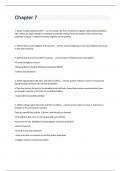
Chapter 7 1. What is action potential (AP)? - correct answer the form of electrical signals called action potentials (AP), which are rapid changes in membrane potential during which the inside of the cell becomes positively charged. (-100mV) From the negative to the positive. 1. Where does an AP originate and travel to? - correct answer Originates in the axon hillock and travels to the axon terminal. 2. Define leak channels and their locations. - correct answer • Always open (non-gated) • Found throughout neuron • Responsible for Resting Membrane Potential (RMP) -sodium and potassium 2. Define ligand-gated channels and their locations. - correct answer • Open or close in response to ligand binding chemicals aka neurotransmitters. • They are densely located in the dendrites and cell body. Areas that receive communication from presynaptic neurons in the form of neurotransmitters. -responsible for graded potential. 2. Define voltage gated channels and their locations. - correct answer Open or close in response to changes in the membrane potential They are specifically Sodium, Calcium, and Potassium channels • Throughout, but more in axon (especially axon hillock) •necessary for the initiation and propagation of Action potentials Calcium channels • Found in the Axon terminals . Open and close in response to arriving action potentials. • triggers release of neurotransmitter Calcium voltage gated channels - correct answer • Found in the Axon terminals . Open and close in response to arriving action potentials. • triggers release of neurotransmitter 3. What is a resting membrane potential (RMP)? - correct answer the voltage that exists across a cell membrane when the cell is not transmitting electrical signals; polarity is such that the inside of the cell is negative with respect to the outside. What is the value of RMP? - correct answer - RMP of neurons is -70 mV. - Exists because more negative charges inside cell and more positive charges outside cell -All cells in the body have a negative RMP range of (-5mV to -100mV) 3. What factors contribute RMP? - correct answer - Two factors critical in determining resting membrane potential • Sodium and Potassium Ion concentration gradients. • Membrane permeability to these ions using Ion channels aka the amount of leak channels. Determining the equilibrium potentials for potassium and sodium Ions - correct answer • For potassium ions, higher concentration in the cell. - This potential is the K+ equilibrium potential, Ek = - 94 mV in neurons. • For sodium ions, higher concentrations outside the cell. - Eventually, Na+ equilibrium potential, ENa = + 60 mV. 4. What are the functions of Na+/K+ pump? - correct answer Sodium pump maintains the resting potential!!!! The pump not only establishes the concentration gradient but maintains them as well!!!!! - Electrochemical forces cause Na+ to continually leak into the cell and K+ leak out of the cell, these changes would eventually abolish the concentration gradients for both ions, therefore, the Na+/K+ pump controls the RMP by moving 3 Na+ out of the cell and 2 K+ into the cell at the same rate at which both leak in and leak out of the cell.
Escuela, estudio y materia
- Institución
- RMP
- Grado
- RMP
Información del documento
- Subido en
- 25 de octubre de 2023
- Número de páginas
- 9
- Escrito en
- 2023/2024
- Tipo
- Examen
- Contiene
- Preguntas y respuestas
Temas
-
chapter 7

Documento también disponible en un lote